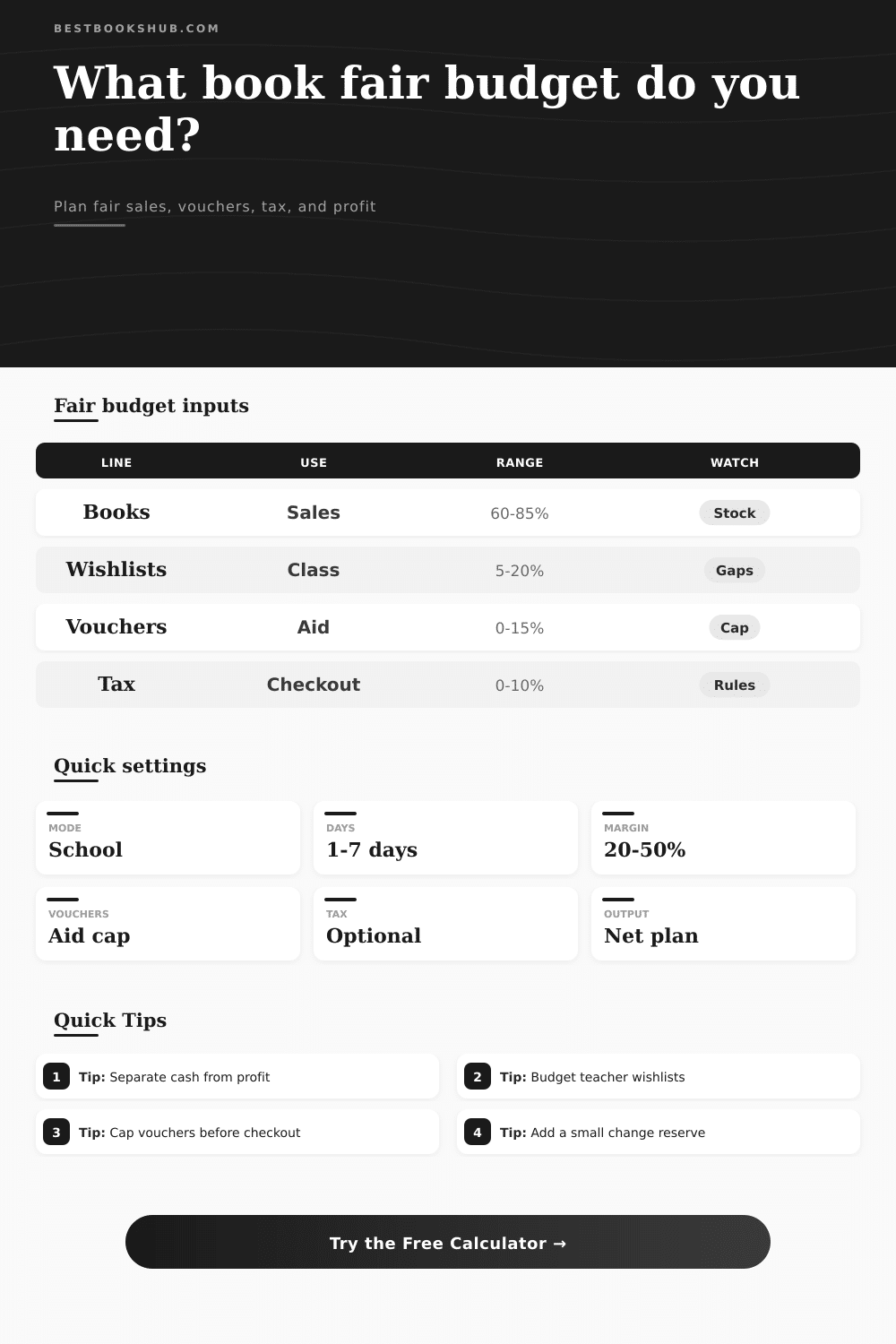
📓 School fair planner
Book Fair Budget Calculator
Plan a school, library, classroom, or community book fair with shoppers, average sales, vouchers, teacher wishlists, discounts, tax, setup expenses, deposits, and expected profit.
| Fair type | Typical duration | Main budget driver | Useful planning metric |
|---|---|---|---|
| Elementary school week | 4 to 6 days | Student traffic and family night orders | Checkout sales per invited student |
| Middle school fair | 3 to 5 days | Lower participation but larger basket swings | Average ticket by shopper group |
| Library pop-up | 1 to 3 days | Community orders and staff purchases | Sales per open hour or event day |
| Holiday or gift fair | 2 to 5 days | Giftable books, novelty items, and tax | Support fund plus cash reserve |
| Budget line | Calculator input | What it affects | Common planning mistake |
|---|---|---|---|
| Student sales | Students, shopping rate, average checkout | Core merchandise sales and stock count | Using enrollment as if every student buys |
| Family orders | Order count and average order value | Evening, online, and take-home flyer sales | Forgetting online orders in the fair total |
| Vouchers | Voucher fund and amount per student | Supported shoppers and net proceeds | Promising more vouchers than the fund supports |
| Wishlists | Class count, average list, coverage goal | Classroom book support and donor ask | Counting wishlist books as ordinary sales only |
| Card fees | Card share and processing rate | Net proceeds after checkout fees | Ignoring fees when card usage is high |
| Sales mix | Typical share | Budget behavior | Stock planning cue |
|---|---|---|---|
| Paperbacks | 55% to 75% | High unit count with approachable ticket sizes | Keep series starters and popular age bands visible |
| Hardcovers | 5% to 20% | Raises average ticket and unsold risk | Limit duplicates unless demand is clear |
| Novelties and supplies | 5% to 20% | Can lift checkout totals but blur book goals | Cap the share if the fair is book-first |
| Staff and teacher buys | 5% to 15% | Often discount-sensitive and predictable | Apply staff discount before tax if allowed |
| Line item | Amount | Share | Budget signal |
|---|---|---|---|
| Projected rows | $0 | 0% | Run the calculator to fill the allocation table. |
DISCLOSURE: This post may contain affiliate links, meaning when you click the links and make a purchase, I receive a commission. As an Amazon Associate I earn from qualifying purchases.
With any luck, every book fair begins with a clipboard and a sense of hope, but few PTAs ends up with money in their pockets from this approach. The distance between net proceeds and gross sales (the difference between how much you sold and how much you’ll ultimately need to pay) often define your book fair’s balance sheet. While organizers may be happy to announce the total at check-out time, they’d do well to remember the ledger below it. Our purpose in creating this calculator is to connect those two numbers: to ensure you examine net proceeds prior to cutting the ribbon. Knowing how many books you’ll sell comes first. This is where enrollment numbers can be misleading so we ask for participation rates instead of total enrollment counts. Four-hundred kids may be enrolled in your school, but it’s unrealistic to think that all of them are going to purchase a book. Elementary schools tend to have a sixty-five percent shop rate (meaning sixty-five percent of enrolled students purchase a book) while the numbers can be lower at middle schools (and higher average ticket prices) even with a lower percentage. Then there’s the issue of online sales and family night orders. While these occur outside the physical limits of the fair, they still contribute to your bottom line. Evening sale baskets tend to be larger because parents aren’t buying on impulse, but are instead buying class sets or gifts for family members. Get this part right; otherwise everything else downstream gets skewed. And here is the hard part: How do you balance making a profit while also being supportive? Being socially minded means offering vouchers for kids who can’t afford books, but that costs money! You can’t promise to give each student ten dollars and then not put aside that amount in your estimated income. When it comes time to pay the bill, you’re going to be left holding the bag. By keeping support costs separate from other costs on the calculator, you’ll know how much money you have left to spend on your library or technology grants. It’s best to set realistic expectations for the voucher program rather than setting them too high and then having to fall short. Schools tend to throw off-base resources at classroom wishlists as well. While it may seem like a good idea to meet 100% of every teacher’s wishlist, those books paid for by outside donations or discounts shouldn’t count against your normal profits. There’s an added level of complexity from how you manage your stock. Inventory doesn’t evaporate cleanly. A feature enables you to set a stock coverage target (typically about a point one five times anticipated sales). That will keep you from going dry on hot items without flooding the tables with excess stock. While hardcovers boost the avg. Ticket, they likewise put you at greater risk for having unsold product. Supplies & novelties can goose the checkouts, yet they also occupy valuable shelf space and can muddle the educational mission. The sales mix feature lets you visualize that equation. It keeps paperbacks as the engine and the rest as supporting players who don’t dominate the game. Remember: You’re not simply moving books, you’re operating a mini retail business with specific inventory limitations. Last but not least: The overhead costs take most organizers by surprise when they’re only accounting for money from merchandise sales. Two to three percent of every card is eaten up in credit-card processing fees (which add up fast if you have mostly electronic payments), shipping and handling for your merchandise inventory isn’t always free, and you’ll need to stash some extra cash to hold as deposits until you get your checks from vendors. There’s also smart advice about having a few bucks’ worth of change handy, it prevents any check-out-day headaches. Add it all up and you know what kind of hard number will go back into the community: the net proceeds that you can then use as an actual budget line item, turning a vague notion of “raising funds” into a real outcome. You leave with a clear idea of how many future readers those sales will support. With any luck, every book fair begins with a clipboard and a sense of hope, but few PTAs ends up with money in their pockets from this approach. The distance between net proceeds and gross sales (the difference between how much you sold and how much you’ll ultimately need to pay) often define your book fair’s balance sheet. While organizers may be happy to announce the total at check-out time, they’d do well to remember the ledger below it. Our purpose in creating this calculator is to connect those two numbers: to ensure you examine net proceeds prior to cutting the ribbon. Knowing how many books you’ll sell comes first. This is where enrollment numbers can be misleading so we ask for participation rates instead of total enrollment counts. Four-hundred kids may be enrolled in your school, but it’s unrealistic to think that all of them are going to purchase a book. Elementary schools tend to have a sixty-five percent shop rate (meaning sixty-five percent of enrolled students purchase a book) while the numbers can be lower at middle schools (and higher average ticket prices) even with a lower percentage. Then there’s the issue of online sales and family night orders. While these occur outside the physical limits of the fair, they still contribute to your bottom line. Evening sale baskets tend to be larger because parents aren’t buying on impulse, but are instead buying class sets or gifts for family members. Get this part right; otherwise everything else downstream gets skewed. And here is the hard part: How do you balance making a profit while also being supportive? Being socially minded means offering vouchers for kids who can’t afford books, but that costs money! You can’t promise to give each student ten dollars and then not put aside that amount in your estimated income. When it comes time to pay the bill, you’re going to be left holding the bag. By keeping support costs separate from other costs on the calculator, you’ll know how much money you have left to spend on your library or technology grants. It’s best to set realistic expectations for the voucher program rather than setting them too high and then having to fall short. Schools tend to throw off-base resources at classroom wishlists as well. While it may seem like a good idea to meet 100% of every teacher’s wishlist, those books paid for by outside donations or discounts shouldn’t count against your normal profits. There’s an added level of complexity from how you manage your stock. Inventory doesn’t evaporate cleanly. A feature enables you to set a stock coverage target (typically about a point one five times anticipated sales). That will keep you from going dry on hot items without flooding the tables with excess stock. While hardcovers boost the avg. Ticket, they likewise put you at greater risk for having unsold product. Supplies & novelties can goose the checkouts, yet they also occupy valuable shelf space and can muddle the educational mission. The sales mix feature lets you visualize that equation. It keeps paperbacks as the engine and the rest as supporting players who don’t dominate the game. Remember: You’re not simply moving books, you’re operating a mini retail business with specific inventory limitations. Last but not least: The overhead costs take most organizers by surprise when they’re only accounting for money from merchandise sales. Two to three percent of every card is eaten up in credit-card processing fees (which add up fast if you have mostly electronic payments), shipping and handling for your merchandise inventory isn’t always free, and you’ll need to stash some extra cash to hold as deposits until you get your checks from vendors. There’s also smart advice about having a few bucks’ worth of change handy; it prevents any check-out-day headaches. Add it all up and you know what kind of hard number will go back into the community: the net proceeds that you can then use as an actual budget line item, turning a vague notion of “raising funds” into a real outcome. You leave with a clear idea of how many future readers those sales will support. With any luck, every book fair begins with a clipboard and a sense of hope, but few PTAs ends up with money in their pockets from this approach. The distance between net proceeds and gross sales (the difference between how much you sold and how much you’ll ultimately need to pay) often define your book fair’s balance sheet. While organizers may be happy to announce the total at check-out time, they’d do well to remember the ledger below it. Our purpose in creating this calculator is to connect those two numbers: to ensure you examine net proceeds prior to cutting the ribbon. Knowing how many books you’ll sell comes first. This is where enrollment numbers can be misleading so we ask for participation rates instead of total enrollment counts. Four-hundred kids may be enrolled in your school, but it’s unrealistic to think that all of them are going to purchase a book. Elementary schools tend to have a sixty-five percent shop rate (meaning sixty-five percent of enrolled students purchase a book) while the numbers can be lower at middle schools (and higher average ticket prices) even with a lower percentage. Then there’s the issue of online sales and family night orders. While these occur outside the physical limits of the fair, they still contribute to your bottom line. Evening sale baskets tend to be larger because parents aren’t buying on impulse, but are instead buying class sets or gifts for family members. Get this part right; otherwise everything else downstream gets skewed. And here is the hard part: How do you balance making a profit while also being supportive? Being socially minded means offering vouchers for kids who can’t afford books, but that costs money! You can’t promise to give each student ten dollars and then not put aside that amount in your estimated income. When it comes time to pay the bill, you’re going to be left holding the bag. By keeping support costs separate from other costs on the calculator, you’ll know how much money you have left to spend on your library or technology grants. It’s best to set realistic expectations for the voucher program rather than setting them too high and then having to fall short. Schools tend to throw off-base resources at classroom wishlists as well. While it may seem like a good idea to meet 100% of every teacher’s wishlist, those books paid for by outside donations or discounts shouldn’t count against your normal profits. There’s an added level of complexity from how you manage your stock. Inventory doesn’t evaporate cleanly. A feature enables you to set a stock coverage target (typically about a point one five times anticipated sales). That will keep you from going dry on hot items without flooding the tables with excess stock. While hardcovers boost the avg. Ticket, they likewise put you at greater risk for having unsold product. Supplies & novelties can goose the checkouts, yet they also occupy valuable shelf space and can muddle the educational mission. The sales mix feature lets you visualize that equation. It keeps paperbacks as the engine and the rest as supporting players who don’t dominate the game. Remember: You’re not simply moving books, you’re operating a mini retail business with specific inventory limitations. Last but not least: The overhead costs take most organizers by surprise when they’re only accounting for money from merchandise sales. Two to three percent of every card is eaten up in credit-card processing fees (which add up fast if you have mostly electronic payments), shipping and handling for your merchandise inventory isn’t always free, and you’ll need to stash some extra cash to hold as deposits until you get your checks from vendors. There’s also smart advice about having a few bucks’ worth of change handy (it prevents any check-out-day headaches). Add it all up and you know what kind of hard number will go back into the community: the net proceeds that you can then use as an actual budget line item, turning a vague notion of “raising funds” into a real outcome. You leave with a clear idea of how many future readers those sales will support. With any luck, every book fair begins with a clipboard and a sense of hope, but few PTAs ends up with money in their pockets from this approach. The distance between net proceeds and gross sales (the difference between how much you sold and how much you’ll ultimately need to pay) often define your book fair’s balance sheet. While organizers may be happy to announce the total at check-out time, they’d do well to remember the ledger below it. Our purpose in creating this calculator is to connect those two numbers: to ensure you examine net proceeds prior to cutting the ribbon. Knowing how many books you’ll sell comes first. This is where enrollment numbers can be misleading so we ask for participation rates instead of total enrollment counts. Four-hundred kids may be enrolled in your school, but it’s unrealistic to think that all of them are going to purchase a book. Elementary schools tend to have a sixty-five percent shop rate (meaning sixty-five percent of enrolled students purchase a book) while the numbers can be lower at middle schools (and higher average ticket prices) even with a lower percentage. Then there’s the issue of online sales and family night orders. While these occur outside the physical limits of the fair, they still contribute to your bottom line. Evening sale baskets tend to be larger because parents aren’t buying on impulse, but are instead buying class sets or gifts for family members. Get this part right; otherwise everything else downstream gets skewed. And here is the hard part: How do you balance making a profit while also being supportive? Being socially minded means offering vouchers for kids who can’t afford books, but that costs money! You can’t promise to give each student ten dollars and then not put aside that amount in your estimated income. When it comes time to pay the bill, you’re going to be left holding the bag. By keeping support costs separate from other costs on the calculator, you’ll know how much money you have left to spend on your library or technology grants. It’s best to set realistic expectations for the voucher program rather than setting them too high and then having to fall short. Schools tend to throw off-base resources at classroom wishlists as well. While it may seem like a good idea to meet 100% of every teacher’s wishlist, those books paid for by outside donations or discounts shouldn’t count against your normal profits. There’s an added level of complexity from how you manage your stock. Inventory doesn’t evaporate cleanly. A feature enables you to set a stock coverage target (typically about a point one five times anticipated sales). That will keep you from going dry on hot items without flooding the tables with excess stock. While hardcovers boost the avg. Ticket, they likewise put you at greater risk for having unsold product. Supplies & novelties can goose the checkouts, yet they also occupy valuable shelf space and can muddle the educational mission. The sales mix feature lets you visualize that equation. It keeps paperbacks as the engine and the rest as supporting players who don’t dominate the game. Remember: You’re not simply moving books, you’re operating a mini retail business with specific inventory limitations. Last but not least: The overhead costs take most organizers by surprise when they’re only accounting for money from merchandise sales. Two to three percent of every card is eaten up in credit-card processing fees (which add up fast if you have mostly electronic payments), shipping and handling for your merchandise inventory isn’t always free, and you’ll need to stash some extra cash to hold as deposits until you get your checks from vendors. There’s also smart advice about having a few bucks’ worth of change handy, it prevents any check-out-day headaches. Add it all up and you know what kind of hard number will go back into the community: the net proceeds that you can then use as an actual budget line item, turning a vague notion of “raising funds” into a real outcome. You leave with a clear idea of how many future readers those sales will support. With any luck, every book fair begins with a clipboard and a sense of hope, but few PTAs ends up with money in their pockets from this approach. The distance between net proceeds and gross sales (the difference between how much you sold and how much you’ll ultimately need to pay) often define your book fair’s balance sheet. While organizers may be happy to announce the total at check-out time, they’d do well to remember the ledger below it. Our purpose in creating this calculator is to connect those two numbers: to ensure you examine net proceeds prior to cutting the ribbon. Knowing how many books you’ll sell comes first. This is where enrollment numbers can be misleading so we ask for participation rates instead of total enrollment counts. Four-hundred kids may be enrolled in your school, but it’s unrealistic to think that all of them are going to purchase a book. Elementary schools tend to have a sixty-five percent shop rate (meaning sixty-five percent of enrolled students purchase a book) while the numbers can be lower at middle schools (and higher average ticket prices) even with a lower percentage. Then there’s the issue of online sales and family night orders. While these occur outside the physical limits of the fair, they still contribute to your bottom line. Evening sale baskets tend to be larger because parents aren’t buying on impulse, but are instead buying class sets or gifts for family members. Get this part right; otherwise everything else downstream gets skewed. And here is the hard part: How do you balance making a profit while also being supportive? Being socially minded means offering vouchers for kids who can’t afford books… But that costs money! You can’t promise to give each student ten dollars and then not put aside that amount in your estimated income. When it comes time to pay the bill, you’re going to be left holding the bag. By keeping support costs separate from other costs on the calculator, you’ll know how much money you have left to spend on your library or technology grants. It’s best to set realistic expectations for the voucher program rather than setting them too high and then having to fall short. Schools tend to throw off-base resources at classroom wishlists as well. While it may seem like a good idea to meet 100% of every teacher’s wishlist, those books paid for by outside donations or discounts shouldn’t count against your normal profits. There’s an added level of complexity from how you manage your stock. Inventory doesn’t evaporate cleanly. A feature enables you to set a stock coverage target (typically about a point one five times anticipated sales). That will keep you from going dry on hot items without flooding the tables with excess stock. While hardcovers boost the avg. Ticket, they likewise put you at greater risk for having unsold product. Supplies & novelties can goose the checkouts, yet they also occupy valuable shelf space and can muddle the educational mission. The sales mix feature lets you visualize that equation. It keeps paperbacks as the engine and the rest as supporting players who don’t dominate the game. Remember: You’re not simply moving books; you’re operating a mini retail business with specific inventory limitations. Last but not least: The overhead costs take most organizers by surprise when they’re only accounting for money from merchandise sales. Two to three percent of every card is eaten up in credit-card processing fees (which add up fast if you have mostly electronic payments), shipping and handling for your merchandise inventory isn’t always free, and you’ll need to stash some extra cash to hold as deposits until you get your checks from vendors. There’s also smart advice about having a few bucks’ worth of change handy. It prevents any check-out-day headaches. Add it all up and you know what kind of hard number will go back into the community: the net proceeds that you can then use as an actual budget line item, turning a vague notion of “raising funds” into a real outcome. You leave with a clear idea of how many future readers those sales will support. With any luck, every book fair begins with a clipboard and a sense of hope, but few PTAs ends up with money in their pockets from this approach. The distance between net proceeds and gross sales (the difference between how much you sold and how much you’ll ultimately need to pay) often define your book fair’s balance sheet. While organizers may be happy to announce the total at check-out time, they’d do well to remember the ledger below it. Our purpose in creating this calculator is to connect those two numbers: to ensure you examine net proceeds prior to cutting the ribbon. Knowing how many books you’ll sell comes first. This is where enrollment numbers can be misleading so we ask for participation rates instead of total enrollment counts. Four-hundred kids may be enrolled in your school, but it’s unrealistic to think that all of them are going to purchase a book. Elementary schools tend to have a sixty-five percent shop rate (meaning sixty-five percent of enrolled students purchase a book) while the numbers can be lower at middle schools (and higher average ticket prices) even with a lower percentage. Then there’s the issue of online sales and family night orders. While these occur outside the physical limits of the fair, they still contribute to your bottom line. Evening sale baskets tend to be larger because parents aren’t buying on impulse, but are instead buying class sets or gifts for family members. Get this part right; otherwise everything else downstream gets skewed. And here is the hard part: How do you balance making a profit while also being supportive? Being socially minded means offering vouchers for kids who can’t afford books, but that costs money! You can’t promise to give each student ten dollars and then not put aside that amount in your estimated income. When it comes time to pay the bill, you’re going to be left holding the bag. By keeping support costs separate from other costs on the calculator, you’ll know how much money you have left to spend on your library or technology grants. It’s best to set realistic expectations for the voucher program rather than setting them too high and then having to fall short. Schools tend to throw off-base resources at classroom wishlists as well. While it may seem like a good idea to meet 100% of every teacher’s wishlist, those books paid for by outside donations or discounts shouldn’t count against your normal profits. There’s an added level of complexity from how you manage your stock. Inventory doesn’t evaporate cleanly. A feature enables you to set a stock coverage target (typically about a point one five times anticipated sales). That will keep you from going dry on hot items without flooding the tables with excess stock. While hardcovers boost the avg. Ticket, they likewise put you at greater risk for having unsold product. Supplies & novelties can goose the checkouts, yet they also occupy valuable shelf space and can muddle the educational mission. The sales mix feature lets you visualize that equation. It keeps paperbacks as the engine and the rest as supporting players who don’t dominate the game. Remember: You’re not simply moving books… You’re operating a mini retail business with specific inventory limitations. Last but not least: The overhead costs take most organizers by surprise when they’re only accounting for money from merchandise sales. Two to three percent of every card is eaten up in credit-card processing fees (which add up fast if you have mostly electronic payments), shipping and handling for your merchandise inventory isn’t always free, and you’ll need to stash some extra cash to hold as deposits until you get your checks from vendors. There’s also smart advice about having a few bucks’ worth of change handy, it prevents any check-out-day headaches. Add it all up and you know what kind of hard number will go back into the community: the net proceeds that you can then use as an actual budget line item, turning a vague notion of “raising funds” into a real outcome. You leave with a clear idea of how many future readers those sales will support. With any luck, every book fair begins with a clipboard and a sense of hope, but few PTAs ends up with money in their pockets from this approach. The distance between net proceeds and gross sales (the difference between how much you sold and how much you’ll ultimately need to pay) often define your book fair’s balance sheet. While organizers may be happy to announce the total at check-out time, they’d do well to remember the ledger below it. Our purpose in creating this calculator is to connect those two numbers: to ensure you examine net proceeds prior to cutting the ribbon. Knowing how many books you’ll sell comes first. This is where enrollment numbers can be misleading so we ask for participation rates instead of total enrollment counts. Four-hundred kids may be enrolled in your school, but it’s unrealistic to think that all of them are going to purchase a book. Elementary schools tend to have a sixty-five percent shop rate (meaning sixty-five percent of enrolled students purchase a book) while the numbers can be lower at middle schools (and higher average ticket prices) even with a lower percentage. Then there’s the issue of online sales and family night orders. While these occur outside the physical limits of the fair, they still contribute to your bottom line. Evening sale baskets tend to be larger because parents aren’t buying on impulse, but are instead buying class sets or gifts for family members. Get this part right; otherwise everything else downstream gets skewed. And here is the hard part: How do you balance making a profit while also being supportive? Being socially minded means offering vouchers for kids who can’t afford books, but that costs money! You can’t promise to give each student ten dollars and then not put aside that amount in your estimated income. When it comes time to pay the bill, you’re going to be left holding the bag. By keeping support costs separate from other costs on the calculator, you’ll know how much money you have left to spend on your library or technology grants. It’s best to set realistic expectations for the voucher program rather than setting them too high and then having to fall short. Schools tend to throw off-base resources at classroom wishlists as well. While it may seem like a good idea to meet 100% of every teacher’s wishlist, those books paid for by outside donations or discounts shouldn’t count against your normal profits. There’s an added level of complexity from how you manage your stock. Inventory doesn’t evaporate cleanly. A feature enables you to set a stock coverage target (typically about a point one five times anticipated sales). That will keep you from going dry on hot items without flooding the tables with excess stock. While hardcovers boost the avg. Ticket, they likewise put you at greater risk for having unsold product. Supplies & novelties can goose the checkouts, yet they also occupy valuable shelf space and can muddle the educational mission. The sales mix feature lets you visualize that equation. It keeps paperbacks as the engine and the rest as supporting players who don’t dominate the game. Remember: You’re not simply moving books, you’re operating a mini retail business with specific inventory limitations. Last but not least: The overhead costs take most organizers by surprise when they’re only accounting for money from merchandise sales. Two to three percent of every card is eaten up in credit-card processing fees (which add up fast if you have mostly electronic payments), shipping and handling for your merchandise inventory isn’t always free, and you’ll need to stash some extra cash to hold as deposits until you get your checks from vendors. There’s also smart advice about having a few bucks’ worth of change handy; it prevents any check-out-day headaches. Add it all up and you know what kind of hard number will go back into the community: the net proceeds that you can then use as an actual budget line item, turning a vague notion of “raising funds” into a real outcome. You leave with a clear idea of how many future readers those sales will support. With any luck, every book fair begins with a clipboard and a sense of hope, but few PTAs ends up with money in their pockets from this approach. The distance between net proceeds and gross sales (the difference between how much you sold and how much you’ll ultimately need to pay) often define your book fair’s balance sheet. While organizers may be happy to announce the total at check-out time, they’d do well to remember the ledger below it. Our purpose in creating this calculator is to connect those two numbers: to ensure you examine net proceeds prior to cutting the ribbon. Knowing how many books you’ll sell comes first. This is where enrollment numbers can be misleading so we ask for participation rates instead of total enrollment counts. Four-hundred kids may be enrolled in your school, but it’s unrealistic to think that all of them are going to purchase a book. Elementary schools tend to have a sixty-five percent shop rate (meaning sixty-five percent of enrolled students purchase a book) while the numbers can be lower at middle schools (and higher average ticket prices) even with a lower percentage. Then there’s the issue of online sales and family night orders. While these occur outside the physical limits of the fair, they still contribute to your bottom line. Evening sale baskets tend to be larger because parents aren’t buying on impulse, but are instead buying class sets or gifts for family members. Get this part right; otherwise everything else downstream gets skewed. And here is the hard part: How do you balance making a profit while also being supportive? Being socially minded means offering vouchers for kids who can’t afford books… But that costs money! You can’t promise to give each student ten dollars and then not put aside that amount in your estimated income. When it comes time to pay the bill, you’re going to be left holding the bag. By keeping support costs separate from other costs on the calculator, you’ll know how much money you have left to spend on your library or technology grants. It’s best to set realistic expectations for the voucher program rather than setting them too high and then having to fall short. Schools tend to throw off-base resources at classroom wishlists as well. While it may seem like a good idea to meet 100% of every teacher’s wishlist, those books paid for by outside donations or discounts shouldn’t count against your normal profits. There’s an added level of complexity from how you manage your stock. Inventory doesn