📦 Mailer and box sizing
Book Packaging Size Calculator
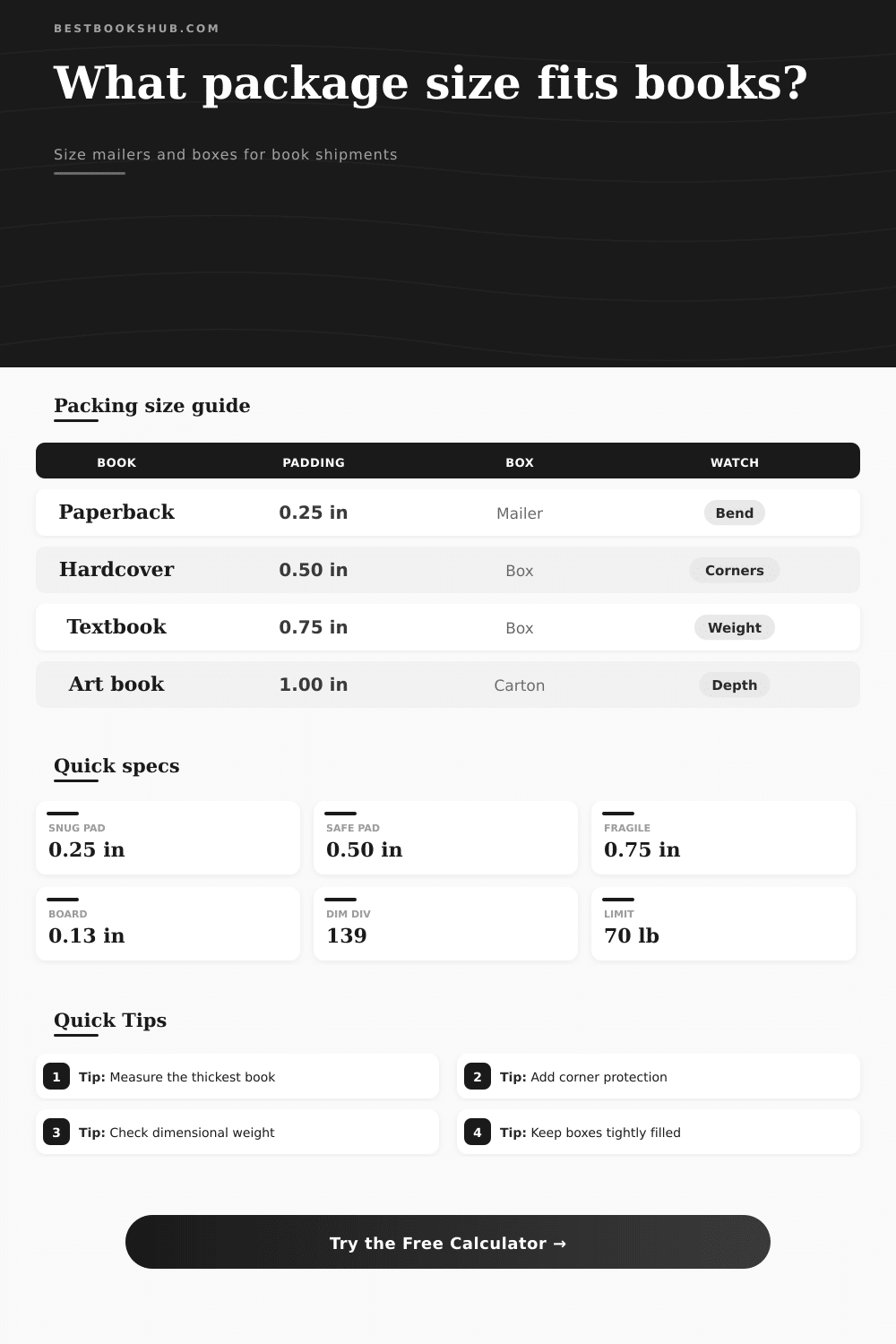
Estimate the inside and outside package size for one book, stacked sets, boxed lots, padded mailers, and cartons using book dimensions, layout, padding, board thickness, and dimensional-weight rules.
Load a common book shipment, then adjust dimensions, quantity, layout, padding, wall thickness, and dimensional-weight settings.
| Book format | Typical book size | Thickness | Weight each | Packaging watch point |
|---|---|---|---|---|
| Mass market paperback | 4.25 x 6.87 in / 10.8 x 17.4 cm | 0.90 in / 2.29 cm | 0.40 lb / 0.18 kg | Small footprint, easy to overpad. |
| Trade paperback | 5.50 x 8.00 in / 14.0 x 20.3 cm | 0.80 in / 2.03 cm | 0.80 lb / 0.36 kg | Fits many rigid book mailers. |
| Hardcover novel | 6.25 x 9.30 in / 15.9 x 23.6 cm | 1.20 in / 3.05 cm | 1.50 lb / 0.68 kg | Protect jacket and corners. |
| Textbook | 8.50 x 10.90 in / 21.6 x 27.7 cm | 1.50 in / 3.81 cm | 3.50 lb / 1.59 kg | Weight often matters before volume. |
| Picture book | 8.00 x 10.00 in / 20.3 x 25.4 cm | 0.35 in / 0.89 cm | 0.45 lb / 0.20 kg | Wide face needs bend protection. |
| Graphic novel | 6.70 x 10.20 in / 17.0 x 25.9 cm | 0.55 in / 1.40 cm | 0.75 lb / 0.34 kg | Tall trim can exceed small mailers. |
| Manga volume | 5.00 x 7.50 in / 12.7 x 19.1 cm | 0.65 in / 1.65 cm | 0.42 lb / 0.19 kg | Bundles stack cleanly but shift easily. |
| Large art book | 9.50 x 12.00 in / 24.1 x 30.5 cm | 1.10 in / 2.79 cm | 4.00 lb / 1.81 kg | Use strong corners and wider carton. |
| Package style | Wall used | Best for | Default padding | Fit behavior |
|---|---|---|---|---|
| Rigid book mailer | 0.06 in / 0.15 cm | Single paperback or slim hardcover | 0.25 to 0.50 in | Snug wrap with stiffener boards. |
| Padded mailer | 0.08 in / 0.20 cm | Low-risk paperbacks | 0.25 to 0.50 in | Compresses more than a carton. |
| Literature mailer | 0.09 in / 0.23 cm | Book gifts and small sets | 0.50 in | Good corner coverage when folded tight. |
| Single-wall box | 0.13 in / 0.33 cm | Mixed books and textbooks | 0.50 to 0.75 in | Predictable outside dimensions. |
| Double-wall carton | 0.25 in / 0.64 cm | Heavy or rare book lots | 0.75 to 1.00 in | Stronger shell adds measured size. |
| Scenario | Book layout | Interior size before walls | Suggested style | Weight note |
|---|---|---|---|---|
| Single trade paperback | 1 x 1 x 1 | About 6.3 x 8.8 x 1.5 in | Rigid mailer | Usually actual weight driven. |
| Hardcover gift | 1 x 1 x 1 | About 7.5 x 10.6 x 2.6 in | Literature mailer | Padding protects jacket edges. |
| Two textbooks | 1 x 1 x 2 | About 10.0 x 12.4 x 4.5 in | Single-wall box | Actual weight usually dominates. |
| Ten manga volumes | 2 x 1 x 5 | About 11.0 x 8.5 x 4.2 in | Single-wall box | Void fill matters around stack. |
| Large art book | 1 x 1 x 1 | About 11.5 x 14.0 x 3.1 in | Double-wall carton | DIM weight can rise quickly. |
| Dimensional weight rule | Formula | Inputs | Use when |
|---|---|---|---|
| Inch divisor 139 | L x W x H / 139 | Outside inches | Domestic parcel estimates. |
| Inch divisor 166 | L x W x H / 166 | Outside inches | Economy or alternate rules. |
| Metric divisor 5000 | cm x cm x cm / 5000 | Outside cm | Metric carrier worksheets. |
| Metric divisor 6000 | cm x cm x cm / 6000 | Outside cm | Lower DIM sensitivity. |
DISCLOSURE: This post may contain affiliate links, meaning when you click the links and make a purchase, I receive a commission. As an Amazon Associate I earn from qualifying purchases.
If you’ve ever had a book show up bent, only to find its cover completely intact, or if you’ve had one float around in an oversize box and bend, you’re not alone. That’s not typically random, either. It’s the result of calculating amount of protection required versus the amount of space available based off shipping costs. Unless you’ve measured your books before, you might think this is easy.
Then you discover that one-half-inch of extra cushioning changes the outside size enough to change the dimensional weight charge. You need just enough room so there isn’t movement inside the pack yet enough space to absorbs impact without crushing things when something happen. A lot of folks use the size of their book as starting point when they order a box. But this fails to take into account physics of shipping.
How to Pack Books Safely and Cheaply
Packages gets stacked on top of each other by carriers who also throw stuff around inside a sortation machine. When you put your book inside a box it requires some breathing room, which creates volume. Once you enter the dimensions the calculator do the rest. You won’t have to guess how many inches of cardboard inserts or bubble wrap you need. You’re not packing paper. You’re packing dead space meant to prevent kinetic energy.
Underpack? Cover gets dented. Overpack? You pay for air. Either way, you end up with a bruised ego or smaller bank account. Go to the previous post or the next post. This is where most shippers drop money: Dimensional weight. Actual weight is only part of how much a carrier charges. They also consider dimensions (length, width and height) and will charge whichever is greater.
So a package of light paperback books can cost more to ship then a single large brick if its packaging is bulky enough. This means that the packaging material, or void fill, play an important role. Since cubic inches are converted into pounds using a divisor, shaving off a few quarter inches from the outside dimensions will reduce the package size being measured. And across hundreds of shipments, those fractions adds up to significant savings.
But it’s a different story when we talk about what material they’re packaged in. Thinner-walled rigid mailers has nearly all of their volume devoted to book itself with little extra padding. Thicker double-wall cartons have thick walls that takes up some of their volume and add weight. The calculator handles those shell-thicknesses for you. It calculates how much extra volume each adds. And it then displays your true outside dimensions once you’ve got the shell on there.
Before you close the box, you want to know what those are because if they exceed an outside dimension limit, higher dimensional charges could erase any savings gained by switching to a lower-weight mailer. It’s nuanced; how much padding is needed depends on the book. Paperback? A quarter inch of stiffener board will suffice. Rare first edition? More like it. Corner and spine need a little more help without being dented or cracked.
Input fields let you adjust side padding, top clearance, and corner protection separately. That level of detail enables you to match professional grade standards at home. It also simulates library-level protection when storing precious volumes. And consistency is important here: extra wrap randomly thrown into one area only introduces pressure points that do more harm then good. Even padding ensures that it’s evenly distributed when moving.
When packing books, they’ll shift during transport. They need some sort of void fill to prevent them from moving. However, this void fill should of be solid enough that it won’t expand when compressed or heated. That way you can see what percentage of the box your books take up vs how much empty space they have. If they have too much air, then you’re paying for nothing. If they have too little, then the cardboard will rattle around with the books.
It’s a process of finding the sweet spot, but with the data at the beginning, you don’t need to guess anymore. You don’t rely on instinct as much; you rely on geometry. There’s an art to packing books for shipping. There’s always something about how heavy they can be, but you don’t want your invoice to be bloated, nor do you want your books to look as if they’ve been opened. It’s all about making sure the box size is right, and knowing how to measure twice and calculate once.
When you use those tools, your gut feeling will turn into precision. You will know exactly which box to use for any given book so the spine isn’t broken and the invoice isn’t bloated. It doesn’t rattle around in there anymore; that’s why the best sized package is the one you can hardly hear as it rattles its way across the country. That’s the kind of quiet you’re paying for when you order the proper sized box.