📖 BestBooksHub light planner
Reading lamp distance calculator
Estimate how far a lamp should sit from a book page, balancing target lux, bulb output, beam spread, lamp angle, shade loss, ambient light, and print difficulty.
| Lamp type | Typical output | Beam behavior | Starting distance |
|---|---|---|---|
| Clip-on book light | 30 to 100 lumens | Narrow spot, close to page | 6 to 14 in / 15 to 36 cm |
| Bedside reading lamp | 250 to 600 lumens | Shade softens and spreads light | 14 to 28 in / 36 to 71 cm |
| Desk task lamp | 400 to 900 lumens | Adjustable head, moderate beam | 12 to 26 in / 30 to 66 cm |
| Floor reading lamp | 600 to 1200 lumens | Higher mounting, wider throw | 24 to 46 in / 61 to 117 cm |
| Wide shade table lamp | 450 to 1000 lumens | Diffuse light with more room spill | 18 to 38 in / 46 to 97 cm |
| Reading condition | Page target | Ambient role | Placement note |
|---|---|---|---|
| Large print paperback | 250 to 350 lux | Room light can carry more load | Use a softer angle to prevent hot spots. |
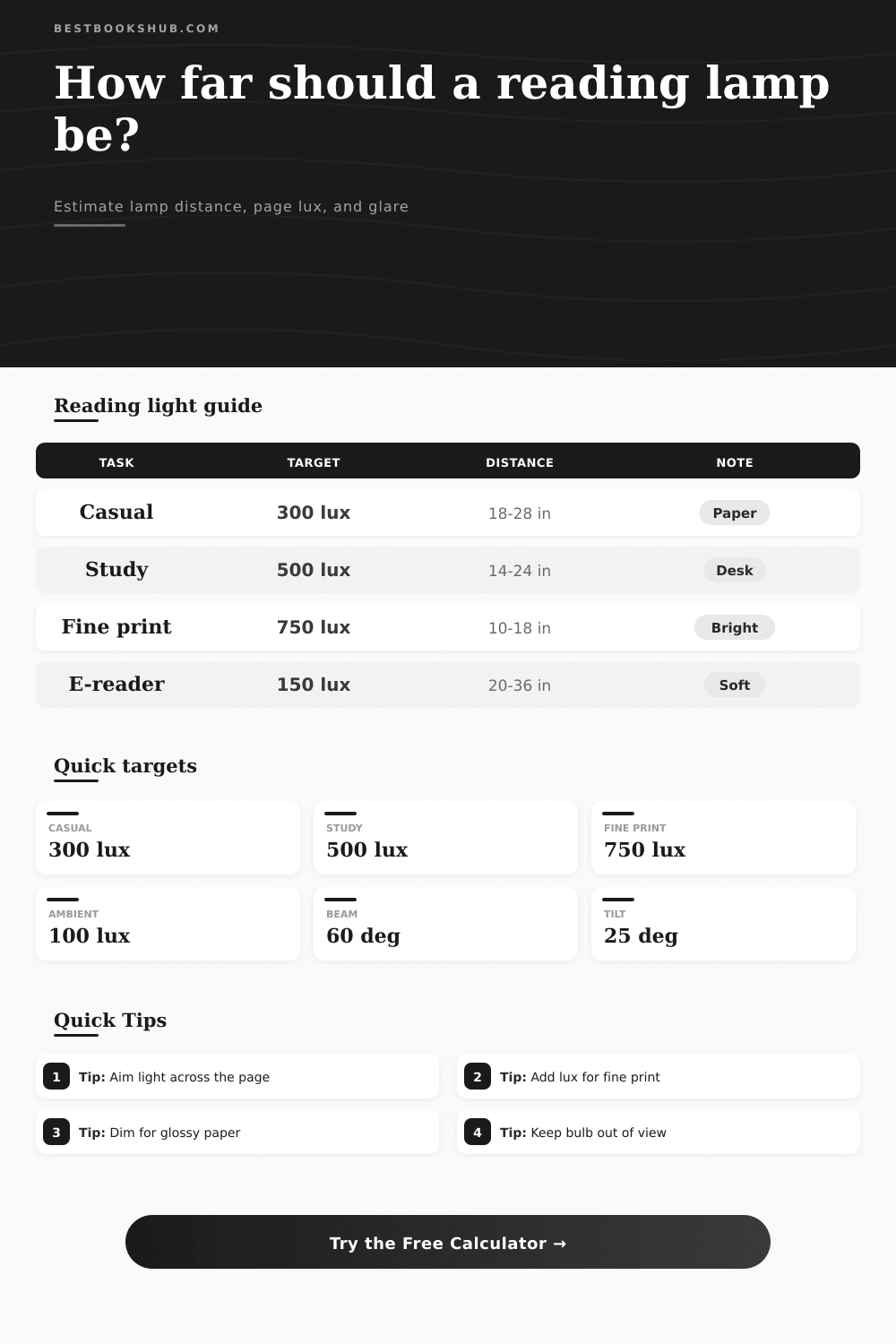
| Standard novel | 300 to 500 lux | Subtract nearby ambient light | Aim across the page from the opposite hand. |
| Study or annotation | 500 to 700 lux | Even room light reduces contrast fatigue | Keep the bulb shielded from direct view. |
| Fine print reference | 700 to 1000 lux | Ambient should not cause glare | Bring the lamp closer or narrow the beam. |
| Backlit e-reader | 100 to 250 lux | Low ambient often feels best | Use indirect light and reduce screen brightness. |
| Beam angle | Best for | Distance effect | Watch for |
|---|---|---|---|
| 20 to 35 degrees | Clip lights, focused spots | Can sit farther for same lux | Small bright patch and edge falloff. |
| 40 to 70 degrees | Adjustable task lamps | Balanced page coverage | Aim angle matters for evenness. |
| 80 to 110 degrees | Shade lamps and wide LEDs | Usually needs closer placement | More spill into the room. |
| 120 degrees or wider | Diffuse ambient support | Poor as the only reading light | Dim pages unless output is high. |
Look from your reading position before settling the lamp. If the bulb, LED chips, or shiny shade lining is visible, move the head higher, farther to the side, or behind a diffuser.
DISCLOSURE: This post may contain affiliate links, meaning when you click the links and make a purchase, I receive a commission. As an Amazon Associate I earn from qualifying purchases.
Light that crosses the page from the side often feels better than light aimed straight at your eyes. For glossy pages, increase offset and lower the target brightness.
When most of us purchase lamps, we do so based off style or wattage. That’s a good place to start, but its not really the issue. We’re not concerned if light emitted from our bulb is sufficient. Rather, it’s where does the light land? How does it hit your page? If you position a bright bulb too closely, you get a harsh glare spot that makes it hard to see the difference between light and dark. Position the exact same bulb just a bit farther away, however, and you spread into a soft, even wash which make the text pop without straining your eyes. It is less about raw power and more about geometry.
After that, plugging in your exact configuration into the calculator (above) will do all the math for you. You won’t have to guess whether or not to pull your desk lamp out a foot further.
How to Position Your Lamp for Better Reading
Begin by choosing a reading profile. Flipping through a novel on a weekend night requires different space than annotating a flood of dense academic texts does. Wider beam, lower brightness is fine for casual reading. Tighter focus, higher intensity are necessary for the fine print. It’ll adjust its target lux based off this. That way you’re never shooting for blinding brightness when something softer would of do just fine. And you won’t settle for some dimness when seeing clearly is a must.
Beam angle is one of the most tricky input variables. It is often overlooked on the package, but it is critical for real world performance. Narrow means the beam concentrates its light (like a spotlight). This keep the light intensity high on the page and lets you sit further back. Wide means the beam spreads light widely. It’s gentler, but the light drops off fast as you get further back. So if you’ve got a wide-shaded table lamp, you’ll probably want to bring it closer. At that close range, you’ll be able to read about as well as you would with a narrow clip-on light sitting farther back. This helps you get the same readability.
This is the angle the calculator uses to estimate candela from lumens. Which converts abstruse bulb specs to actual page brightness. Note that most manufacturers only list total lumens emitted, which are the number of lumens shining in all directions. It is not the useful downward thrust that actualy lights up your book. Another variable that gets people is the amount of light that’s lost through shade and diffusers. Fabric drum shades or frosted glass shades absorbs a large amount of light before it even hits the paper. Including that percentage in the tool will help it account for those invisible losses. That way you won’t position the lamp further than necessary. After all, you may think all the light that comes out of the lamp makes it over to your text.
Tilt angle and side offset matter. Lining up a lamp above your head almost always means looking straight at the bulb or at least at the bulb’s reflection in your glasses. This is not comfortabley. Pointing the light across the page from the other side of your dominant hand cuts down on shadow and glare which result in a lot more comfort. There’s an additional caveat with glossy paper: it behaves more like a mirror compared to a matte surface which diffuses light in all directions. So when using magazines or art books with coated pages, try approaching from a higher angle. Or else tweak the offset to get rid of blinding reflection. To help you visualize this, it estimates how far up vertically you’ll need to go, depending on where on side you place it. That provides a practical reference for adjusting your lamp arm or head angle as needed.
Background ambient lighting matters too. Bump up background brightness and it diminishes contrast. So even when the page is well-lit, it becomes tougher to pick out text. There’s a bit of an experiment in finding the best level. But as long as you start from measured distances, then you have a far better starting place for experimenting than pure chance.
It should be comfortable to read. There should be enough light so you can see what’s going on. Don’t use so much light that it washes everything out. That it takes your attention away from the words. The light should be just enough so that when it is working properly, you don’t notice it at all. And when the angles are just right, its like you’re looking directly through it at the words. They becomes nice and sharp. There is no fussing around. You are just reading.