📖 Focus reading lab
Focus session length calculator
Find a realistic focused reading or study block from your material, pace, energy, environment, note load, recall target, and available daily window.
Choose the focus mode, then enter the text profile, daily time, energy, and friction factors that change how long a clean session should last.
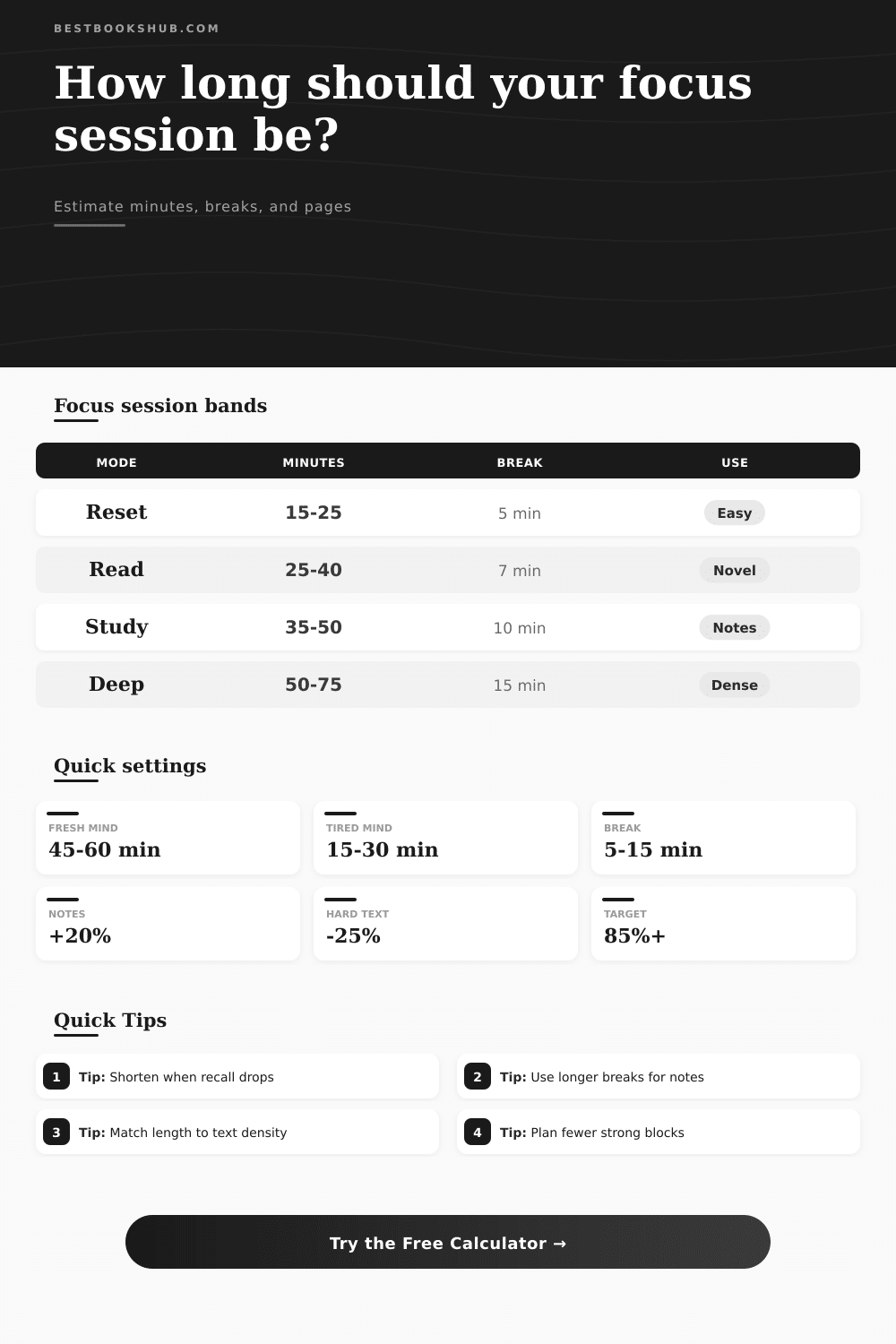
| Focus situation | Good session length | Break range | Useful when |
|---|---|---|---|
| Low energy reset | 15 to 25 minutes | 5 to 8 minutes | You want to restart a habit without overreaching. |
| General reading | 25 to 40 minutes | 6 to 10 minutes | The book is moderate and your attention is steady. |
| Study reading | 35 to 50 minutes | 8 to 12 minutes | You are summarizing, reviewing, or preparing for recall. |
| Deep reading | 50 to 75 minutes | 10 to 18 minutes | You are fresh, in a quiet space, and reading difficult material. |
| Material type | Session factor | Pace effect | Planning note |
|---|---|---|---|
| Light fiction | 1.05x length | Fastest pages | Use longer blocks if the story is easy to re-enter. |
| Literary fiction | 0.95x length | Moderate pages | Leave room for pauses, rereading, and interpretation. |
| General nonfiction | 0.90x length | Moderate pages | Add a small review pause at the end of each block. |
| Textbook or manual | 0.70x length | Lower pages | Use shorter blocks with active recall after each section. |
| Research paper | 0.62x length | Lowest pages | Plan annotation time separately from first-pass reading. |
| Audiobook | 1.10x length | Playback based | Longer sessions work when movement keeps attention stable. |
| Daily window | Suggested rhythm | Total focus | Best fit |
|---|---|---|---|
| 30 minutes | 1 block of 25 plus reset | 25 minutes | Slump recovery, commute, or short chapter. |
| 60 minutes | 2 blocks of 25 plus break | 50 minutes | Light reading or a page-count sprint. |
| 90 minutes | 2 blocks of 40 plus break | 80 minutes | Most reading nights and book-club catch-up. |
| 120 minutes | 3 blocks of 35 plus breaks | 105 minutes | Study reading with notes and recall. |
| 180 minutes | 3 blocks of 50 plus breaks | 150 minutes | Fresh deep-work day in a quiet setting. |
DISCLOSURE: This post may contain affiliate links, meaning when you click the links and make a purchase, I receive a commission. As an Amazon Associate I earn from qualifying purchases.
Here’s what happens: You’ve got two hours for reading, there’s a book on the table in front of you, your phone is turned off face-down, and clock ticks. You open to first page and…at the forty-minute mark, words begins swimming. After an hour, letters blur into a gray wash that won’t hold still long enough for you to remember anyone’s name. You push on, guiltily, but you can’t quite remember who any of the characters are now.
This isn’t a lack-of-willpower problem. It’s a problem with how you set up your sessions. Most people does not realize that focus acts more like a battery with its own unique discharge curve. They treat it like bucket instead: “If I fill my bucket with enough time, then I’ll learn.”
Why Shorter Study Sessions Work Better
Once you understand this curve, studying becomes about something different: replacing random guesses with model of the material’s density versus friction of your own energy state. You don’t guess at numbers; instead, calculator accounts for this friction. You enter a high recall target, and it calculates that you require more time per page. That reduces ideal session length, which goes against what most people assume, they think longer means deeper learning.
But in fact, depth is tied to shortness. You’re running two heavy cognitive processes when you’re reading something dense and annotating in detail, which will fatigue you sooner then if you were simply skimming a lighter piece of fiction. It’s not a penalty for working hard: it’s a break. It’s downtime for your brain to process what you just learned.
A chart shows different break lengths depending on how hard youve been reading. Five minutes sounds like plenty for resetting after an easy novel, but maybe fifteen will do the trick after a long study block full of heavy note taking, letting the arguments digest in your mind. Skipping that rest period leaves you starting from behind your next session; you’re sputtering as if you were still recovering, trying to sprint again. That’s why the calculator calculates breaks relative to this balance, so you get rested up proportionally to the amount of mental effort you just use.
Pace is density of material. Textbooks and dense nonfiction resist flow, whereas light fiction flows easy. How many times have you thought, “I’ll just pick up a book and unwind”? Light fiction is easy; it rolls off the tongue. The way the story stays connected grips you and moves you along. A few hours pass as if no time has gone by.
On the other hand, textbooks and other non-fiction are thick. Your brain have to actively build meaning from it. When text gets really hard, the calculator reduces the session length. It knows that you’ll push through, strain your eyes, and end up with a vague recognition of what happened, rather than actualy understanding it. It is better to have 30 minutes of clarity then 45 minutes of fuzzy understanding.
Your daily rhythm matters as much as individual sessions. The tool recommends a single concentrated block if all you can muster up is half an hour. It would of been too much effort to set up and down for two little mini-sessions. Splitting an hour or 90-minutes into two helps get back on track; otherwise, you’re crashing at session’s end after grinding through a long period. Instead of letting your attention slide away, you reset halfway through. Keep average quality high throughout the whole time by avoiding this crash at the end.
Treat the calculator’s recommendation as a ceiling, not a floor, and dial back down if you discover you’re wasting time getting distracted before the clock runs out. Don’t lie about how tired/distracted you are, a good study plan acknowledges that you’re human! It carves out room for taking a break so that focus becomes possible. You don’t fight nature, you work with it: that’s how you read not just longer but better.