📓 Daily journal planner
Morning pages word count calculator
Estimate words per morning pages session, writing time, weekly load, catch-up pages, notebook usage, and month-long journal totals from your page format and pace.
Choose whether you want the estimate to start from pages, available minutes, or a word goal. Page density uses typical longhand and typed journal ranges.
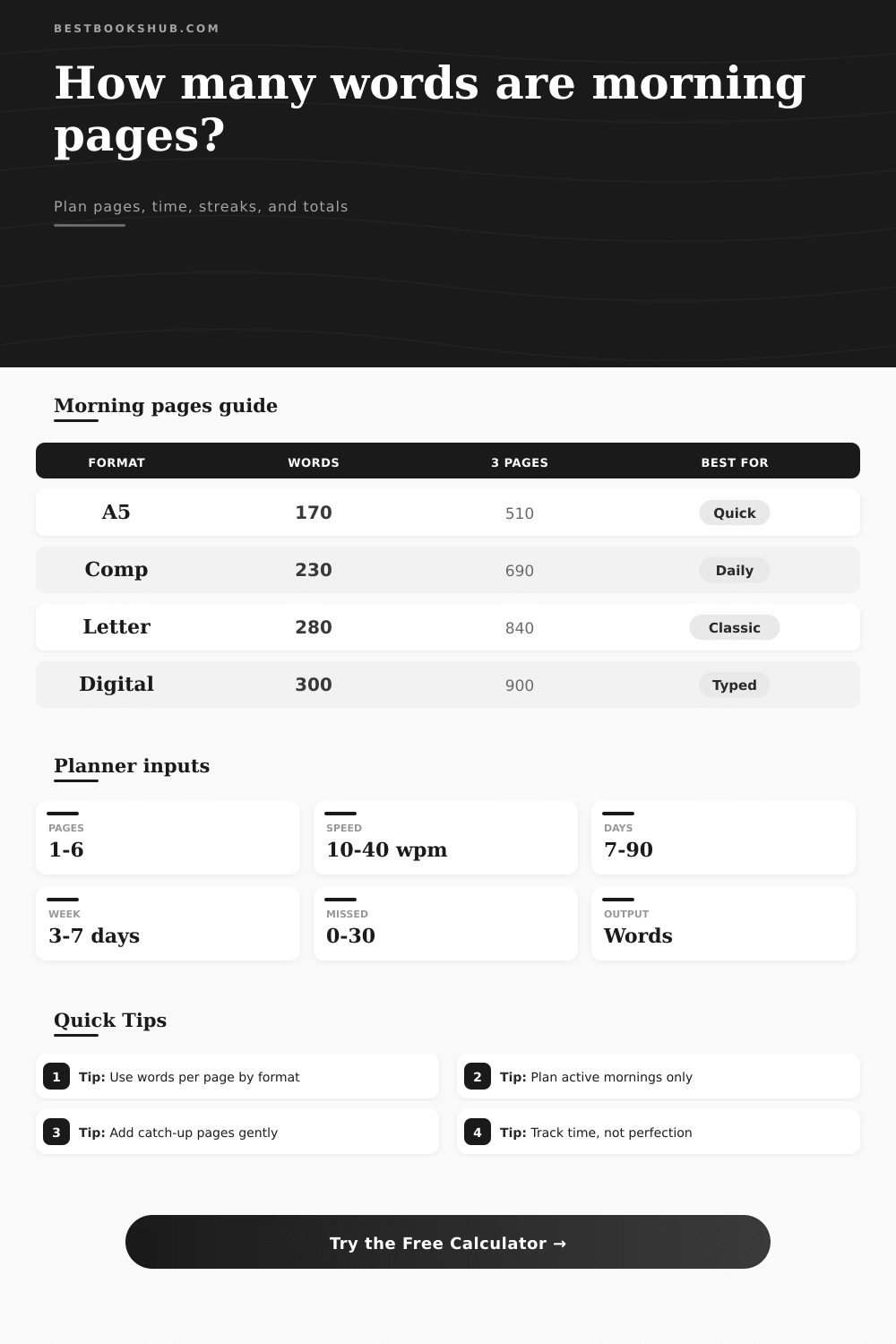
| Format | Words per page | Three-page session | At 20 wpm |
|---|---|---|---|
| Pocket notebook | 110 words | 330 words | 17 minutes |
| A5 journal | 170 words | 510 words | 26 minutes |
| Composition notebook | 230 words | 690 words | 35 minutes |
| Letter notebook | 280 words | 840 words | 42 minutes |
| College-ruled notebook | 320 words | 960 words | 48 minutes |
| Typed digital journal | 300 words | 900 words | 45 minutes at 20 wpm, less at keyboard pace |
| Habit shape | Pages per session | Sessions per month | Monthly words |
|---|---|---|---|
| Daily classic | 3 pages | 30 | 25,200 words at 280/page |
| Weekday practice | 3 pages | 22 | 18,480 words at 280/page |
| Light reset | 1.5 pages | 20 | 8,400 words at 280/page |
| Retreat week | 4 pages | 7 | 7,840 words at 280/page |
| Digital sprint | 900 words | 30 | 27,000 words typed |
| Writing speed | Best label | 750-word session | 1,000-word session |
|---|---|---|---|
| 10 wpm | Very reflective longhand | 75 minutes | 100 minutes |
| 15 wpm | Slow longhand | 50 minutes | 67 minutes |
| 20 wpm | Steady longhand | 38 minutes | 50 minutes |
| 25 wpm | Fast longhand | 30 minutes | 40 minutes |
| 35 wpm | Keyboard warm-up | 22 minutes | 29 minutes |
DISCLOSURE: This post may contain affiliate links, meaning when you click the links and make a purchase, I receive a commission. As an Amazon Associate I earn from qualifying purchases.
Count one finished page from your actual notebook, then replace the default words-per-page estimate for a cleaner plan.
When missed mornings pile up, spread the words across active days instead of forcing one oversized session.
Morning pages start off romantic: You think it’ll be like this: easy-flowing stream-of-consciousness. By page two, though, it’s usually tick-tick-tick going on in your head while your hand starts to cramp up. This is where most journal go to die. Why? Because you didn’t factor in the physical effort required to get your brain to dump itself onto a piece of paper. Showing up isn’t enough. Before you even finish pouring that cup of coffee, you need to know how much work you’re expecting yourself to do every damn day.
The calculator above will do the math for you. But understanding what those numbers say will keep you writing when the inspiration dissapears. Page density is the first variable that gets people tripped up. Sure, three pages sounds like three pages no matter what notebook you grab. But a pocket Moleskine hold about half as many words as a wide-ruled letter sheet. This means the available writing surface is vastly different based off format and transforms your daily note taking from a twenty-minute sprint into an hour-long slog.
How to Make Morning Pages Work for You
Depending on what format you’re working with (i.e., a compact A5 journal), you’ve got around five hundred words in a typical session. Five hundred words in longhand take much longer than five hundred words typed. This is where the reference table on the page comes in handy, it shows exactly how how much time each format requires, showing how format affects both its look and your time commitment.
There’s also the unspoken limitation on how fast you can write. When most people are writing longhand, their speed range from about fifteen to twenty words per minute, and this assumes they’re thinking while they write. Morning pages asks you to both think and write, which will slow you down even more. (Morning pages asks you to do both: think and write.) So that’ll slow you down more.
If you think, “Oh I’m gonna write three letter-sized pages in fifteen minutes,” then you’ve set yourself up to fail, since there’s a lot going on inside your head. That’ll be more like a forty-minute session if you do it realisticly. That is a pretty big chunk of the morning. You won’t fit that in-between brush-your-teeth-and-check-email time unless either you radically change your format or radically change your expectations.
And if you miss several days and try to catch back up, well then: the habit breaks too. And the temptation is to just write double on Saturday to make up for Monday-through-Wednesday, but don’t. Because turning therapy into torture defeats the whole purpose. Instead, distribute the deficit among whatever other active days remain, or acknowledge that this is part of the practice and let go.
There’s nothing worse than trying to be perfect; the point isn’t perfection, it’s consistency. Distributing a hundred extra words over four days add up to the whisper of additional effort. Writing eight hundred words all at once create a lot of resistance, which is why the tool has some options to help you catch up gently.
Also consider how long the notebooks last. What if you write three pages a day on a thin pocket notebook? You’ll be burning through them every couple of weeks. You will run out of paper and be forced to either switch to bigger volumes, buy new ones all the time, or carry around multiple journal. Know how many words you write a month, and that will guide you to correct physical form of your choice.
Three months straight of consistent use of a composition book should of give you just enough time to build the neural pathways that come from establishing this as a habit, before you need to worry about finding more of the same. Finally, morning pages are a container for your mind. Make it a container big enough to fit what’s inside, but not bigger than your schedule can handle.
Rush through it, and you’ve missed the point. Give yourself something so heavy that you dread it, and you’ll quit. Find instead your sweet spot: something that seems like it might be ambitious but is definitely doable. And then persist, persist, persist, until your mind begins to clear, and your hand ceases to cramp from holding on. When the pressure is just right, words will come.