📓 Reflective word planner
Gratitude journal word calculator
Estimate gratitude journal words from entries, prompts, detail level, writing speed, active days, catch-up load, and notebook capacity.
Choose whether the estimate starts from entry structure, available minutes, or a daily word goal. The detail slider represents how much explanation you add after each gratitude item.
| Journal format | Typical structure | Words per entry | At 16 wpm |
|---|---|---|---|
| One-line gratitude list | 3 short items, no expansion | 30 to 60 words | 2 to 4 minutes |
| Classic three things | 3 items plus one reason each | 75 to 150 words | 5 to 10 minutes |
| Five good things | 5 items with light detail | 100 to 220 words | 6 to 14 minutes |
| Gratitude letter | 1 person, memory, and thanks | 200 to 500 words | 13 to 31 minutes |
| Weekly review | 7 items plus pattern note | 350 to 700 words | 22 to 44 minutes |
| Notebook page type | Estimated words per page | 160-page notebook | Best fit |
|---|---|---|---|
| Pocket journal | 80 to 120 words | 12,800 to 19,200 words | Short lists and travel notes |
| A5 journal | 140 to 190 words | 22,400 to 30,400 words | Daily gratitude entries |
| Composition notebook | 200 to 260 words | 32,000 to 41,600 words | Longer reflective practice |
| Letter notebook | 240 to 320 words | 38,400 to 51,200 words | Therapy notes and letters |
| Digital page | 300 to 500 words | 48,000 to 80,000 words | Typed weekly review |
| Plan shape | Active sessions | Session words | Plan total |
|---|---|---|---|
| Daily 30-day list | 30 sessions | 75 words | 2,250 words |
| Weekday month | 22 sessions | 120 words | 2,640 words |
| 30-day challenge | 30 sessions | 180 words | 5,400 words |
| Weekly letters | 4 sessions | 350 words | 1,400 words |
| Quarter habit | 65 sessions | 120 words | 7,800 words |
DISCLOSURE: This post may contain affiliate links, meaning when you click the links and make a purchase, I receive a commission. As an Amazon Associate I earn from qualifying purchases.
Write one normal gratitude entry, count the words, then use that number as the base for future sessions.
When missed days collect, use half-size catch-up or a weekly review instead of forcing every skipped entry at full length.
Why? Because most of us approach our gratitude journal as if it’s an assignment rather than a reflective tool. We purchase a beautiful notebook, fill out a couple entries at the start of the week, feel overwhelmed by blank pages on Wednesday, and shove it into a drawer. This isn’t typically a matter of willpower. It’s about setting expectations for how much you’ll write each day that dont match the time you actualy have.
If you plan your output ahead of time, you’ll avoid this sort of burnout. You don’t need to guess whether or not that’s enough for a page. You just plug in how fast you want to write and what kind of writing it is, and the calculator do the rest.
Why You Should Plan Your Journaling Time
When we’re thinking clearly, most people can writes around sixteen words per minute. That’s quicker than looking at a wall but slower then typing. And when you’ve got only half as much time as you thought you did? It breeds resentment. Enter your time and tool will give you real-world estimate based off how many words you should of be aiming for.
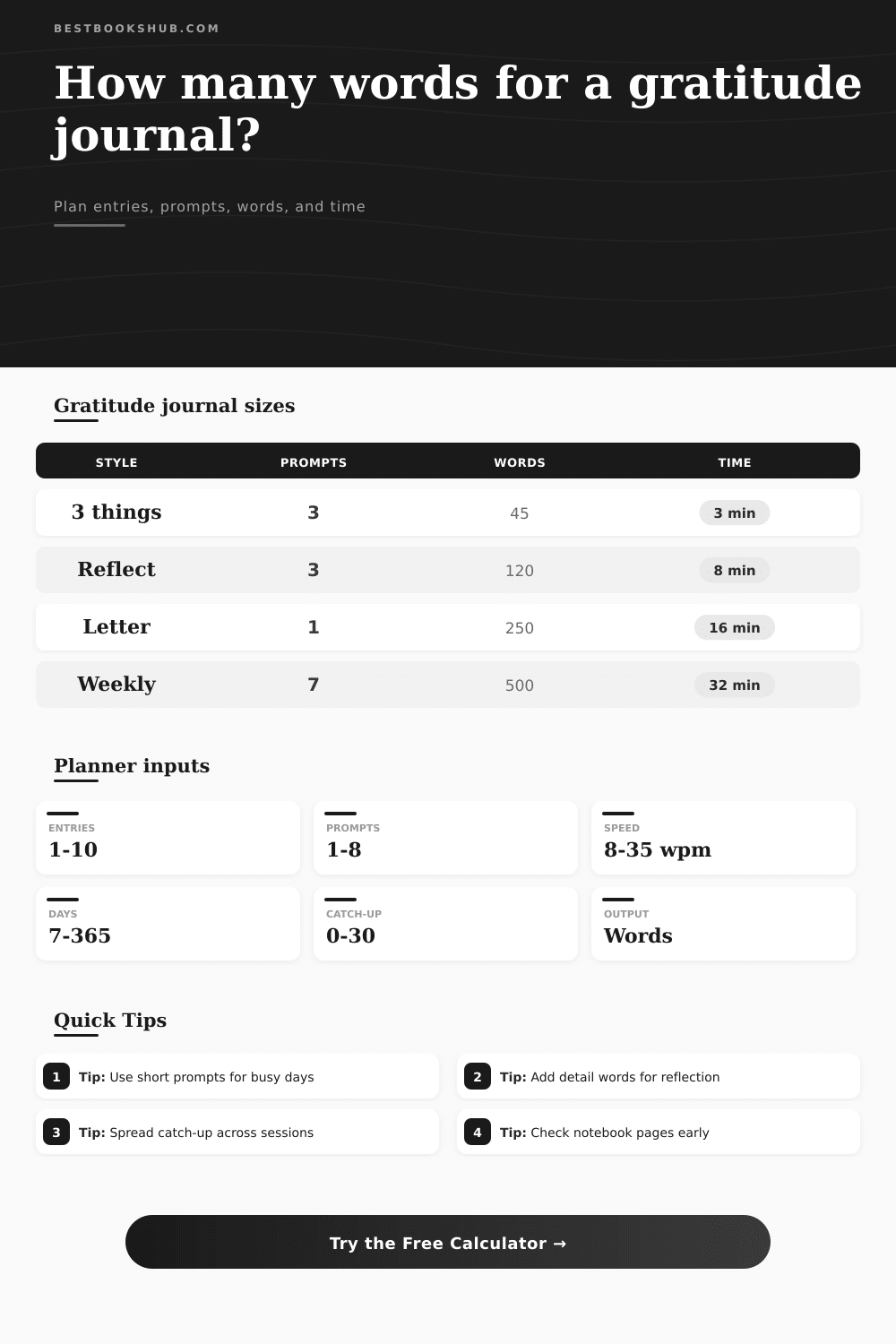
And that’s why journal-style is more important than journal-cover design. In just three minutes and forty-five words, you could write a simple list of three good things. Or in eight minutes and one-hundred-twenty words, you could write a paragraph about your thoughts, including “why.” You can also write gratitude letters. These sometimes goes over two-hundred-fifty words. That’s what the reference table is for: to illustrate the tradeoff between time (how long) versus depth (what level of reflection).
If all you’ve got is two minutes until dinnertime, you’re not going to do much deep thinking. But if you only have enough time for a hasty list, your brain won’t has had a chance to process it in a way that changes your mood.
What kills most habits? Catch-up plans. You get busy, miss a couple days, now you’re missing several. And writing four days of reflections in a single night? It is exhausting. Gratitude becomes a chore. With the calculator, you can model other recovery plans: write slightly less each day and spread out your backlog across upcoming sessions. Maintain momentum without needing superhuman effort.
Another hidden constraint is amount of space available in notebooks. Assuming that you have average handwriting, about one hundred and eighty words fit onto single page in a normal A5 notebook. This means that in under two months with daily writing of one hundred and fifty words, you’ll run out of room and need a new notebook. That can help you make an informed decision between purchasing a bigger notebook or using shorter lists. And it saves you from the stress of running out of space just when you’re starting to get into the swing of things.
How fast you write depends on what kind of medium you use. For example, if you type in a journal, you may gets up to thirty-five words per minute. If you do longhand reflective writing, it’s typically more carefuly and slower. It also engages other areas of the brain. This variation is included in the calculator. Because when we write by hand, it’s not just about getting our thoughts down; it’s also part of the therapeutic process. It gives us time to slow down and let emotions settle.
It’s smart to tack on a little wiggle room when estimating your word counts. Some days, you’ll find yourself wanting to elaborate on something; other days, a prompt will remind you of some memory you didn’t expect. By adding in a ten percent buffer, you’re allowing for breathing space without throwing off the plan. It also recognizes that life isn’t exactly a straight line.
Tracking words, in other words, isn’t about reaching some number. It’s about creating a habit that makes sense for real-life version of yourself, rather than the imagined version you think people want to see on social media. The notebook becomes a resource when expectations align with reality. It no longer stresses you out, but instead is there to serve you. The reason you reach for it is because it serves you, not because you’re obligated to give it words.