📖 Long-view journal desk
Five-year journal projection calculator
Estimate five years of entries, pages, notebooks, writing time, missed-day catch-up, and yearly archive totals before you commit to a journal layout.
Choose the journal start date and the entry pattern you want to sustain. The calculator counts actual dates, including leap years, and separates planned writing from catch-up writing.
DISCLOSURE: This post may contain affiliate links, meaning when you click the links and make a purchase, I receive a commission. As an Amazon Associate I earn from qualifying purchases.
Run the calculator to generate a five-year journal plan.
| Journal style | Typical entry | Entries per page | Best fit |
|---|---|---|---|
| One-line five-year diary | 8 to 20 words | 4 to 6 | Quick memory tracking with very low daily friction. |
| Classic five-year journal | 25 to 50 words | 2 to 4 | Short dated paragraphs, gratitude notes, and reading highlights. |
| Prompt-based journal | 40 to 80 words | 1 to 2 | Guided reflections where each date needs room for context. |
| Reader's five-year log | 30 to 90 words | 1 to 3 | Books finished, quotes, chapter reactions, and yearly reading patterns. |
| Study or research log | 60 to 140 words | 0.5 to 1.5 | APA-style source notes, study decisions, and reference follow-ups. |
| Entry pattern | Approx. entries | Monthly load | Planning note |
|---|---|---|---|
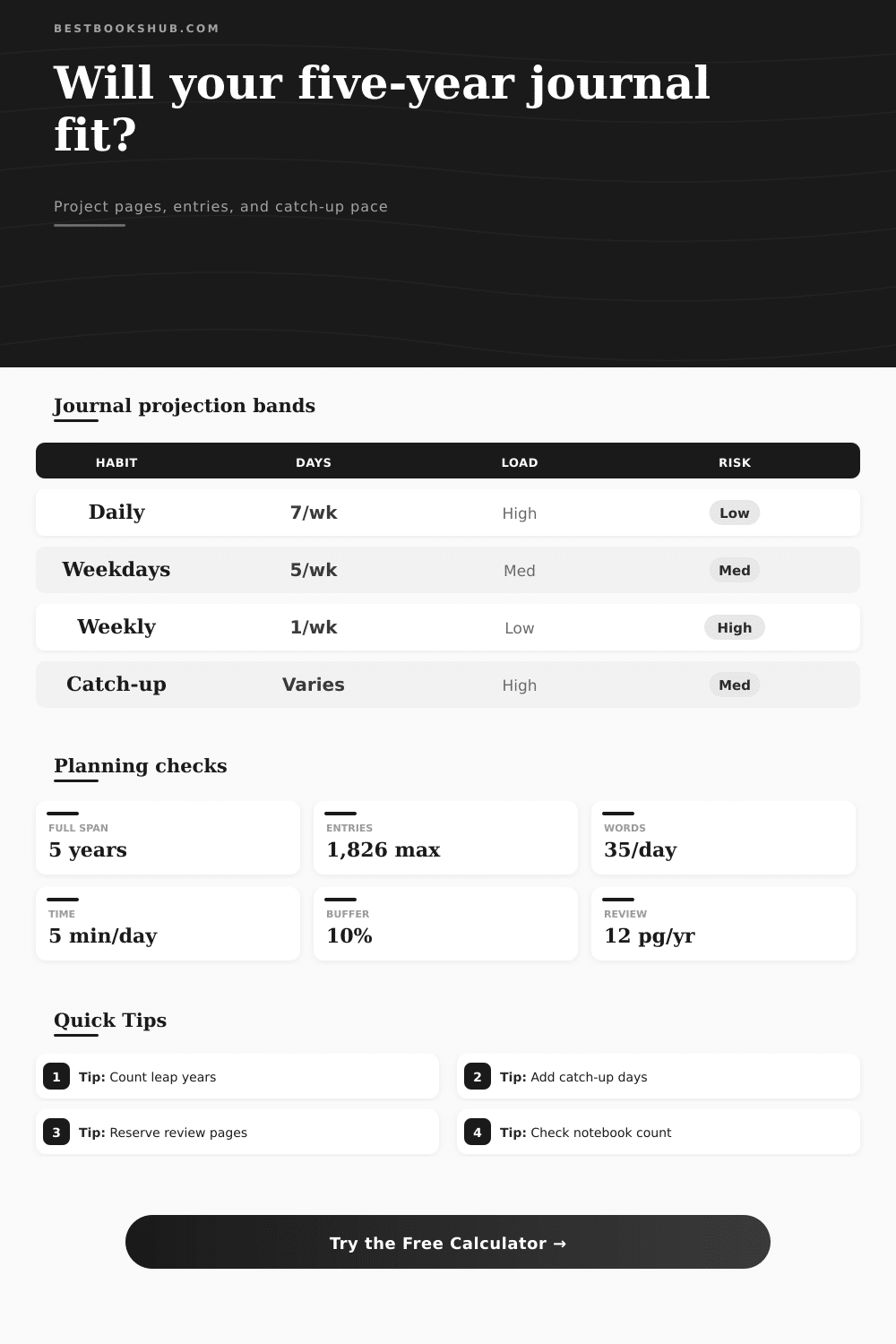
| Daily | 1,825 to 1,827 | 30 to 31 | Best for dated five-year diaries and daily reading streak records. |
| Weekdays only | About 1,305 | 21 to 23 | Useful for class logs, workday study notes, and school-year routines. |
| Weekly | About 261 | 4 to 5 | Works for summaries, book club notes, and low-maintenance archive habits. |
| Four days per week | About 1,044 | 17 to 18 | A flexible rhythm for readers who journal around sessions, not every date. |
| Catch-up batch | Variable | Depends on misses | Plan session capacity before backlog makes the five-year journal feel heavy. |
| Notebook setup | Writable pages | Entry density | Five-year fit |
|---|---|---|---|
| Slim prompted journal | 160 pages | 3 entries/page | One notebook fits a sparse or weekday plan, not full daily detail. |
| Standard hardcover journal | 240 pages | 4 entries/page | Often needs two volumes for daily entries plus yearly reviews. |
| Large dot-grid notebook | 320 pages | 5 entries/page | Can fit a compact daily five-year log with a modest page buffer. |
| Two-volume archive | 480 pages | 3 entries/page | Comfortable for daily notes, monthly summaries, and index pages. |
| Research notebook set | 600 pages | 1.5 entries/page | Better for long source notes, class reflections, and formal study logs. |
When the 5th anniversary rolls around and there is no place for it, what do you do? It will be February sometime, and then the leap year mess up your brain’s math. And there you are, staring at a blank page that simply does not exist because you already filled it up.
Why? Because you were so excited about getting started, you didn’t think ahead about how many pages would actualy be required over time. That’s why thinking through your journal requirements beforehand is important. Most people choose a notebook based off cover or feel. Few select by math: “How many days can I make last?” If you only plan for the good days, but not the hard ones, you won’t have a lasting practice; you’ll abandon it.
Plan Your Journal Space Before You Start
Until it gets complicated. In a regular calendar with no leap years, there are 1,826 days in five year. Throw in February 29 of your own making, and you tack on another day. Still feels doable, right?
You need to think about how dense your writing might be. Let’s say you write a brief paragraph per day. Even at that pace, you’ll have filled up normal 240-page notebook in under three months. To cover all 1,826-plus days might requires six or seven notebooks. This is the math your calculator will perform when you plug in your word count and frequency. It removes any guesswork as to how small your handwriting may become over the next five years.
It factors in the fact that you’ll skip some days. Catching up feels like friction. Most writing-advice about journals overlooks this. “Oh, I will only miss one a month! Who cares?” It doesn’t seem important right now. But over five years, those single missed entries add up, you end up with almost sixty unwritten days stacked up for you. And if you attempt to catch up by stuffing them all into a weekend session, the mental weight of it is too much. The tool estimates how much time you’ll spend catching up, given your assumed miss rate.
Why does this help? Because it changes the question from ‘how can I be perfect?’ to ‘what’s the lowest-maintenance way to keep doing this?’ Do you have to write every day? Nope! You just need something that can deal with skipped days and still get you caught up, without making you feel like you’ve failed. That’s everything when you’re building a practice.
This depends a lot on entry density. Two lines for a gratitude list. One page for a detailed reading note, complete with quotations and reflection. Switching journal styles midway through five years? Not factoring in style variance? You’ll burn through pages before you know it. To give you an idea of typical densities, here are the reference tables from the page. Compare the classic daily diary to the reader log. The former is compact by design, while the latter requires room to breathe.
The former needs some breathing room. The latter’s designed to be compact. Knowing what type of journal habit you have… Whether you’re a detailed researcher or a simple reader, can help you decide how big of a notebook to get, since slim journals can suffocate researchers and massive pads might intimidate simple writers. You won’t want to smother a slim prompt journal with detail. Someone who only wants to write a single thought each day would be intimidated by a massive dot-grid pad.
Review pages are another quiet space-waster. A lot of people don’t leave enough space for index or year-end summary pages. You’re not including any dated content on them, but they take up space in the actual book. Plan to do an end-of-year review? Subtract out those review pages when figuring out how many notebooks you’ll have room for. They’re included in the projection as extra space. This ensures you don’t find yourself saying, “Oh, no! Only 2 more pages after this and I’m already full!” at the end of the year because you wrote too big on the set-up pages back on January 1st.
The second overlooked constraint is writing time. Say you want to write 20 minutes each day. Over five years, that’s about 170 hours. That’s a significant commitment. How does it feel when you scale it back to five minutes per day? It feels lighter and more doable. It is more sustainable.
Enter your desired habit duration into the calculator. It will show you how many hours in total that adds up to. Experiment with different options until you see what’s realistically possible within your given schedule. Perhaps there are certain times (like during stressful work periods or exam season) where detailed daily entries just aren’t viable. Change it so that you only record weekdays. Or tweak it so you aim for X number of entries per week instead. This may be the difference between completing the journal or dropping out halfway. But continuity is what you’re going for, not volume.
A five-year journal is a record to stretch across large periods of time without being a burden. And planning it out takes the guesswork away so you can enjoy the writing itself. Knowing in advance how much room to leave for each year, and how many notebooks to purchase, that frees you from wondering how this will all work out. That spares you the panic of the blank page when your line comes to an end. You end up with a five-year record of well-thought-out reflection. You finish with room to spare and can look forward to reflecting on the experence.