📖 Vocabulary pace lab
Words learned per month calculator
Estimate how many new vocabulary words you can discover, capture, review, and retain each month from reading, word lists, classes, or mixed study.
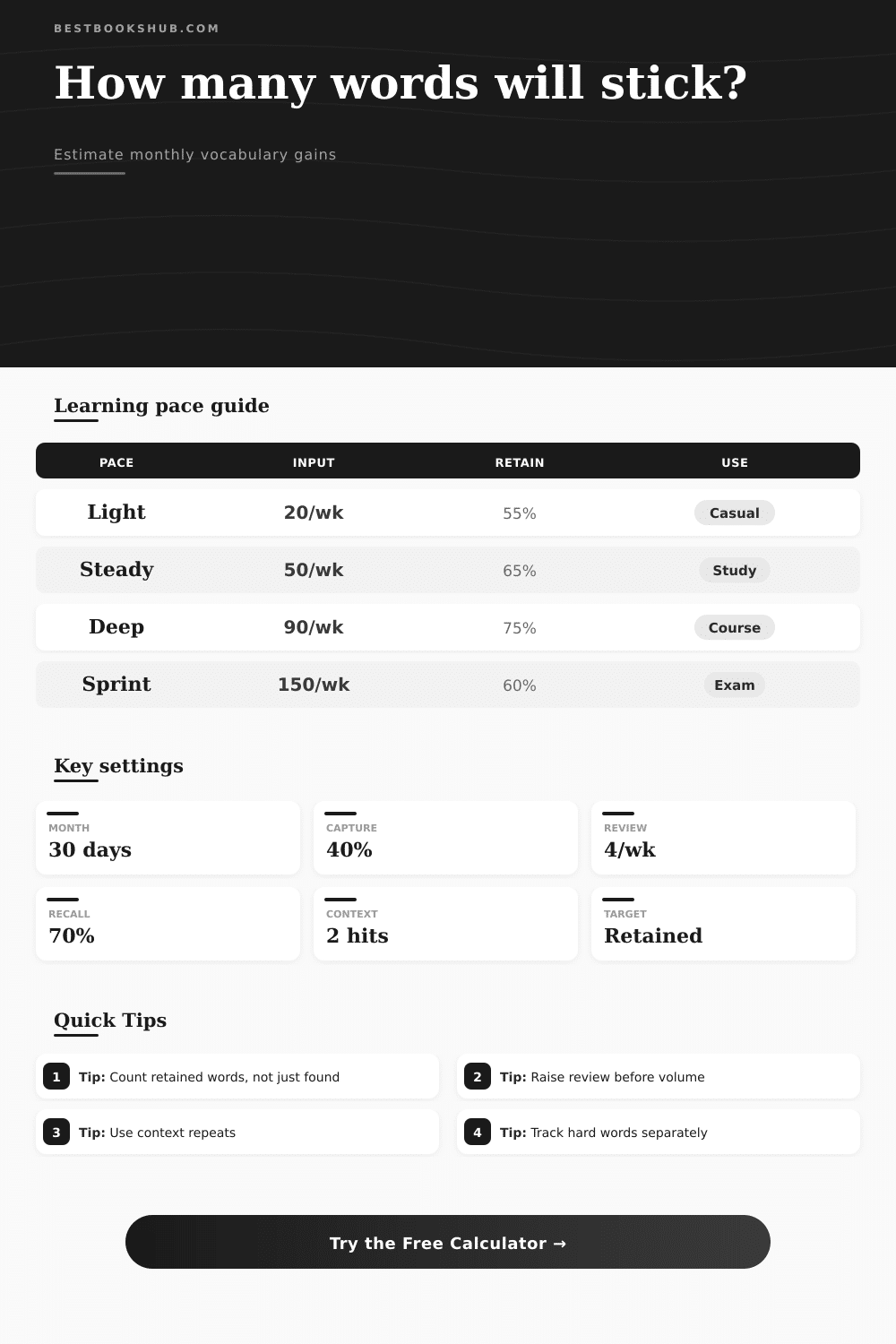
Choose how the words enter your month, then tune capture, review, and recall assumptions. Results separate discovered words from words likely to remain usable after review.
| Study habit | Capture rate | Recall range | Best use |
|---|---|---|---|
| Underline only | 10-25% | 30-50% | Light recognition while reading |
| Lookup and note | 25-45% | 45-65% | Book clubs, nonfiction, casual study |
| Flashcards | 45-75% | 60-85% | Language learning, tests, academic terms |
| Use in sentences | 55-85% | 70-90% | Writing transfer and spoken recall |
| Review pace | Cards per 20 min | Monthly capacity | Practical note |
|---|---|---|---|
| Slow recall | 40-55 | 160-220 | Hard words, examples, definitions |
| Normal recall | 60-75 | 240-300 | Most flashcard or notebook reviews |
| Fast recognition | 80-110 | 320-440 | Quick reads and familiar roots |
| Mixed production | 35-60 | 140-240 | Writing sentences takes more time |
| Source type | Words per page | Unknown density | Learning pattern |
|---|---|---|---|
| Modern fiction | 220-280 | 5-20 per 1,000 | Context-rich, moderate repetition |
| Literary classics | 250-330 | 15-45 per 1,000 | Older usage and varied diction |
| Academic nonfiction | 300-420 | 25-70 per 1,000 | Terminology-heavy, lower repetition |
| Language graded reader | 120-220 | 20-90 per 1,000 | Designed repetition, easier review |
DISCLOSURE: This post may contain affiliate links, meaning when you click the links and make a purchase, I receive a commission. As an Amazon Associate I earn from qualifying purchases.
When captured words exceed review capacity, the retained number falls faster than the discovered number rises.
A word seen in several contexts usually needs less deliberate review than a technical term met once.
Retention: Let’s face it, you download that dictionary app, make a grand plan for growing your vocabulary, and after two weeks your progress grind to a halt. That’s not due to a lack of trying. It’s due to an inability to account for how fast you forget what you just learned.
Just because you looked up a definition doesn’t mean you’ve learned that word. Finding a word does not mean you remember it. When you look up a word, your brain feel like it has just learned something. This is why it feels like learning. But unless you return to the word, that feeling evaporates rapidy.
Why You Forget New Words
Once you input your review habits and amount you read, this calculator do all the math for you, saving you from guessing how much effort equals long-term memory. To understand what goes into the system, consider your workflow beyond number of pages. How many words do you read during an average day? What’s the reading material (fiction v. Academic)?
Fiction has fewer unknown word, but richer context (you’re seeing the word used naturaly in conversation/description; that helps you anchor its meaning). In contrast, academic papers throws terms at you without context, which means you must put in more intentional work for the words to “stick.” This can help you adjust properly with the tool; don’t oversell yourself when switching from, say, fiction to academia.
And then there’s how much do you actualy capture? In other words, how many unknown words do you stop to save or even note down? If you’re reading casually, perhaps you’ll only catch 20% of the words you see; there is nothing wrong with that. You don’t want to mine every page. Doing so take away from the joy of reading.
The higher your capture rate, the more review burden you will face, since now you need to determine whether you want to read for flow or study for expansion. Most sustainable plans falls somewhere in the middle, you’re doing enough selective lookup to keep up with the pace but not overloading your attention span.
That’s why the calculator also requests your review time and recall accuracy: this is the meat and potatoes of the process. Spaced repetition only becomes effective when it makes you struggle to remember something right on the cusp of forgetting it; once doesn’t cut it, reviewing a word one time doesn’t mean it’s become part of you.
If your recall rate is high (say, eighty-two percent), you’re probably reviewing things too well. Being super efficient, but maybe not challenging yourself enough. If your recall rate is low (forty-five percent, maybe) then you’re either overwhelmed with volume or maybe it lack enough context. You want that number to be in a trustworthy band such that your efforts pays off.
Repetition alone isn’t as powerful than contextual use. Reading the same word in two separate sentence forms a deeper mental model than repeating the word’s definition five times over. The tool allows you to input the number of times you’ve encountered each word in context. Since immersion-based learning is connected to meaning instead of letters alone, those words tend to stick better. It’s one thing to know what a word means; it’s another to feel how it plays out in a sentence.
Last, consider how many minutes of review time per week you have in reality, since this is what matter. Be honest; if you say an hour but discover that you can do only 20, then you won’t be disappointed and your retained count will decrease to match. You’ll see from the breakdown section just how much you put into the bucket compared to how much you can get out. It’s a leaky bucket problem.
If you capture more words than you have time to review, the number of words you remember will drop more slowely than the number of words you find will grow. But use this to establish a pace in keeping with real life, not some idealization of it. You should of begin small, and then begin reviewing before you step up volume. Track difficult words separately from your other stats if you find yourself dragging them down.
Strive for slow accumulation instead of burning out on a race that tires you and leaves you remembering only half of what you began with. It’s the system for retaining words more than the number of words learned per month.