📚 Citation density lab
Citation count per page calculator
Estimate citations per page, pages per citation, source variety, references per 1,000 words, and reference-list pages for essays, articles, reviews, and theses.
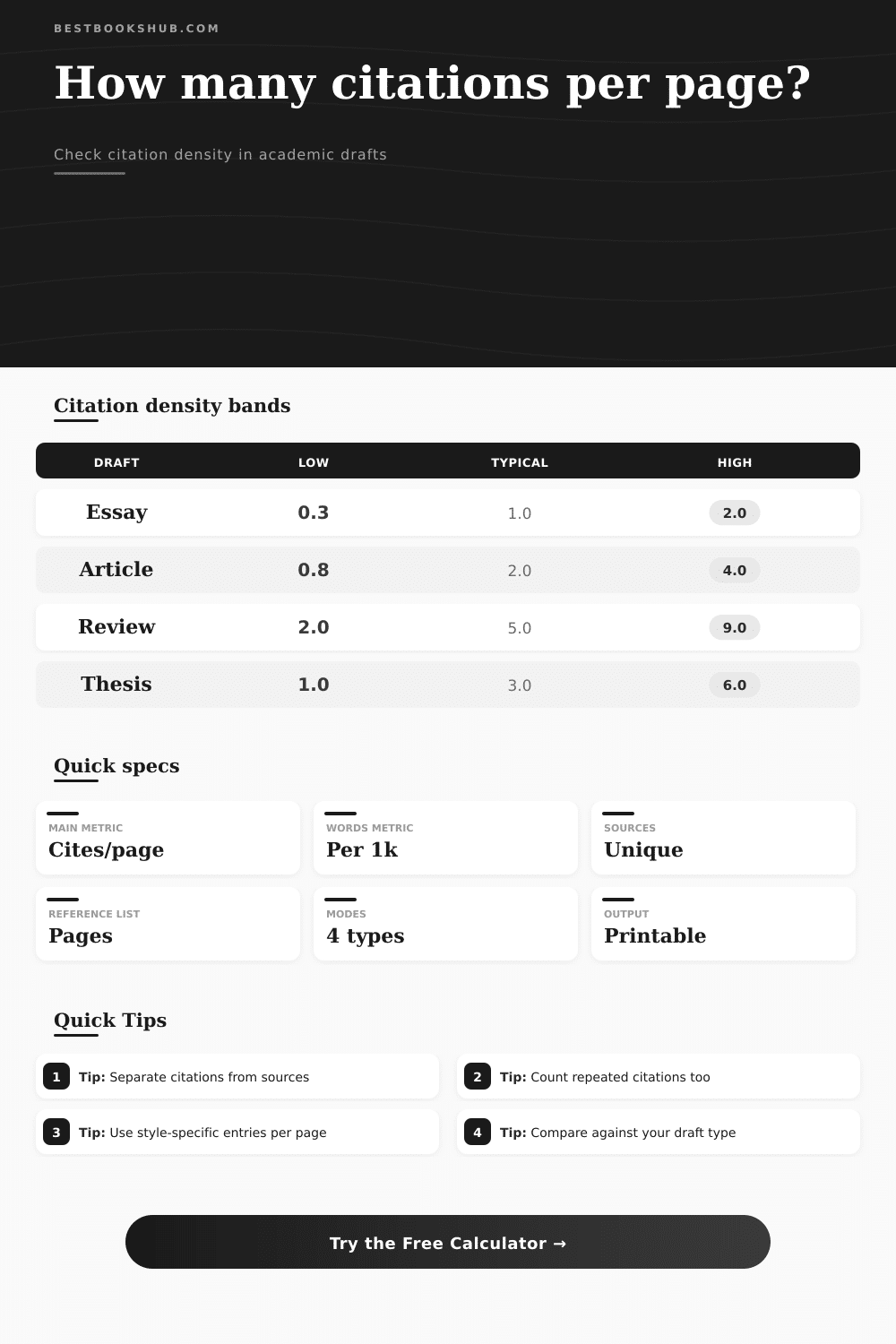
| Draft type | Light support | Balanced range | Source-dense range | Best use |
|---|---|---|---|---|
| Short essay | 0.3 to 0.8 per page | 0.8 to 1.8 per page | 1.8 to 3.0 per page | Claim support and assigned readings |
| Research paper | 0.7 to 1.4 per page | 1.4 to 3.0 per page | 3.0 to 5.0 per page | Course papers and empirical reports |
| Journal article | 0.8 to 1.8 per page | 1.8 to 4.0 per page | 4.0 to 6.0 per page | Introductions, methods, discussion |
| Literature review | 2.0 to 4.0 per page | 4.0 to 7.0 per page | 7.0 to 10.0 per page | Synthesis, comparison, and gaps |
| Thesis chapter | 1.0 to 2.0 per page | 2.0 to 5.0 per page | 5.0 to 8.0 per page | Background, framework, findings |
| Citation style | Typical entry density | Reference list effect | Citation-count note |
|---|---|---|---|
| APA-style reference list | 18 to 24 entries per page | Double-spaced entries need more pages | Parenthetical and narrative citations count as events |
| MLA works cited | 20 to 26 entries per page | Shorter entries can fit more per page | Count each parenthetical citation in the text |
| Chicago notes and bibliography | 14 to 20 entries per page | Footnotes may add citation load outside body text | Count full notes and shortened notes as events |
| Chicago author-date | 18 to 24 entries per page | Similar page estimate to APA-style lists | Repeated author-date mentions increase density |
| Numeric or Vancouver style | 26 to 36 entries per page | Compact numbered lists often fit more entries | Repeated numeric mentions still count as events |
| Common draft | Main pages | Typical citations | Unique sources | Reference pages |
|---|---|---|---|---|
| Five-page essay | 5 | 5 to 10 | 4 to 8 | 0.3 to 0.5 |
| Ten-page paper | 10 | 15 to 30 | 10 to 20 | 0.5 to 1.1 |
| Article draft | 25 | 45 to 95 | 30 to 65 | 1.4 to 3.3 |
| Review chapter | 35 | 140 to 245 | 80 to 150 | 3.6 to 7.5 |
| Dissertation | 180 | 360 to 900 | 160 to 320 | 7.3 to 16.0 |
DISCLOSURE: This post may contain affiliate links, meaning when you click the links and make a purchase, I receive a commission. As an Amazon Associate I earn from qualifying purchases.
Have you ever looked at a blank page and wondered how much support your paper will need? Or worried that there are already to many sources? It’s a familiar feeling among any student writer. More sources = better research right? Not necessarily. Quantity isn’t always the same thing as quality.
While it take more than just a bunch of names on a page to make a good argument, it does take some understanding of how to incorporate those sources into your text in order to create something that feels supported rather than like a simple list. Most students only concern themselves with meeting some arbitrary number of source; they don’t consider whether their pattern of citation is working towards supporting the thesis.
How to Use Sources in Your Paper
Now you can input your citation events and page count into the calculator above, which spits out your magic number for you (meaning no more guesswork on striking the right balance of support vs. Readability). But first, what’s this business about distinguishing between unique sources and citation events? Citation events refers to each time you include a date or drop a name within your writing. So if you mention Smith five times, that’s five event. Unique sources refer to the total number of separate source that make their way onto your bibliography.
Why does it matter? High levels of reuse signal that you’re looking closely at a few key argument, not mindlessly skimming lots of superficial ones. The key here is that there’s no “right” level of density; it depends entireley on context. A short argumentative essay isn’t written with the same rhythm as a literature review.
Why? Because you know that a literature review has to combine and compare the current scholarship, you’re expecting density. But an essay require space for you to develop your own voice and to connect one point to another in a way that makes sense. When every single sentence is a citation, the reader doesn’t have a chance to see where you are taking them.
That’s laid out in the reference table on the page, which shows how the bands shift depending on the type of draft. The five-page assignment will obviously have less weight-per-page than a thesis chapter. Comparing the two directly result in faulty conclusions.
• Normalizing by word count levels the playing field between various formats. Double-spaced journals vs. Others use more compact, single line heights. Margins + font choice can lead to wild differences in pages’ actual content load. A thousand words is a thousand words, so citations per thousand words is a steady metric that allows us to ignore these visual distraction. It makes us focus on the intellectual substance, not the physical layout which is especially helpful for reading drafts prior to applying final formatting.
The physical size of your references is also influenced by style guides. In general, numeric referencing styles like Vancouver create shorter references than citation styles like APA. The combined number of pages used for all your references adds to your paper’s overall page count, and some teachers bases their word/page limits on that figure. That means that reaching a page limit may not result from writing insufficiently but rather having an unexpectedly large bibliography. Catching this early on saves you any last-minute worry over cutting words simply to squeeze inside the limits.
Take special care because direct quotes use up a lot of word count and don’t always add much valuable analysis. If your paper has high quote share, it could be because of poor paraphrase skills or too many appeals to authority different than argumentation. Footnotes also complicate things, particularly in law or history, where they carry a lot of weight. Don’t neglect the subtleties here, because failing to do so will make it hard to asses how much external material you actualy used in your paper.
Strive for the sweet spot of support density (not too sparse; not too dense). For most authors this mean striving for balanced support. This conveys “I’ve done my homework,” while still leaving room for the story to flow. Your sources should help make your case, but they shouldn’t take center stage. You’re leading the conversation. You bring literature along. When you hear yourself reading it out loud, the citations adds depth without breaking stride. This is your happy place.