📚 Citation spacing lab
In-text citation density calculator
Measure how often citations appear in your prose, whether the marker mix is too quote-heavy, and how your draft compares with style-aware academic density bands.
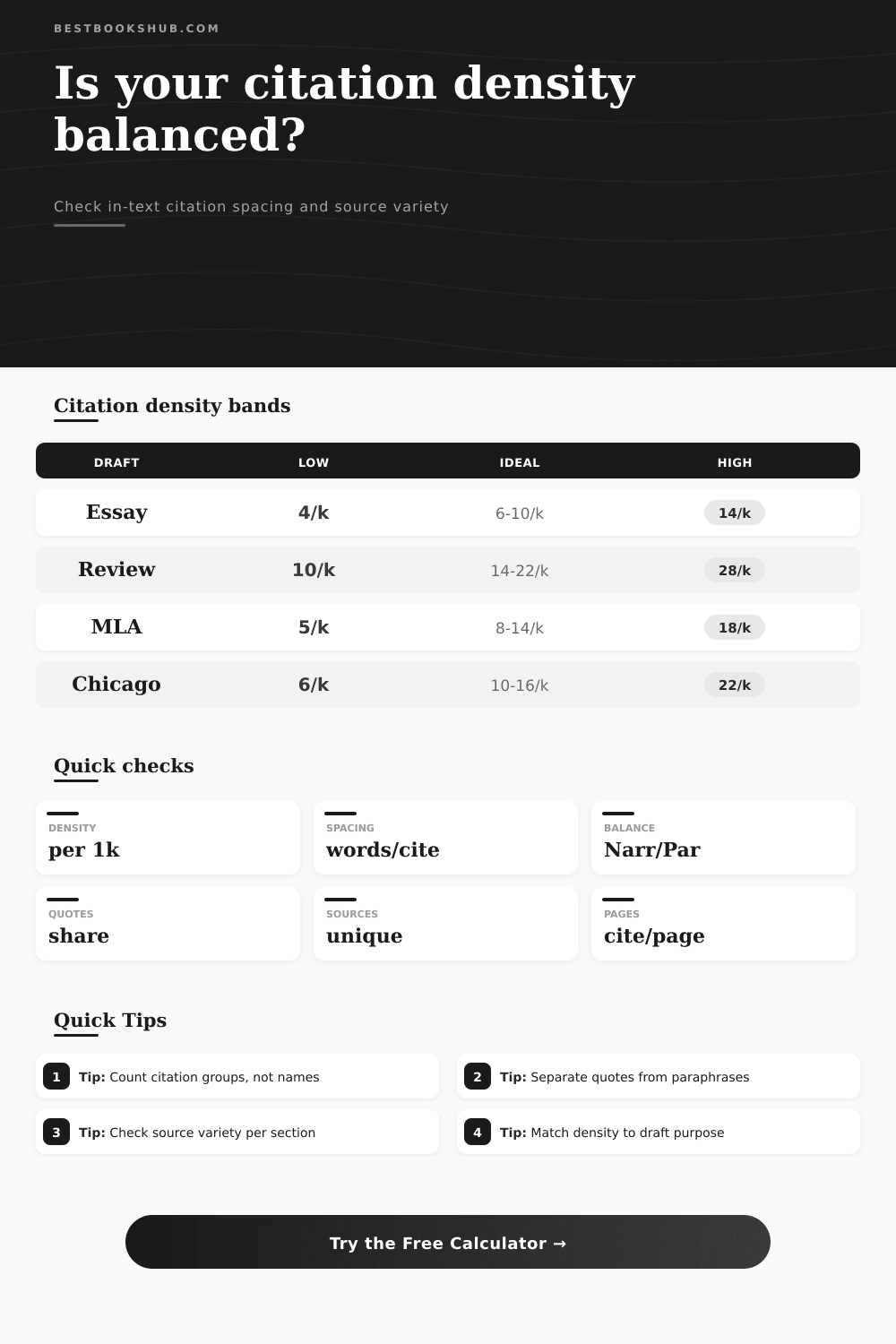
| Style and draft type | Target markers per 1,000 words | Approximate spacing | Density reading |
|---|---|---|---|
| APA 7 undergrad essay | 6 to 10 | 100 to 167 words per marker | Moderate evidence rhythm with room for analysis between citations. |
| APA 7 literature review | 14 to 22 | 45 to 71 words per marker | High synthesis density, especially in source comparison paragraphs. |
| MLA close reading | 8 to 14 | 71 to 125 words per marker | Textual evidence appears often, with quotations doing more visible work. |
| Chicago history paper | 10 to 16 | 63 to 100 words per marker | Claims, dates, archival details, and interpretations are commonly supported. |
| Science background section | 12 to 20 | 50 to 83 words per marker | Dense source support is common when framing prior findings. |
| Citation form | What to count | Density effect | Common warning |
|---|---|---|---|
| Parenthetical citation | One marker per citation group, even if multiple authors appear inside it. | Raises visible citation frequency without changing sentence grammar. | Too many in a row can make paragraphs feel mechanically patched. |
| Narrative citation | One marker when the source author is part of the sentence. | Improves flow when discussing what a researcher argues, finds, or defines. | Too much narrative citation can turn synthesis into a list of source names. |
| Direct quote citation | Count the citation marker and track the quote share separately. | Can be necessary for close reading, primary sources, or disputed wording. | High quote share may reduce paraphrase, analysis, and synthesis. |
| Numbered or note-backed citation | Count the bracket number, superscript note, or sentence-level note signal. | Often looks visually lighter while still supporting claims. | Dense notes can still overwhelm the reader if every sentence is sourced. |
| Source variety signal | Formula | Usual interpretation | Best use |
|---|---|---|---|
| Low variety | Unique sources are under 25% of citation markers. | The draft may be leaning hard on a small source cluster. | Good for close readings, risky for broad research arguments. |
| Moderate variety | Unique sources are 30% to 45% of citation markers. | The draft repeats useful sources while still showing a research base. | Common for essays, research papers, and chapter sections. |
| High variety | Unique sources are over 50% of citation markers. | The draft introduces many voices relative to its citation count. | Useful for literature mapping, but watch for thin one-off mentions. |
| Repeat load | Total markers divided by unique sources. | Shows how many times the average source is reused in the prose. | Helpful for spotting overused foundational sources. |
| Draft size | Words | Moderate marker range | What it feels like in prose |
|---|---|---|---|
| Short response | 750 to 1,200 | 4 to 10 markers | Evidence appears in key claims, not every sentence. |
| Standard essay | 1,800 to 3,000 | 12 to 30 markers | Most body paragraphs carry one to three visible source signals. |
| Research paper | 4,000 to 6,000 | 32 to 78 markers | Source density varies by section, with heavier literature passages. |
| Thesis chapter | 8,000 to 12,000 | 96 to 216 markers | Dense review sections balance against lower-density analysis sections. |
DISCLOSURE: This post may contain affiliate links, meaning when you click the links and make a purchase, I receive a commission. As an Amazon Associate I earn from qualifying purchases.
You don’t cite because you want to spend hours running a citation marathon; you cite because you have a point to make, and you want your writing to reflect that point, not get bogged down with in-text citations. Most of us see in-text citations as a check-list: scatter ’em everywhere until the page is filled up enough, right? That never works out well; professors read for arguments, for flow, not for fullness.
Too many citations in a row clutters prose; author’s voice becomes muffled under a jumble of source names and dates. If there are too few, the student’s claims sound more like opinion then scholarship. Your challenge: strike the balance. Examine space between citations almost as closely as you examine the sentences between citations.
How to Balance Your Citations
You can eyeball what that looks like with this tool (above), there’s no need to count out paragraphs by hand. Instead, it spits out numbers that show how your brain understands information. These include average number of words between markers, density per thousand words, and more. If the input is relevant, does your narrative share look low? Then your text could read as mechanical; you’re tacking tags on at the end of thoughts rather than weaving those sources into conversation.
Rhythm comes from context: different assignments need different densities. For example, the main task of a lit review is to map out what’s been said about a topic and compare perspectives among various studies. It makes sense that this assignment calls for greater density (i.e., greater frequency). By comparison, when writing an original analysis section or a short response to a seminar prompt, you can afford to breathe easier between citations.
These situations is built into the calculator’s presets, and they’ll help you set your expectations to match. Don’t expect to achieve the same rate of citation in a close reading of one poem that you do in a history paper, for instance. Just as formal shoes aren’t ideal for hiking, a uniform benchmark per draft isn’t ideal for every situation.
The hidden metric is variety of sources. Writers gets stuck on this one all the time. There’s this one source they can use over and over again because it supports everything they say. Sure, it’s convenient but it also bottlenecks their argument. This calculator will show you how many unique sources you have vs. How many markers you got.
For example, let’s say you got 50 citations. But you’re only using 5 unique sources. That could mean you’re not building a broad enough base for your research. Instead of sounding like you’re simply repeating the same voice, you’ll sound credible when you vary your evidence. You can do this by showing your hard work in exploring multiple perspectives.
There’s also a subtler effect of quotations on density: direct quotations are weighty, since they break up your own sentence structure and force a greater level of care when putting them into your writing. If you rely on lots of quoted citation, your reader might infer that you’re summarizing instead of synthesizing. Paraphrase is usually preferred by teachers, since it shows that you’ve absorbed the source material and can reproduce it in your own analytical voice.
One way to get a rough sense of how reliant you are on other people’s word choice is to calculate your share of quotation, which provides a fast sanity check for overreliance on original phrasing. This is one tiny tool with an outsize influence on the whole feel of your document. In the end, then, citation counts comes down to trust. Yes, you cite to demonstrate that you’ve done the reading and to place your arguments into some sort of academic conversation. But you’re also trying to create breathing room for your own arguments.
You don’t want to be hitting some magical mark-per-page target. You want each citation to deserve its spot: to support a particular claim, to provide helpful context. As you review your paper, ask yourself whether you’re using citations as decoration, or whether they’re pushing the argument along. Once you know how many words and markers you want to use, the calculator on this page can crunch numbers for you, and you won’t have to guess anymore about whether you’re churning too slowly or running too fast.
This is where it comes in handy: revision. Often I’ll see a section that contains many parenthetical tags, followed by another where there aren’t any. It is simple enough to redistribute some evidence into narrative shape or break up chunks that seem overly laden. What’s most important is knowing what you’re measuring.
This isn’t meant to penalize you for using too many citations; instead, you should of asked yourself if your voice is still visible through the evidence. Before submitting, look at the rhythm. A well-balanced draft honors the reader and the sources.