✍ first-line lab
Opening sentence length checker
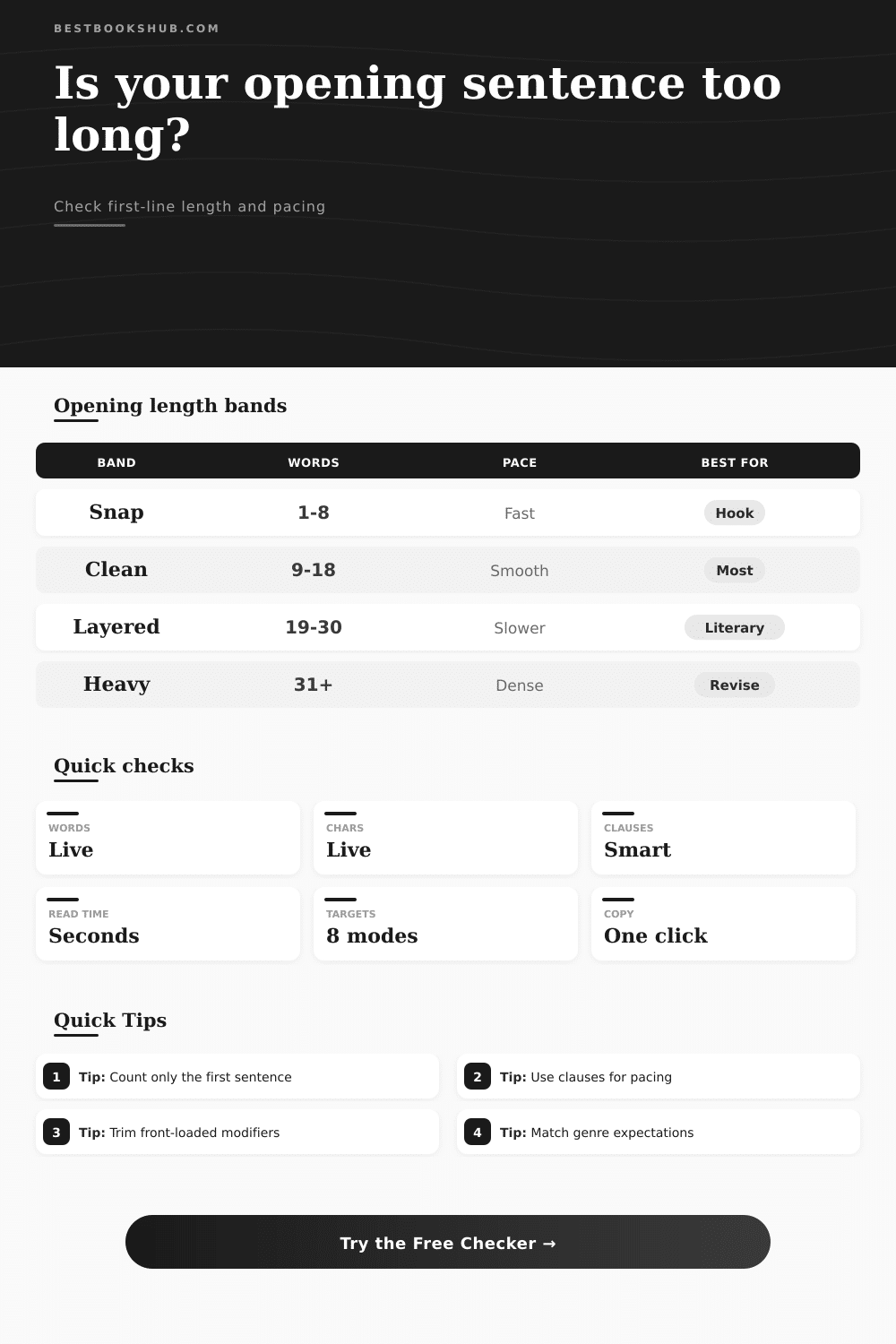
Measure the first sentence of a draft for word count, character load, clauses, readability pressure, and genre fit before the paragraph settles into its rhythm.
📌Opening sentence presets
🔍Check the first sentence
📊Opening sentence bands
📖Reference targets
| Opening type | Target words | Clause ceiling | Best use |
|---|---|---|---|
| Commercial fiction | 8-20 | 3 | Clear hook with quick orientation. |
| Thriller or suspense | 5-16 | 2 | Urgency, risk, reversal, or a question. |
| Middle grade | 6-15 | 2 | Direct movement and low syntactic drag. |
| Literary fiction | 12-32 | 4 | Voice, image, contrast, and controlled complexity. |
| Memoir | 9-24 | 3 | Memory, stance, scene, or confession. |
| General nonfiction | 8-22 | 3 | Problem framing without burying the point. |
| APA academic intro | 12-28 | 4 | Research context, construct, or scope. |
| Query or pitch hook | 6-18 | 2 | Compact premise with a strong noun and verb. |
🧭Revision cues
| Signal | Often means | Check first | Possible edit |
|---|---|---|---|
| 31+ words | Delayed entry point | Main verb position | Split after the first turn. |
| 4+ clauses | Heavy syntax | Comma chain | Move one modifier later. |
| 80+ characters before comma | Slow first breath | Front-loaded phrase | Start closer to the actor. |
| Many abstract nouns | Low image pressure | Concrete subject | Add a person, object, or action. |
| No end mark | Draft fragment | Sentence boundary | Finish the thought before judging. |
📝Common opening patterns
| Pattern | Typical range | Strength | Risk |
|---|---|---|---|
| Action beat | 5-14 words | Momentum | Thin context |
| Scene image | 10-24 words | Atmosphere | Slow verb |
| Contradiction | 8-18 words | Curiosity | Forced cleverness |
| Research frame | 14-30 words | Scope | Nominal clutter |
| Confessional line | 6-20 words | Voice | Vagueness |
✔Practical notes
DISCLOSURE: This post may contain affiliate links, meaning when you click the links and make a purchase, I receive a commission. As an Amazon Associate I earn from qualifying purchases.
Every opening line are a bet. It asks a stranger for their time, and only allows you about one breath to explain why they should grant it. Writers agonize over what to say in those words yet forget how much they weigh.
Too many writers trip their readers over the starting line by making it too heavy. Too few remember to make sure it doesn’t feel trivial. Sometimes, the difference between a slog and a hook depend as much on sentence structure than on substance.
How to Write a Strong Opening Line
What does it mean physcially to read? To read a lengthy sentence, you’re forced to hold on to the beginning as you parse through the middle (then await the end). That’s working memory… And that cognitive load might seem like friction to you in those initial few seconds of a book or article.
Plug your draft into calculator above, and let it do the math: You don’t need to guess anymore if you’ve written something elegant or downright exhausting. It will break down its clause structure, character density and word count so that you know exacty how the pressure is building.
And it all depends so much on genre. You want a snap opening in a thriller that set up urgency right away. Don’t spend thirty words setting an atmosphere then reveal the threat, this will lose momentum. The page reference table makes this clear. Literary fiction use longer sentences to give space to both image and voice. Commercial fiction tend toward shorter sentences. That doesn’t mean long sentences is bad; just that they has to earn their place.
As soon as you pull down the lever to your chosen mode in the tool, the success standards shifts to reflect these expectations. A twenty word sentence may pass muster as a memoir opener but fall flat as a thriller hook. While people obsess over word counts, what really matters is clauses. Sentences made up of three short clause flow more punchily and fast than sentences with two dependent clauses and one long main clause.
The tool detects this structural complexity because it change how your eye moves across the page. The denser the number of clauses in your writing, the slower it go. It sounds formal, deliberate. It is perfect for an academic introduction that has to set out scope. But it is deadly for a blog post whose job are to catch attention quickly.
One thing that trips people up is that you’re always afraid to leave something out. So you write a long opening line. You want to give the reader all of the context at once. But some amount of confusion can make for engaging reading. It’s one thing to confuse a reader. It’s another to invite him or her to lean in and read a few sentences where you’ve written something that’s not immediately clear.
A dense, comprehensive sentence push readers back. It requires too much work for them to get through it. The revision cues in the writing-interface help flag when we’ve front-loaded too many modifier. They also flag when we’ve buried our main verb under layers of syntax. The editing for length thing have nothing to do with dumbing it down. You can add detail in the second sentence. The point is to clear the path. Get them through the door.
If the tool tells you the opening is dense, look at your subjects and verbs. Are they concrete? Do you have a clear actor? Abstract nouns is the enemy of speed. They don’t correspond to anything physical that you can visualize instanty, so they require extra processing power.
Consider these rules of thumb: don’t take them as laws; they’re diagnoses. If the tool tells you your line is slow, then figure out why and make it faster if that’s what you want. Could of you split something? Can you put a modifier later? What’s important is that the reader feel your voice moving in time with theirs from the opening period on.
Start where you mean to start, near the image, near the action. Keep the syntax clean and let the rest flow naturaly. Make it an invitation instead of a hurdle. That’s how you turn a first line into an invitation.