✍ final-line lab
Closing sentence length checker
Extract the final sentence from a draft, measure its length and cadence, and compare the ending against practical targets for chapters, essays, articles, queries, and academic conclusions.
📌Closing sentence presets
🔍Check the final sentence
📊Closing sentence spec grid
📚Reference tables
| Ending context | Target words | Clause limit | Best cadence | Watch for |
|---|---|---|---|---|
| Fiction chapter close | 8-24 | 3 | Image, turn, or unresolved pressure | Explaining the twist after it lands |
| Literary final line | 12-32 | 4 | Layered image or emotional resonance | Beautiful but vague abstraction |
| Essay conclusion | 10-22 | 3 | Clear claim with a finished rhythm | Repeating the thesis mechanically |
| APA discussion close | 16-34 | 4 | Implication, limitation, or research path | Overloaded citations and qualifiers |
| Article takeaway | 9-20 | 2 | Useful summary or next action | Ending with generic encouragement |
| Query or pitch close | 8-18 | 2 | Confident professional handoff | Apology, filler, or overexplaining |
| Length band | Words | Reader effect | Useful when | Revision move |
|---|---|---|---|---|
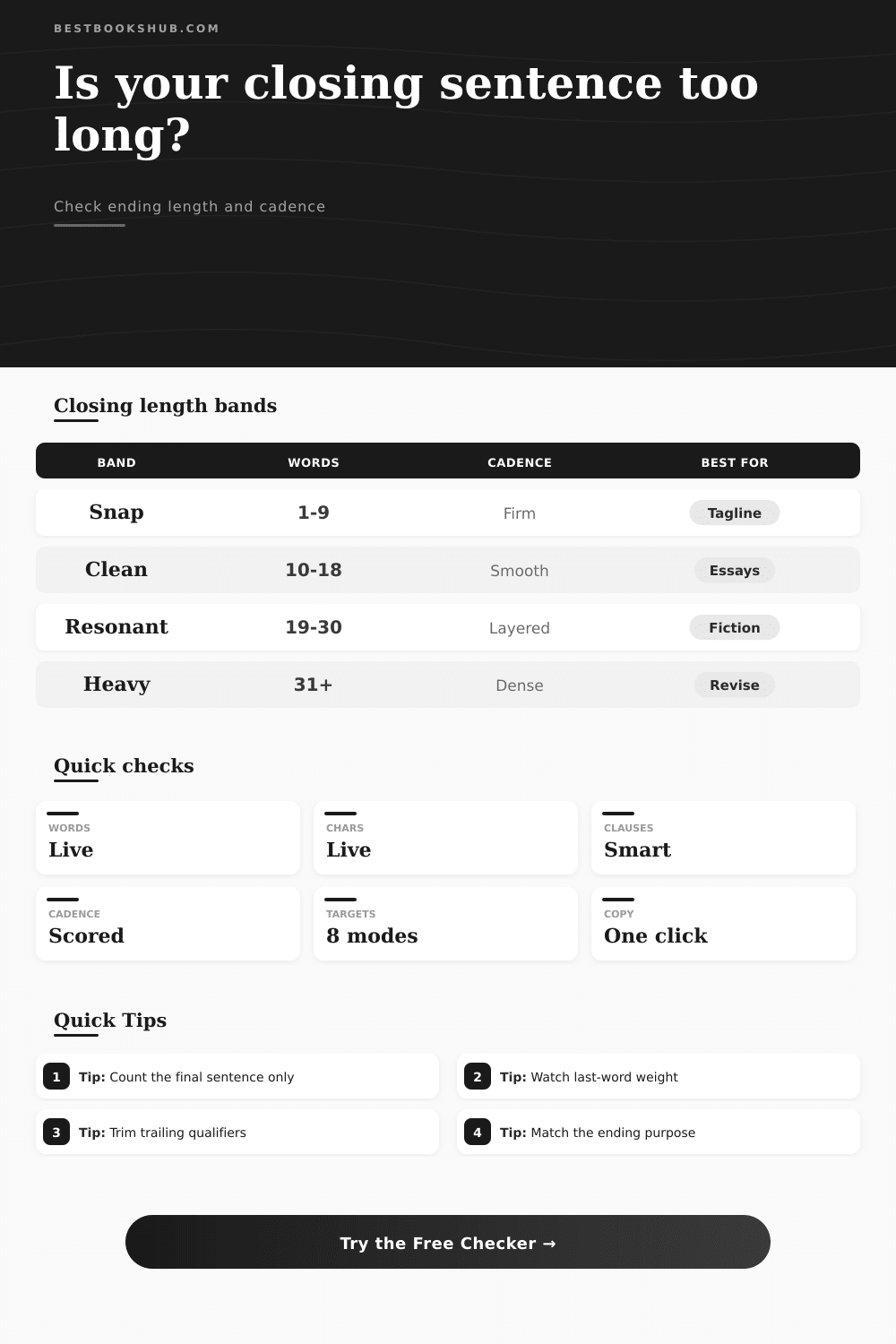
| Snap | 1-9 | Fast, final, memorable | The prior sentence carries context | Check it is not too thin |
| Clean | 10-18 | Readable and decisive | Most nonfiction and scene endings | Keep the strongest noun or verb last |
| Resonant | 19-30 | Slower, reflective, layered | Memoir, literary prose, academic close | Trim stacked modifiers first |
| Heavy | 31-44 | Dense but sometimes intentional | Complex argument or formal summary | Split if the last clause weakens |
| Overloaded | 45+ | Hard to land cleanly | Rarely, for deliberate breathlessness | Move context to the prior sentence |
| Final word type | Examples | Signal | Good use | Caution |
|---|---|---|---|---|
| Concrete noun | door, river, page | High weight | Scene image or remembered object | Do not force symbolism |
| Strong verb | stayed, opened, returned | Active finish | Motion, decision, consequence | Weak if buried after adverbs |
| Abstract noun | truth, freedom, change | Medium weight | Argument or reflective prose | May feel generic without image |
| Function word | it, them, there | Low weight | Dialogue or casual tone | Often softens final emphasis |
| Qualifier | perhaps, generally, somewhat | Weak tail | Careful academic claims | Can drain a decisive ending |
| Punctuation | Closing feel | Works well for | Risk | Checker cue |
|---|---|---|---|---|
| Period | Settled stop | Most closing lines | Can feel flat if sentence is generic | Score depends on word and clause load |
| Question mark | Open resonance | Essays, memoir, unresolved scenes | May dodge the conclusion | Purpose should be open question |
| Exclamation | High emphasis | Dialogue, humor, children's prose | Can sound forced | Penalty in formal contexts |
| Ellipsis | Trailing fade | Voice-heavy dialogue or suspense | Often weak in nonfiction | Flagged as soft landing |
| No mark | Unfinished | Notes or fragments | May be accidental | Flagged for completion review |
📝Practical revision cues
DISCLOSURE: This post may contain affiliate links, meaning when you click the links and make a purchase, I receive a commission. As an Amazon Associate I earn from qualifying purchases.
Because it’s the last thing a reader will remember, a sentence near end of a work is weighted more heavily then the sentences that came before it. It floats above text as we turn page, scroll down screen. In fact, writers spends hours obsessing over their last line, yet few take pains to judge it carefuly. When do you know an ending “works”? Chances are you just go with your gut. That’s fine… But it can be easily derailed by momentum of preceding passage.
Maybe you’ve written 10 pages leading up to this, and you just want thing to wrap up, so you give it a sprawling conclusion. But does it need to be that long? Does it serve the moment? Quantifying the last sentence helps to distinguish between what feels emotionally good and what work structurally. It looks at exit velocity of writing without context of surrounding paragraph.
How to Write a Strong Ending
So what’s the metric? It’s all about word count, but it’s about word count clustering at end of your text. Does it make a difference if you get a big burst of 12 words or 40 words? Yes. Yes it does. And calculator breaks them down into bands, ranging from a snap finish to a heavy, resonant close.
Why? Because every genre have its rhythm. You don’t want speed bump when you’re reading a thriller; you want stop sign. An academic article may require some scaffolding (a bridge to future research) and thus needs more than just an image at the close. Each type gets table of reference on page to show how fiction, essay, and query each work best in different ways.
Length isn’t everything; cadence matters too. You can have a short sentence that sounds clunky because of all its clauses and stutters your authority. Or you can have long one that flows well, because you’ve phrased it well. The checker will note when there’s been a pile-on of clause in a final line so that it feels overly structured.
Stacking three separate idea in one final period means the reader is probably not taking it in. They are scanning for end instead of enjoying getting there. Often, by trimming qualifiers or breaking up sentences, you find stronger, cleaner conclusion buried under extra words.
What about last word itself? That last word is period at end of reader’s mind. Generally speaking, stronger words carry more weight, such as concrete nouns like light, door, or river versus weak ones. These are weak function words or abstract concepts. Perhaps and generally sap energy from any previous argument. When you want conviction, they signal hesitation.
The tool looks at this last word and flags if it fades into vague territory. It’s a subtle cue, one easily overlooked in self-editing since you already know what you mean. The reader doesn’t have that luxury. All they’ve got is last word bouncing around in their head.
The acceptable word count depend on context as well. You can purposefully extend concluding sentence for a literary effect (e.g., to bring out the lingering quality of memory in a memoir). But such gravity crushes business email. With this tool, you specify your desired end context. You might be writing a blog takeaway, a literary novel, or an APA-style conclusion, and that adjusts parameters. It recognizes that not everything demand rigid brevity. Sometimes we need room for resonance.
The difference is that when something extends beyond the usual cut-off, additional words should of been emotionally rich rather than padded with filler phrases or unnecessary repetition. So: Many writers worry about being too short in their conclusions and end up saying same thing over again. This happens in every style of writing. It assumes the reader needs to be told again why they should care.
If the rest of your piece is good, then trust it. A powerful ending sentence make one last turn, offers an unexpected final image, or brings something new into play. When you run your draft against this test, you’ll know if you’re adding value. Or simply bulk.
These aren’t tests of idea quality (and don’t treat them like such). They’re a test of how well the structure support it. Do you want reader to finish your words on a soft note? A strong snap? Do you want both? Knowing what your options are allows you to make this decision comfortabley.
It makes end of sentence more than an afterthought; it becomes a conscious part of your writing. Measure it out and consider the rhythm. Let last word fall where you know it needs to be felt. Your audience will notice it even as they put book down.