📖 Closing paragraph lab
Last paragraph word count calculator
Paste a draft to isolate the final paragraph, count its words, compare it with closing-length targets, and check whether the ending feels rushed, balanced, or overextended.
Load original samples for essays, chapters, reviews, posts, abstracts, notes, and query endings.
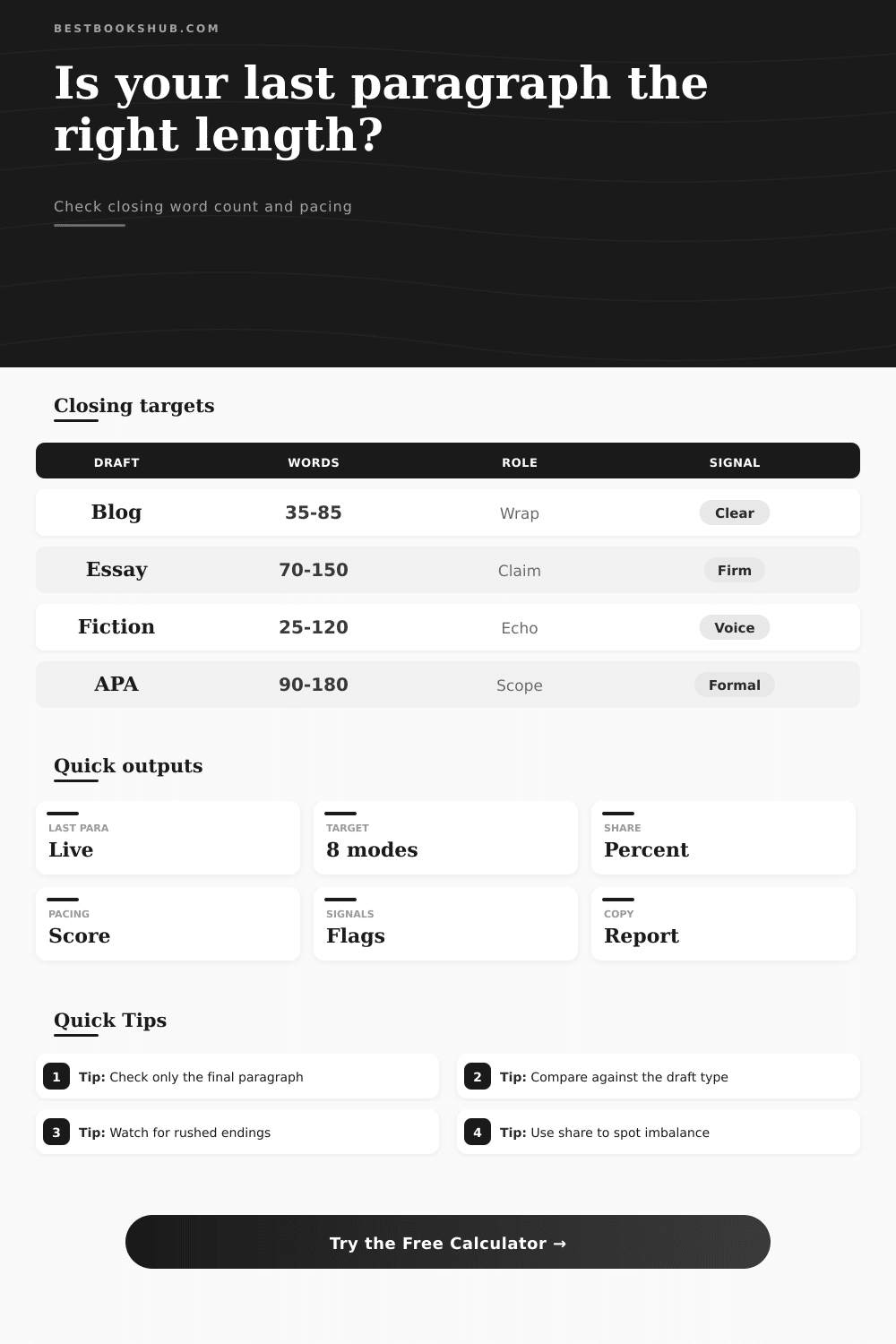
| Draft type | Last paragraph target | Common role | Watch signal |
|---|---|---|---|
| Blog post or article | 35-85 words | Wrap the point | Too much recap |
| Book review | 45-110 words | Final judgment | New claim added late |
| Fiction chapter | 25-120 words | Image, beat, turn | Explaining the scene |
| Essay conclusion | 70-150 words | Claim and implication | Restating every point |
| APA academic conclusion | 90-180 words | Implications and scope | Unsupported overreach |
| Newsletter signoff | 25-70 words | Action and closure | Buried instruction |
| Query letter close | 35-90 words | Bio, thanks, next step | Too much summary |
| Length result | Meaning | First edit | Risk if ignored |
|---|---|---|---|
| Below target | The ending may feel abrupt. | Add consequence or image. | Rushed close |
| In target | The length can support closure. | Check precision and sound. | Minor polish only |
| Above target | The close may be doing too much. | Move support earlier. | Heavy landing |
| High draft share | The ending dominates the draft. | Split recap from close. | Structural imbalance |
| Ending goal | Useful cues | Good pattern | Common problem |
|---|---|---|---|
| Summarize and close | therefore, finally | One main takeaway | Repeats the whole draft |
| Echo an image | same noun returns | Specific final image | Overexplains symbolism |
| Call to action | try, choose, review | One clear next step | Several weak asks |
| Formal implication | suggests, indicates | Scope plus limit | Claim is too broad |
| Metric | Formula | Useful when | Interpretation |
|---|---|---|---|
| Word count | tokens in final block | Checking length | Main sizing measure |
| Draft share | last words / total words | Testing balance | High share feels heavy |
| Sentence load | words / sentences | Checking pacing | High load feels dense |
| Closing score | fit minus penalties | Revision triage | Higher means cleaner |
DISCLOSURE: This post may contain affiliate links, meaning when you click the links and make a purchase, I receive a commission. As an Amazon Associate I earn from qualifying purchases.
Every sentence feels like lead in your mouth, and you sit there staring at the flashing cursor. Most writers trip up at the end. That’s when readers makes their final judgment about what they’ve read, but that is exacty where many writer hurry past just to click “publish” and move on. In truth, the last paragraph isn’t just a goodbye gesture: It’s the door you close (or keep open) for your readers.
Length matter. A concluding paragraph that are too long may weaken your main argument by dragging on. However, a very short one risks seeming sudden and dismissive. Here’s what the calculator above calculates. It highlights that last chunk of text and shows whether or not it match what we’d expect to see in terms of a conclusion to your particular format.
How to Write a Good Ending
Why? Because the tool isn’t just counting words, it’s assessing the pace. A strong wrap-up typically fall somewhere between thirty-five and eighty-five words. Why this range? Readers on the web has limited attention when they get down to the bottom of the page. We want them to recieve the takeaway clearly, without having to wade through restating the same point over and over again. Anything beyond that could mean you’re summarizing rather than wrapping up, which waters down the power of your headline.
But it’s totally different than academic writing. As the reference table at the top of the page indicates, in an APA-style paper, there is usually between ninety and one hundred and eighty words devoted to the final section. In academic writing, you need to be able to carefully qualify your claims, talk about limitations, and suggest areas of further research. You cannot just retweet an image and expect readers follow along without some context about what exactly was found.
Often, writers rushes through the end of their piece, running out of time while failing to fully explain their results. If you notice this happening in your own academic writing, the tool will help you realize how it sound.
Mood, not rigid logic, is what fiction run on. Sometimes a visually striking or emotion-packed twenty-five-word paragraph ends a chapter. Memoir and other creative nonfiction require an emotionally resonant close, but one that doesn’t sound like a command performance.
The percentage of the concluding paragraph compared to the entire draft is another helpful gauge of overall structure. If your final paragraph contains fifteen percent of all words in the essay, something is wrong. This is a problem. Chances are you’re cramming explanatory information and/or intro stuff into the conclusion where it doesn’t fit. When the ratio isn’t right, it is telling you to move this elsewhere in the story and let the conclusion actualy land.
This also has a lot to do with how dense your sentences is. Four clean sentences containing a hundred words will seem deliberate and spacious; two complex paragraphs with the same amount of words can seems dense and confusing. To help you catch this problem before it’s a reader frustration, the tool tracks average sentence length. Adding more words doesn’t always make an argument stronger (often it only makes it harder to follow). Precision, not volume, is the goal. You want the final impression to linger, not overwhelm.
In the end writing is a matter of expectation management. You promise something at the beginning and fulfill that promise in the end. You pose a question and give an answer. You tell a story and return to it. But don’t overstay your welcome. A good ending leaves it up to the reader to connect the dots. It gives them just enough structure to take that leap without going too far.
Next time you’re in a bind, use these as benchmarks to see whether you think you’ve landed or are still flapping around on the tarmac. When they match your intention, more often than not the words will follow suit. The secret is knowing what it is you’re measuring, which lets you trust your own work rather than having to guess its shape, you should of checked earlier.