📝 Editorial punctuation tool
Oxford comma frequency counter
Paste prose, notes, jacket copy, or manuscript text to count serial commas, likely missing Oxford commas, plain pairs, and style consistency.
| # | Status | Joiner | Items | Context |
|---|---|---|---|---|
| No list candidates yet. | ||||
| Pattern | Example shape | Counter label | Review note |
|---|---|---|---|
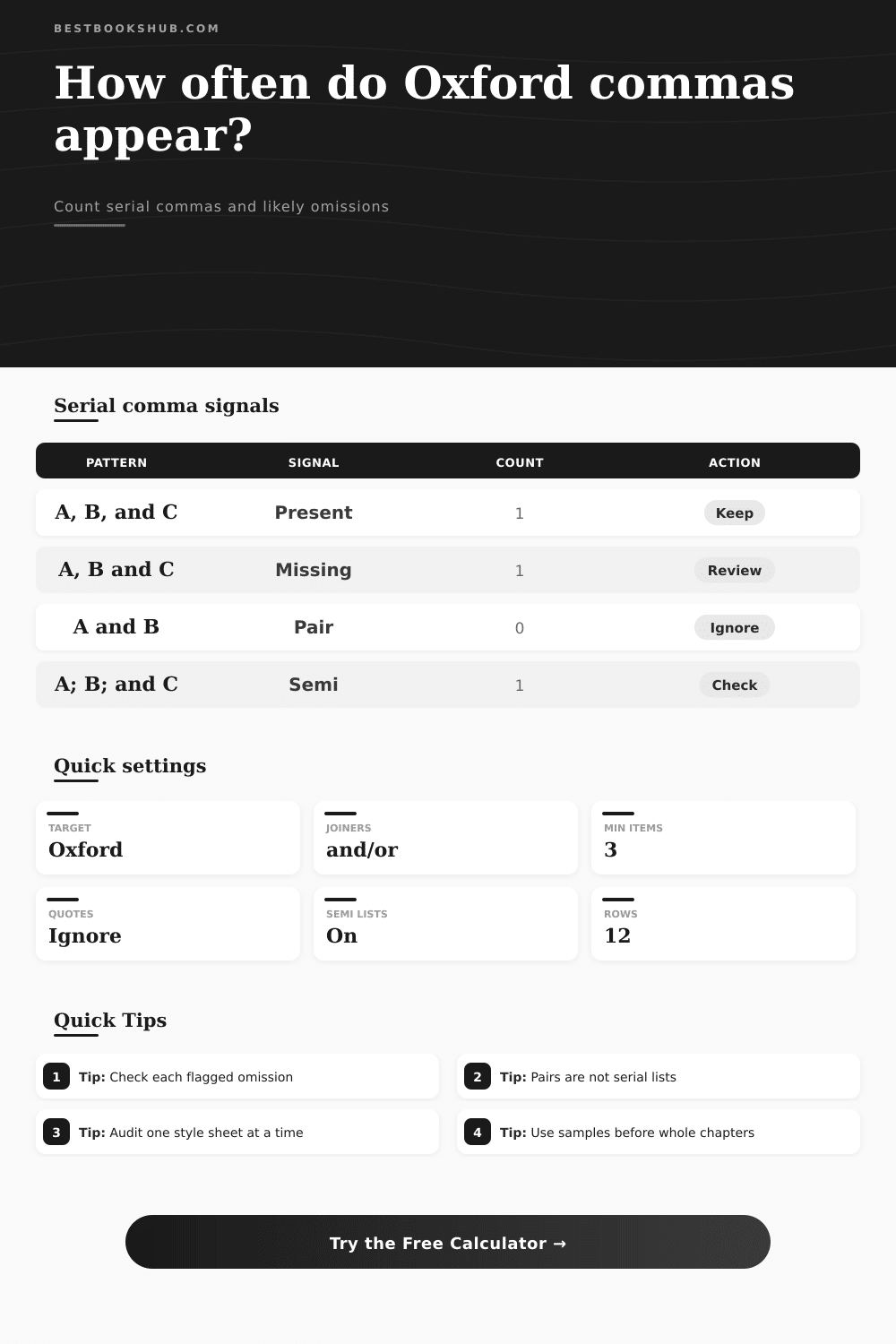
| Oxford comma | A, B, and C | Present | Matches serial-comma style |
| Likely omission | A, B and C | Missing | Review if style requires it |
| Plain pair | A and B | Pair | Not a serial list |
| Semicolon list | A; B; and C | Semi | Useful for complex items |
| Style target | Present counts as | Missing counts as | Best audit use |
|---|---|---|---|
| Oxford expected | Match | Review | Chicago-like copyedits |
| Usually omitted | Review | Match | House styles without it |
| Measure only | Signal | Signal | Mixed source checks |
| Semicolon mode | Separate | Separate | Complex list screening |
| Source profile | Likely list type | Common issue | Counter setting |
|---|---|---|---|
| Manuscript prose | Sentence lists | Mixed usage | Sentences |
| Academic note | Dense clauses | Nested phrases | Include quotes |
| Catalog metadata | Short fields | False pairs | Line by line |
| Jacket copy | Promotional lists | Rhythm edits | Measure only |
| Detection signal | Strong when | Weak when | Editor action |
|---|---|---|---|
| Comma before joiner | Earlier comma exists | Appositive nearby | Confirm list items |
| No comma before joiner | Earlier comma exists | Name pair appears | Review omission |
| Semicolon before joiner | Items have commas | Sentence boundary | Check structure |
| Repeated joiners | List is long | Parallel pairs | Read context |
DISCLOSURE: This post may contain affiliate links, meaning when you click the links and make a purchase, I receive a commission. As an Amazon Associate I earn from qualifying purchases.
It’s called the Oxford comma, and it makes editors anxious: it’s the comma placed before the last item in a list with three or more thing. It clears up ambiguity in sentences that would otherwise be confusing. It is like whether you invited your parents over for dinner or a stripper. (Usually not so literal.) But even if you’re just using inconsistent commas, it annoy us.
This will help you spot the trend without having to squint at each line. This is one of those commas that most writer have an opinion about. Some say use it for clarity; some say leave it off unless you think it will cause confusion.
Why Consistency with the Oxford Comma Matters
In both instances, the issue isn’t so much the decision but the combination of styles in a single document. Chances are you have multiple list throughout your report or manuscript. One list has the comma, another doesn’t. Maybe you didn’t even catch the change until someone pointed it out to you.
As long as you stick with a style and stay consistent, that is what matters, consistency is more important then whatever style guide you are using.
Here’s how the calculator works: When you paste some text into the calculator, it will look for the patterns above. Specifically, it will scan for any of the conjunctions, and, or, nor, and see what comes before those words. If there is a comma, that will be treated as an Oxford hit. If not, and if the rest of the sentence looks like a list, it will flag it as a potential omission.
The system allows you to customize according to your own work style. For example, you could tell it to ignore all quoted text. That makes sense; you shouldn’t edit punctuation inside a direct quote unless it is an error in the original source. Similarly, you might indicate how many elements there must be in a series before it gets flagged. Tell it “three” and it won’t worry about simple two-item lists such as A and B. Such lists never need a serial comma.
Why? Because not all lists is made alike. A long, complex list with commas within it will benefit from the Oxford comma greatly. It clearly divides up the components on that list. A list of brief words, however, may not require any comma at all.
Where it shows up most effectively is when it tells you how clunky your writing has become. Does a section of your writing have lots of semicolons? Lots of flagging for omission? Maybe throw in some commas so that it’s more readable. Do you find yourself writing light and airy stuff? Then don’t bother. You want to know the feel of your own writing. It is not about passing the test. To know how to make it work.
Maybe you’re finding that your marketing copy is rigidly consistent but your academic notes are full of omissions. That’s OK. Just make sure you’re doing this intentionaly. Different types of sources behave differently (see the table on the page). For instance, jacket copy tends to be more rhythmic, more deliberate. Catalog records may be sparse and may not even trigger the detector. Understanding your source material will help you interpret the results. Rough drafts has a higher expected number of missing commas than a final proof.
It is a filter, not an editor. That’s the point. A filter doesn’t know what you mean. A filter recognizes patterns. Sometimes it may mark something like Bill and Ted as a list (when it shouldn’t be). Or sometimes it won’t catch that one line that appears to be part of a list but isn’t. The context will tell you. Run it through the filter so it shows you who the suspects are, and then with your eyes you’ll be able to do the arrests. It makes it easier so you don’t have to look at each line individually. It lets you see the inconsistencies more quicky because it has already aggregated them for you.
The Oxford comma is ultimately a matter of voice and clarity. Careful writers is consistent with its use. Those in a hurry are consistent with its absence. Those who do both are in trouble. Choose whether you love or loathe the comma, but choose one side and stick to it: Your writing will seem more polished as a result. It will signal to the reader that they can trust your sentence structure. Paste on in, flag away, and ask yourself: Is my style hanging together? Clean up the mess and you’ll find your prose feels cleaner, sharper, and far more intentionaly.