📝 Punctuation clarity tool
Comma density calculator
Paste a paragraph, book note, review, abstract, or manuscript sample to measure comma rate, sentence load, clause stacking, and reader pacing pressure.
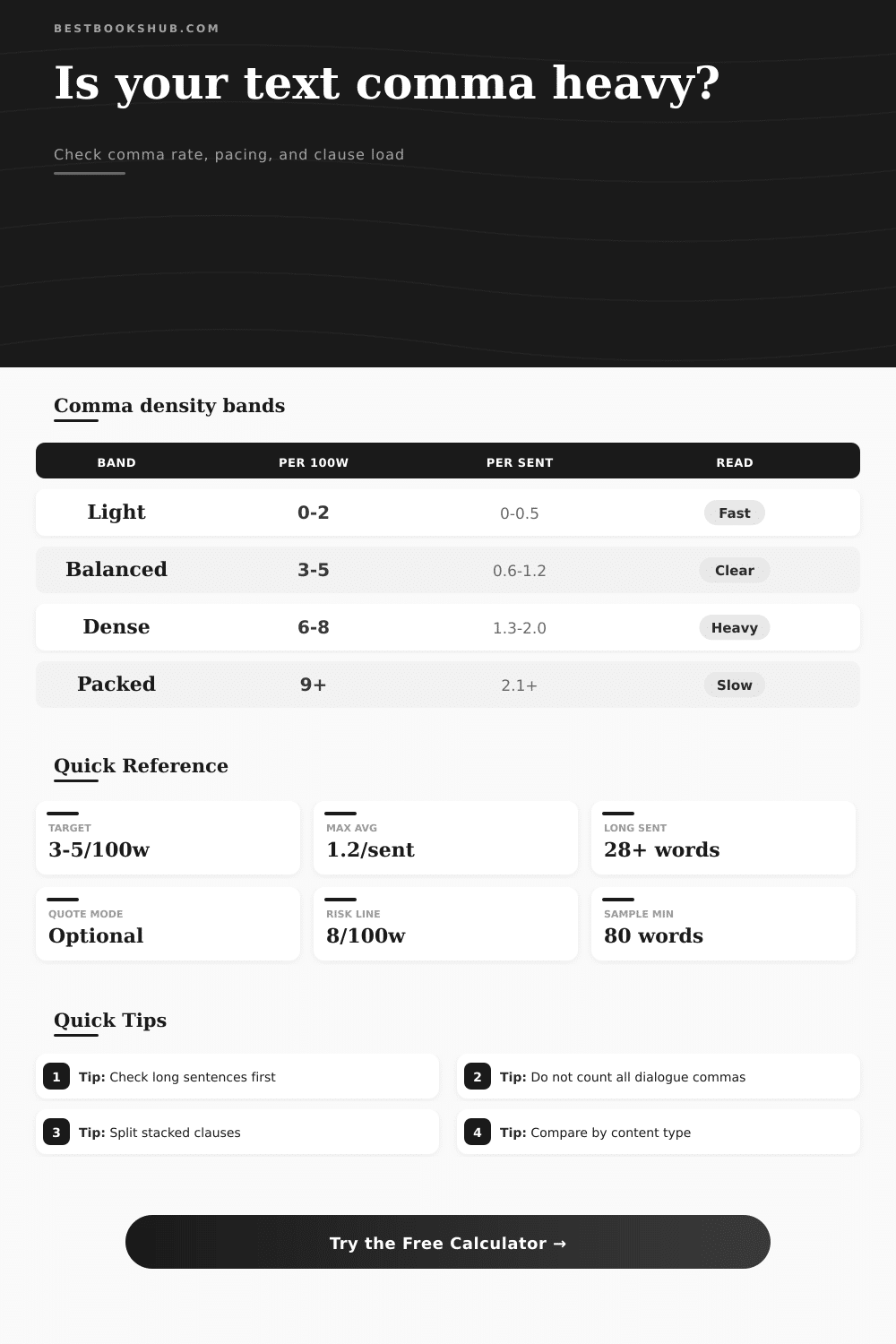
| Density band | Commas per 100 words | Typical effect | Common revision cue |
|---|---|---|---|
| Very light | 0-1.9 | Fast, plain, clipped | Check for abrupt rhythm |
| Balanced | 2.0-5.0 | Clear explanatory flow | Keep sentence variety |
| Layered | 5.1-8.0 | More qualification and aside work | Split long modifiers |
| Heavy | 8.1-12.0 | Dense or breathless pacing | Cut stacked clauses |
| Packed | 12.1+ | Hard to scan quickly | Rewrite sentence groups |
| Writing type | Useful target | Higher density may fit when | Lower density may fit when |
|---|---|---|---|
| Fiction narration | 2-5 per 100 words | The voice is reflective or descriptive | The scene needs speed or impact |
| Dialogue | 1-4 per 100 words | Speech has interruptions or address | Lines should sound brisk |
| Book review | 3-6 per 100 words | The sentence compares several claims | The review needs a sharper verdict |
| Academic prose | 5-9 per 100 words | Definitions and qualifications matter | The argument feels buried |
| Catalog copy | 1-4 per 100 words | One sentence lists format details | Readers need quick browsing cues |
| Comma pattern | What it may signal | Count clue | Editing move |
|---|---|---|---|
| Introductory phrase | Setup before the main clause | Often one comma | Keep if it prevents misreading |
| Nonessential aside | Interrupting detail or apposition | Often comma pair | Remove aside or use parentheses |
| Compound sentence | Two independent clauses joined | Comma before conjunction | Split if both clauses are long |
| Series | Three or more parallel items | Two or more commas | Check serial comma preference |
| Dialogue tag | Speaker tag before or after quote | Inside or near quote marks | Judge separately from narration |
| Sample size | Best use | Reliability | How to read the result |
|---|---|---|---|
| Under 80 words | Single sentence check | Low | Use as a quick warning only |
| 80-200 words | Paragraph check | Medium | Compare with sentence-level flags |
| 200-600 words | Scene, review, or section | High | Trust density bands more |
| 600+ words | Chapter excerpt or article | High | Check uneven sections separately |
Lean copy
Short sentences, few asides, and low comma counts help browsing text move quickly.
Balanced prose
DISCLOSURE: This post may contain affiliate links, meaning when you click the links and make a purchase, I receive a commission. As an Amazon Associate I earn from qualifying purchases.
Moderate comma use supports examples, transitions, and clear comparisons without drag.
Layered analysis
Higher comma density can fit close reading, criticism, and carefully qualified claims.
Stacked clauses
Repeated commas inside long sentences can bury the main point and slow rereading.
Commas are little punctuation marks, right? They’re just like traffic signal telling the reader when to stop and go while reading.
Too many comma will cause the reader’s brain to stall out on each intersection, he has to stop and start his internal engine again. Not enough commas mean he runs into a brick wall of words without any opportunity to catch his breath.
Why You Need a Punctuation Calculator
The great thing about punctuation is that most writers has a good feel for how much to use (based off how they hear it). So you say the sentence out loud and you know if it sounds okay, right?
Well, this approach generaly works well with shorter sentences (and paragraphs), but what happens when you’re reviewing a long academic abstract or even just a whole chapter? In those cases, your ear fall apart. Use this punctuation calculator instead. It takes away all the guesswork.
What does it do? Well, it counts the number of commas and divides it by total word count. Then it compares that number to standard readability bands. The result is a quick peek into whether your piece is dangerously heavy with punctuation, or whether it’s lean and balanced.
Why? Because we humans are awful at detecting patterns in our own writing. We tend to normalize our own clutter. Besides learning to read the final score, it’s also essential to understand what went into it. With this tool, you can customize its input to account for dates, numbers, dialogue, etc.
Why? A series of date (e.g., 1990, 1995, 2000) contains many commas that may slow down your reading speed, but they slow you down less then a complicated dependent clause would. You might also want to turn off the commas within quoted material if you’re analyzing a fiction manuscript. Those commas aren’t part of the story structure; they’re part of the rhythm of someone speaking. Taking those out allows you to see exactly how much work the actual narration is for the mind. Leaving them in falsely inflates your score, making it appear as though there’s a problem when there isn’t.
This is where the revision flags becomes useful again. By pulling up the sentence with the flag, you can see exactly what sentence is causing the most trouble, as well as which ones might be contributing slightly. It’s often just one or two long sentences with multiple clause.
Then there’s the question of the overall rhythm of the text. The output provides a density band and tells you how the text come out: light, balanced, dense, packed. It all comes back to the text moving at a pace that is appropriate for the message.
If it’s an ad or marketing copy, then a light band works really well. But if you’re making a detailed argument, the dense and packed bands risk losing your readers. When the text are balanced, you get clear explanations that don’t tire readers.
And then there’s that sentence load metric. It adds up commas for you in each sentence. Is your average more than one point two? Then probably you’re writing to many complex sentences. People misunderstands this. Because they think the problem is using so many comma, right? But really the problem is you’ve packed too many ideas into one line. Usually splitting them into their own sentence will solve it right away. Your clarity goes up; the density comes down. And the person reading no longer feels as if he or she is wading through mud.
But the figures has to be taken in context. Fiction is going to be lighter than academic writing. Academic writing must naturaly include details like limitations, exceptions, and exact definitions. And a review requires a cutting verdict; it doesn’t require a maze of asides. The reference table on the page explains all of that, including what kind of density is appropriate in each genre.
Don’t strive for a gold star at the expense of your voice. Make certain that the pauses you’re creating serve the meaning, rather than obscure it. Control is what editing is all about: Control over how fast or slow the reader want to read. Where the action is fast, you want the reader to speed up; where the details matter, you want them to slow down. This is where commas can be your tool to achieve this control.
And when I say there’s a high density score, that’s not necessarily an indication that writing is bad. That’s an indication that somebody is doing a lot of hard work here. Is it necessary? Look at the lifts and check whether the reader needs to do too much work just to understand the sentence structure. Split the stacks, trim the fat, let the ideas breathe. Your readers will thank you for clearing their way through the text.