— Punctuation rhythm tool
Dash frequency calculator
Paste prose, book notes, editorial copy, or metadata to measure dash frequency by type, range usage, interruption load, and cluster pressure.
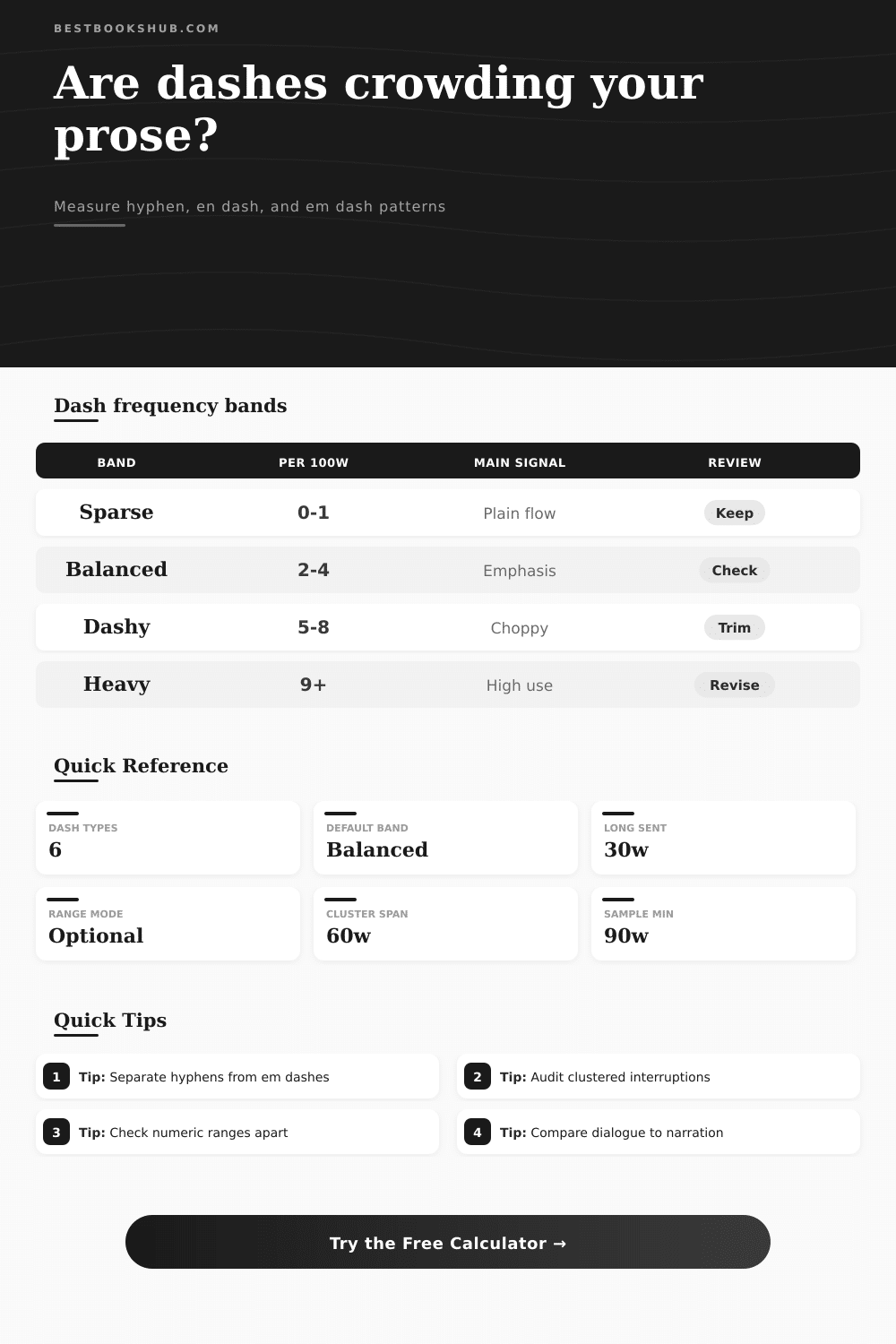
| Band | Scored dashes per 100 words | Reader signal | Typical passage | Review action |
|---|---|---|---|---|
| Sparse | 0 to 1.9 | Direct sentence flow | Plain exposition, short notes, simple blurbs | Keep unless the passage needs stronger emphasis. |
| Balanced | 2.0 to 4.4 | Natural aside or range use | Reviews, jacket copy, lesson notes | Check only clustered sentences. |
| Dashy | 4.5 to 8.4 | Interrupted or heavily qualified rhythm | Expressive narration, close reading, dialogue | Trim repeated asides and replace some marks with commas or parentheses. |
| Heavy | 8.5 or more | Dominant dash style | Drafts with frequent breaks, ranges, or compound terms | Separate range dashes from prose interruptions before revising. |
| Dash type | Code point | Common role | When to inspect | Calculator handling |
|---|---|---|---|---|
| Hyphen-minus | U+002D | Compounds, breaks, plain-text ranges | When it mixes words, page spans, and interruption marks | Classifies compounds and numeric ranges separately. |
| En dash | U+2013 | Page ranges, date ranges, relationships | When technical ranges inflate style density | Can be counted, tracked, ignored, or scored alone. |
| Em dash | U+2014 | Interruptions, asides, abrupt turns | When many sentences contain side comments | Feeds interruption load and style pressure. |
| Minus sign | U+2212 | Mathematical negative values | When formulas sit inside prose samples | Available as its own scoring family. |
| Figure dash | U+2012 | Numbers in aligned text | When copied tables enter the passage | Tracked in the dash inventory. |
| Non-breaking hyphen | U+2011 | Protected compounds | When pasted text has invisible layout decisions | Counted as a protected hyphen signal. |
| Text type | Normal dash use | Likely false signal | Better setting | What to compare |
|---|---|---|---|---|
| Book review | Occasional emphasis and contrast | Publisher subtitles with hyphens | Balanced density, count compounds | Intro versus critique section |
| Fiction dialogue | Interruption, hesitation, broken speech | Quoted speech over-counting | Soften quoted dashes | Dialogue versus narration |
| Bibliography | Page ranges and date spans | Range dashes masquerading as prose rhythm | Track or ignore numeric ranges | Range count versus em dash count |
| Academic prose | Ranges, compound modifiers, parenthetical asides | Technical terms with hyphens | Separate compound hyphens | Argument sentences versus citations |
| Marketing copy | Tagline interruption and feature phrases | Product names with hyphens | Lean or balanced target | Headline, subtitle, and body copy |
| Result | Formula | Low reading | High reading | Revision clue |
|---|---|---|---|---|
| Dash density | Scored marks / words x 100 | Clean flow | Dash-led rhythm | Look for repeated interruptions. |
| Dash mix | Dominant type share | Consistent typography | Mixed punctuation families | Standardize hyphen, en dash, and em dash roles. |
| Interruption load | Sentences with em dash or spaced hyphen / sentence count | Few asides | Frequent breaks | Rewrite stacked clauses as separate sentences. |
| Review band | Density plus clusters, ranges, quotes, and long-sentence pressure | Low effort pass | Focused edit pass | Start with the highest dash cluster. |
Hyphenated modifiers
Compound-word hyphens usually help readers parse phrases. A high compound count is not automatically a prose rhythm problem.
Numeric ranges
DISCLOSURE: This post may contain affiliate links, meaning when you click the links and make a purchase, I receive a commission. As an Amazon Associate I earn from qualifying purchases.
Page spans, dates, and verse ranges can inflate dash totals. Track them apart when auditing notes or bibliographies.
Em dash interruptions
Interruption dashes change sentence movement. Several in one paragraph can make confident prose feel breathless.
Mixed typography
Hyphen-minus, en dash, and em dash marks can look similar in pasted text. The inventory exposes inconsistent sources.
Panic descends when you’re done writing up a long piece or a chapter. Ready for victory, you sit down…then you read it, and see pattern you didn’t mean to create. Your prose are choppy. The sentence rhythm doesn’t feel right. Something isn’t quite right, and yet you can’t quite put your finger on it.
What’s wrong? Dashes. It is like a sudden, unplanned marriage: you’ve used hyphenation, en dashes, and em dashes as punctuation devices in your writing, but never measured out the amount you’ve employed. So what happens most of the time? The piece read either too plain or far more interruptive.
How to Use This Dash Counter Tool
You then copy-and-paste your text into box above and, presto! The calculator do all the work for you instead of making you slowly count every kind of dash as a percentage of your total word count.
The important thing to note isn’t the total number of dashes, but what they’re doing in the sentence. Hyphens between words in a compound adjective has a syntactic purpose; they joins words. Em dashes interrupt thoughts to create a rhythm by breaking them up. Mixing the two purposes in same analysis, without accounting for them, produces nothing but noise. By sorting out the interruption marks from the hyphenation linking a compound word, the tool make that possible.
And this is key: the fact that you have lots of hyphenated term doesn’t necessarily mean choppy writing. It just means you’re writing about technical topics.
How frequent your dashes are depends on context, which is either a bug or a feature. Fiction dialogue can expects interruptions; characters pause and interrupt one another mid-sentence. A high em dash rate in dialogue can be mark of authentic voice instead of bad editing.
To help you benchmark yourself relative to genre norms, the page offers a reference table that classifies dash rates into bands from sparse to heavy. By comparison, other genres benefits from leaner punctuation: academic prose or technical documentation.
Data tables or bibliographies with ranges will inflate your rate unless you instruct the tool to treat those different than running text. False alarms result from ignoring this difference, and you may conclude that you write erratically when what you’ve really done is paste a bibliography with lots of page range.
Of all the features, the cluster window is probably most valuable one for identifying poor writing habits. Bad writers don’t distribute their dashes evenly; they tend to cluster them together. Maybe there are five em dashes in a row in one paragraph giving it a rushed, breathless quality that wears the reader down.
Rather than just taking an average across the entire document, the calculator instead looks for local highs, for those areas where there’s a spike. That’s how humans reads as well: we get the flow in quick bursts. When you’re on a page and something jars, the average won’t capture that issue.
Where do you want to be relieved? You want to know where the pressure points are so you can release some. Dashes are like music’s rest or accent. A few can add flavor; too many make the melody sound stuck.
It’s mainly a matter of knowing what you’re realy measuring, and then asking yourself: Is this showy? Or is it a bit of structural glue? If your review band flags that your text is heavy, consider the load of interruptions. Are those dashes adding clarity, or merely masking weak sentence structure? Sometimes a dash is a placeholder for a word you couldn’t thought of. Swapping out an em dash for a period, a colon, or a comma might clarify your own logic.
Editing is a lot of subtraction. Write freely to get those ideas out of you; then edit to make it legible. That includes checking whether you use too many dashes, and this is where the number comes in: a kind of quantitative check on a qualitative problem.
It doesn’t mean striving for no dashes at all, or striving for anything at all except intentional ones. If each one deserves its spot, it doesn’t matter how many. But if it’s building up from habit, it’ll tell you long before your reader will.
You should of trim there first, starting with the biggest cluster of dashes. Then read it aloud, since your ear will let you know when it is flowing again.