§ Citation symbol analyzer
Section sign frequency calculator
Paste legal text, editorial notes, manuscript references, policy drafts, or index entries to measure section sign density, double-section groups, spelled references, and context consistency.
| # | Type | Before | After | Context |
|---|---|---|---|---|
| Context rows appear after calculation. | ||||
| Band | Symbols per 1,000 words | Typical text | What to inspect |
|---|---|---|---|
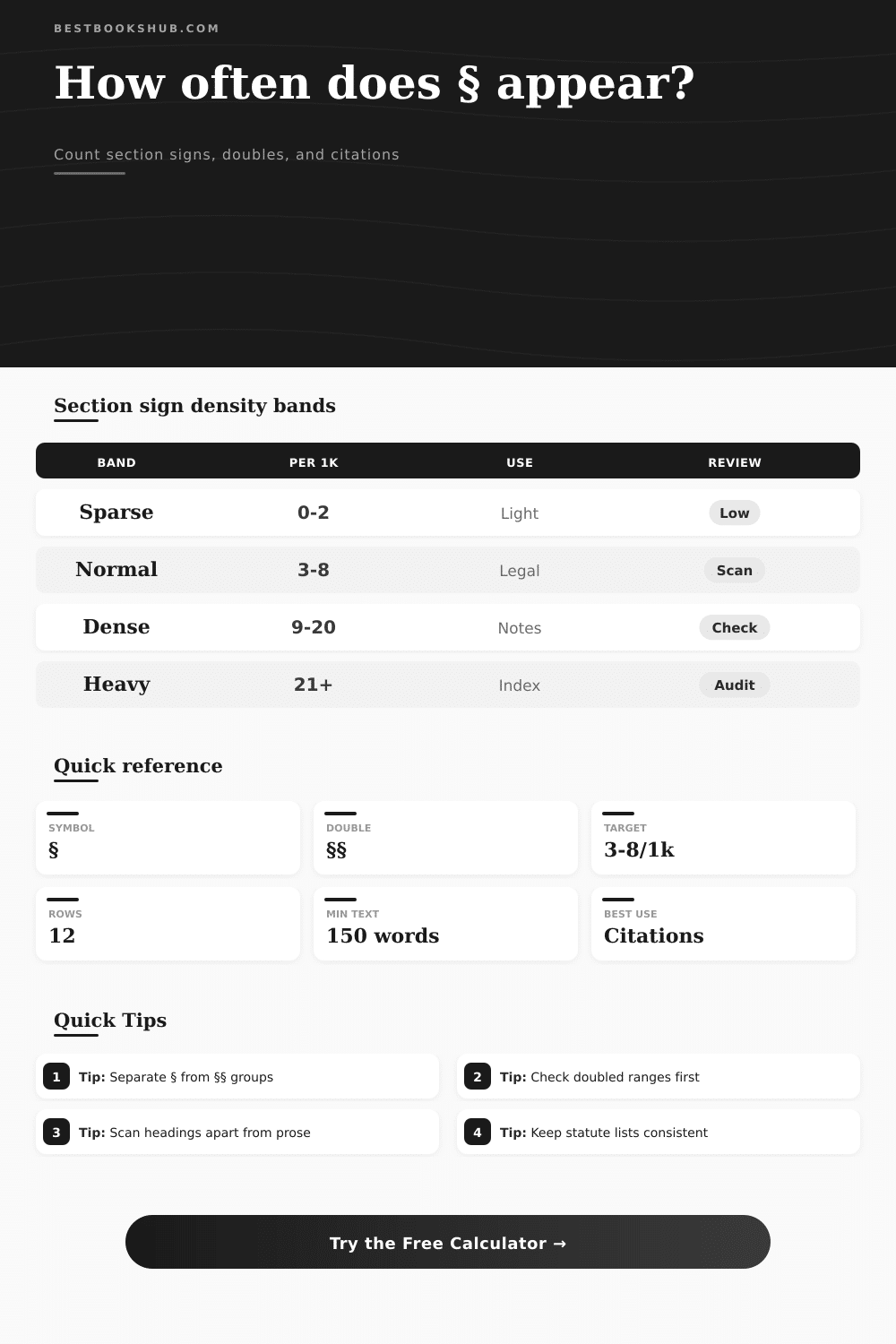
| Sparse | 0 to 2 | General prose, narrative notes, summaries | Confirm that citations are not under-marked compared with the style sheet. |
| Normal legal | 3 to 8 | Memos, commentary, explanatory policy text | Check whether single symbols and spelled references follow one convention. |
| Dense reference | 9 to 20 | Footnotes, legal analysis, syllabus citations | Review clustered paragraphs and repeated statute references. |
| Index or table | 21 or more | Indexes, finding aids, statute tables, appendices | Scan sorted rows, duplicate ranges, and double-section consistency. |
| Pattern | Example shape | Count treatment | Best use |
|---|---|---|---|
| Single section sign | § 12 | One mark, one group | One statute, rule, or clause reference. |
| Double section sign | §§ 12-14 | Two marks, one group | Ranges or multiple sections under one citation. |
| Spelled section | section 12 | Optional scored reference | Running prose where symbols would feel abrupt. |
| Stacked list | Line after line | Cluster risk flag | Indexes, footnote blocks, and tables of authorities. |
| Mixed citation | § 12 and section 13 | Convention warning | Manuscripts switching between formal and prose style. |
| Document sample | Typical length | Expected range | Watch point |
|---|---|---|---|
| Short legal memo | 800 to 1,500 words | 2 to 12 symbols | Repeated citation lead-ins can crowd early paragraphs. |
| Course reading note | 1,200 to 2,500 words | 3 to 20 symbols | Compare syllabus references against footnote references. |
| Policy chapter | 3,000 to 6,000 words | 12 to 48 symbols | Long chapters need consistent clause and section style. |
| Index page | 300 to 900 words | 15 to 80 symbols | Dense rows should keep the same range punctuation. |
| Footnote block | 400 to 1,200 words | 10 to 50 symbols | Double signs and section words should not alternate randomly. |
Legal memo
Usually favors formal symbols for pinpoint references, with prose explanation between citations. Density should rise only where analysis needs repeated statutory anchors.
Academic note
DISCLOSURE: This post may contain affiliate links, meaning when you click the links and make a purchase, I receive a commission. As an Amazon Associate I earn from qualifying purchases.
Often mixes footnotes, course references, and spelled section wording. A medium density score is normal when references support argument structure.
Index page
High symbol density can be acceptable because entries are compressed. The main check is consistency across rows, ranges, and repeated headings.
Editorial draft
Mixed symbols and spelled references may signal unresolved style choices. Review clusters before changing all marks across the manuscript.
When you need to refer specifically to a portion of some law, there is thing called a section sign. It looks kind of like a stretched out eight or a curled-up spring.
For most of us, it is nothing. Students, lawyers, and legal writers/editors considers the section sign to be something you punctuate with; it’s a sort of punctuation in its own right. If you’re drafting a memo or editing a syllabus, the manner in which you use these characters conveys a great deal about how you write. Use too many, and it’s cluttered; use too few, and it reads loosey-goosey. It’s mostly a question of knowing what you’re counting.
How to Use the Section Sign
After plugging in your text, the calculator does all math for you; no need to worry about converting between coefficients anymore. Beyond counting symbols, it takes into account the grouping of those symbols. For example, a single section sign pointing to a specific statute differs from a double sign indicating a range of sections. The tool breaks them out so that you know whether your density stems from heavy citing rather than sloppiness in formatting.
Look at the context rows it produces as well; they will show you precisely where the signs occur within your sentence, which helps you identify clusters that could overwhelm the reader.
For many writers, there’s an anxiety around how frequently they should use a particular word, measured by the number of times it appears per thousand words. But this usually isn’t what matters. What matters is whether their usage are consistently within some reasonable range. Is 3 occurrences of the section sign (§) per thousand words excessive? That same density would feel aggressive. But when you’re writing a legal memo, where every argument must be anchored in the text of the statute, then a moderate density of section signs are normal and appropriate.
To help establish a baseline like this, the tool allows you to select a target band for your document type. This way, you can understand whether your draft is unusually dense (or sparse) relative to other documents in that category.
You can spell out words with symbols. This is another easy one to get wrong. Sometimes you’ll see people write §12 followed by section twelve on the next line. That’s inconsistent and throws off the reader. Your writing appears unfinished. The calculator will let you know about this because it keeps track of both types of spelled references. Pick one and go with it. For example, you can use the symbol for formal citations; it’s fine when you’re citing something formally. But for running prose, spell out the word (though again, mixing them in the same sentence normaly just looks bad). Small things matter, but they also add up to make your piece more polished in the end.
Where do my references come from? Consider the places they appear on a page. Footnote pages and index pages should be densely packed; indeed, they’re intended to be packed! But in the main body of a paper, every section sign break the flow. That means each section sign needs to earn its place. The tool highlights these dense paragraphs (where it finds many citations). So look at those clusters. Can you group them together? You could move some out to footnotes. Maybe! That’ll clear things up in the main text but still preserve the evidence.
And that’s where the audit is most valuable. You don’t care about getting a perfect grade. But you want to make your argument stand out enough that the citations fade into the background.
When you run it through the calculator, it breaks down how many groups of doubles vs singles you have. And it will tell you how much of your text is made up of references, giving you a sense of how you draft. Maybe you’re over-citing in the intro? Or maybe you’re under-citing in your analysis? Once you know that, then you can change things.
Section signs are little distractors. They draw the reader’s attention away from the sentence. By controlling where they go and how often, you ensure that the reader remains focused on what you want him or her to read. With the tool, you get the information to know whether something feels over-weighty or not; it turns a vague feeling about style into concrete numbers instead of making you guess. You just look at the numbers and say: there, there are some rough places, let me even them out. That turns a general sense of style into a specific plan of attack.
Use the section sign as a precision tool. Use it sparingly. Don’t call attention to it, but let it guide the reader along by making the sections count. Remember… Use it for clarity, not complexity. Well-placed, consistent references supports your efforts without cluttering them. When you do that, you’re a good writer. Now go get some data to work for you.