⏱ Tense and sentence analysis
Past tense sentence counter
Paste prose, dialogue, notes, or manuscript text to estimate how many sentences are written in past tense and which verb cues drive the count.
Each preset loads a different sentence style so you can test regular past verbs, irregular verbs, past perfect, dialogue, and mixed tense shifts.
DISCLOSURE: This post may contain affiliate links, meaning when you click the links and make a purchase, I receive a commission. As an Amazon Associate I earn from qualifying purchases.
The counter uses sentence boundaries plus verb-surface cues. It is meant for editing and drafting checks, so ambiguous modals and adjectives are shown as review signals.
Rows are sorted by strongest past-tense signal first. Review low-confidence rows when a word can be either a verb or an adjective.
| # | Status | Cues | Score | Sentence |
|---|---|---|---|---|
| No sentences analyzed yet. | ||||
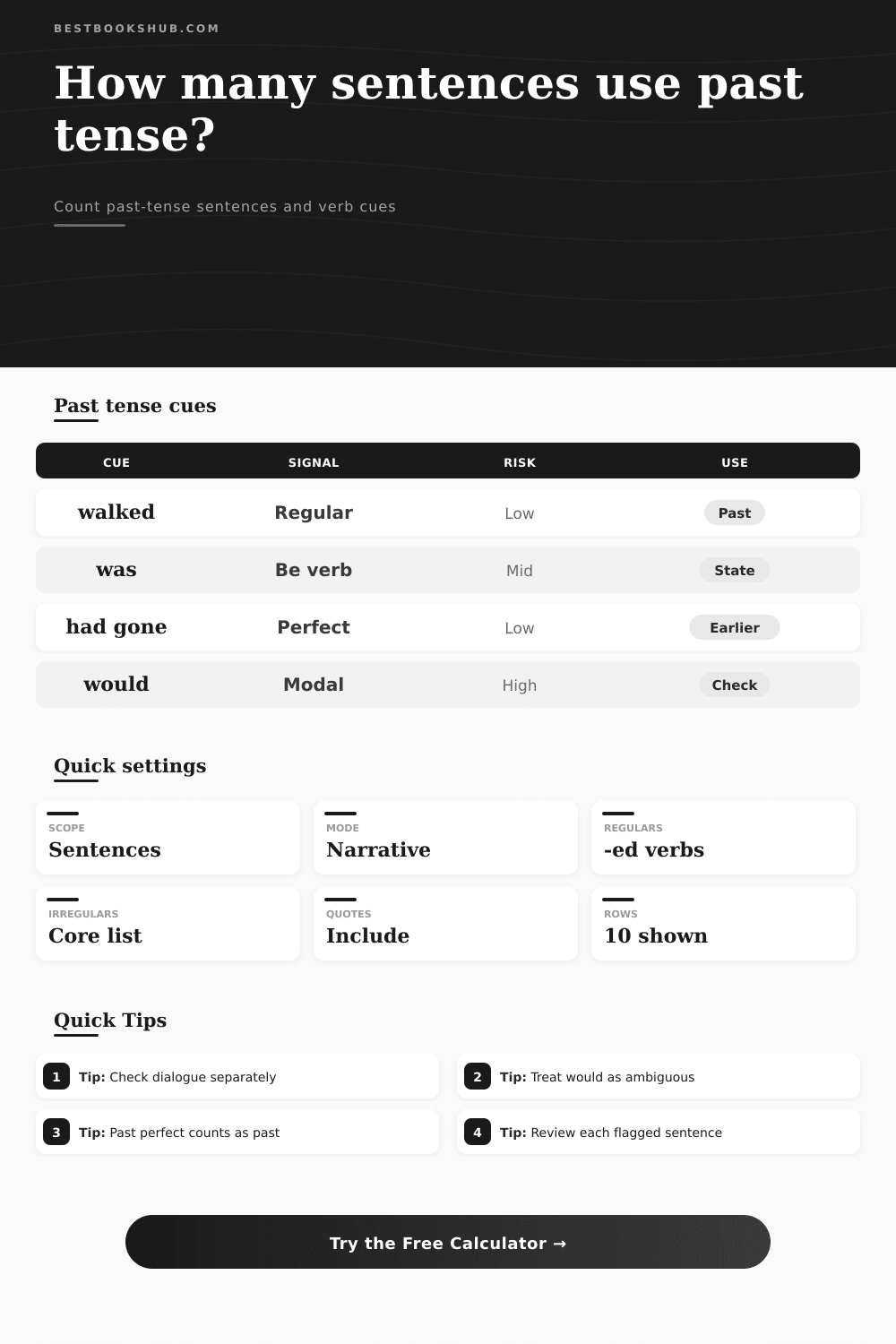
Use these tables to compare past tense cues, ambiguity cases, and recommended settings across different kinds of book and editing text.
| Past cue type | Examples | Counter weight | Review note |
|---|---|---|---|
| Regular past | walked, revised | Strong | Best with verb-like filters |
| Irregular past | went, saw, made | Strong | Needs a stored verb list |
| Past perfect | had finished | Very strong | Marks earlier past action |
| Past be verbs | was, were | Medium | Often describes past state |
| Ambiguous pattern | Example shape | Risk | Suggested handling |
|---|---|---|---|
| Modal past | would, could | May be conditional | Flag for review |
| Adjective -ed | tired reader | May not be verb | Use balanced scan |
| Reported speech | he said | Often true past | Count in narrative |
| Used to | used to read | Past habit | Count as review cue |
| Text profile | Best boundary | Quote choice | Why it helps |
|---|---|---|---|
| Narrative prose | Standard | Include | Captures scene narration |
| Dialogue page | Standard | Separate | Shows speech shifts |
| Transcript notes | Line breaks | Include | Each line can stand alone |
| Grammar sheet | Strict marks | Include | Avoids answer-key noise |
| Past share | Band | Common reading | Editing check |
|---|---|---|---|
| 0-25% | Light | Mostly present or mixed | Check tense target |
| 26-60% | Mixed | Frequent shifts | Review transitions |
| 61-85% | Past led | Typical narration | Spot present intrusions |
| 86-100% | Strong past | Stable retrospective voice | Confirm flashbacks |
It’s always a touchy matter. There can be a time lapse in the story that doesn’t quite add up, and before you know it, film reel has jumped a frame. There may even be no clear violation of any grammatical rule you can call out. On the surface, the sentences seem okay. But something is jarring.
What happened? Sometimes writers believe they’re writing in past tense narrative, but sneakily slip in phrases and words with more future or present markers, which subtly throws reader into cognitive dissonance. The counter above illustrate this hidden form. It removes the guessing game of whether your draft is staying in the lane you thought it was.
Why You Should Check Your Tenses
What it does is scan for certain verb clues, such as ed endings (for regular past-tense), irregular verbs (such as went or saw) and past perfect constructions. Why? When we’re reading for story, our eyes tend to glaze over the rules of sentence structure. Our brain reads for meaning; not for consistency of form. The computer lacks this bias. Every occurrence of a past-tense marker get counted, and sentences without them gets flagged. This provides you with a clear look at the rhythm your narrative voice actualy has.
A more difficult setting to work on is how you handle quoted dialogue. In a novel, for example, your characters may all talk in the present tense while you narrate everything in the past tense. That is perfectly fine. But if you combine all those words into one set of statistics, number of past-tense sentences goes down. Your analysis shows that you’re using present tense narration, which isn’t true. You’re simply reporting what people said. Breaking out quotes away from the rest of text gives you a better sense of the structure of your narrative. It allows you to distinguish between character voice and authorial voice.
Then there are the ambiguous cues. Could and would can mean both a conditional mood and a past tense habit. When someone says something like I would of gone if I’d known, yeah, that’s technically past, but conditional past. The calculator will flag those for you so you don’t count them blindly. And that’s important, since high ambiguity scores mean you’ve got a lot of hypothetical or speculative stuff in your writing instead of concrete action. Narrative momentum comes from action; speculation slow it down.
Then there’s the difference between action and state. To be is the verb whose past tenses are was and were. It signals a state of being in the past. Ran and walked signal action in the past. Sentences with lots of was feel static. Sentences with lots of irregular action verbs feels dynamic. Breaking them down by these categories lets you see the texture of what you’ve written. Do you find that you have more was than action verb? That could mean your narrative has a lot of description but not much plot movement. That’s a common draft problem. Even though the numbers don’t fix it for you, they show you where the balance lies between telling and showing.
Non-fiction authors: Non-fiction differs from fiction. In academic papers, you tend to combine tenses. Established facts are presented in the present tense; individual studies is summarized using the past tense. That’s one place the calculator comes in handy, too. It’ll show you when there’s a sudden lurch toward the present, such as in a paragraph where you’re supposed to be describing experiments but have actualy switched to general commentary. That’s an error to catch early on, because it will save time revising later. What feels like a vague sense of something being “off” becomes something you can pinpoint with data.
In practice, this all boils down to knowing when you’re switching tenses. And why. Knowing that means not relying too much on any one form but having control over it. Which is where the math comes into play: plug in your text, and the counter does the rest for you. You don’t have to carefully scan each comma and period yourself. Instead, it points out the patterns you may otherwise overlook.
Then, yes, you do have to read through the sentences it flags. Context isn’t something numbers can judge. But they can show you the exact line where the timeline fail. From there, you determine whether this is deliberate (a stylistic choice) or accidental (a mistake). Because now you aren’t guessing; you’re editing. And that’s when a draft goes from being a mess to becoming a story that makes sense. The reel no longer jumps its frame. It runs smooth.