⏳ Tense and sentence analysis
Future tense sentence counter
Paste prose, dialogue, notes, or study text to estimate how many sentences point forward and which future-tense cues drive the count.
Each preset loads a different future-tense pattern so you can test modal futures, planned actions, scheduled present, conditional future, and mixed tense shifts.
DISCLOSURE: This post may contain affiliate links, meaning when you click the links and make a purchase, I receive a commission. As an Amazon Associate I earn from qualifying purchases.
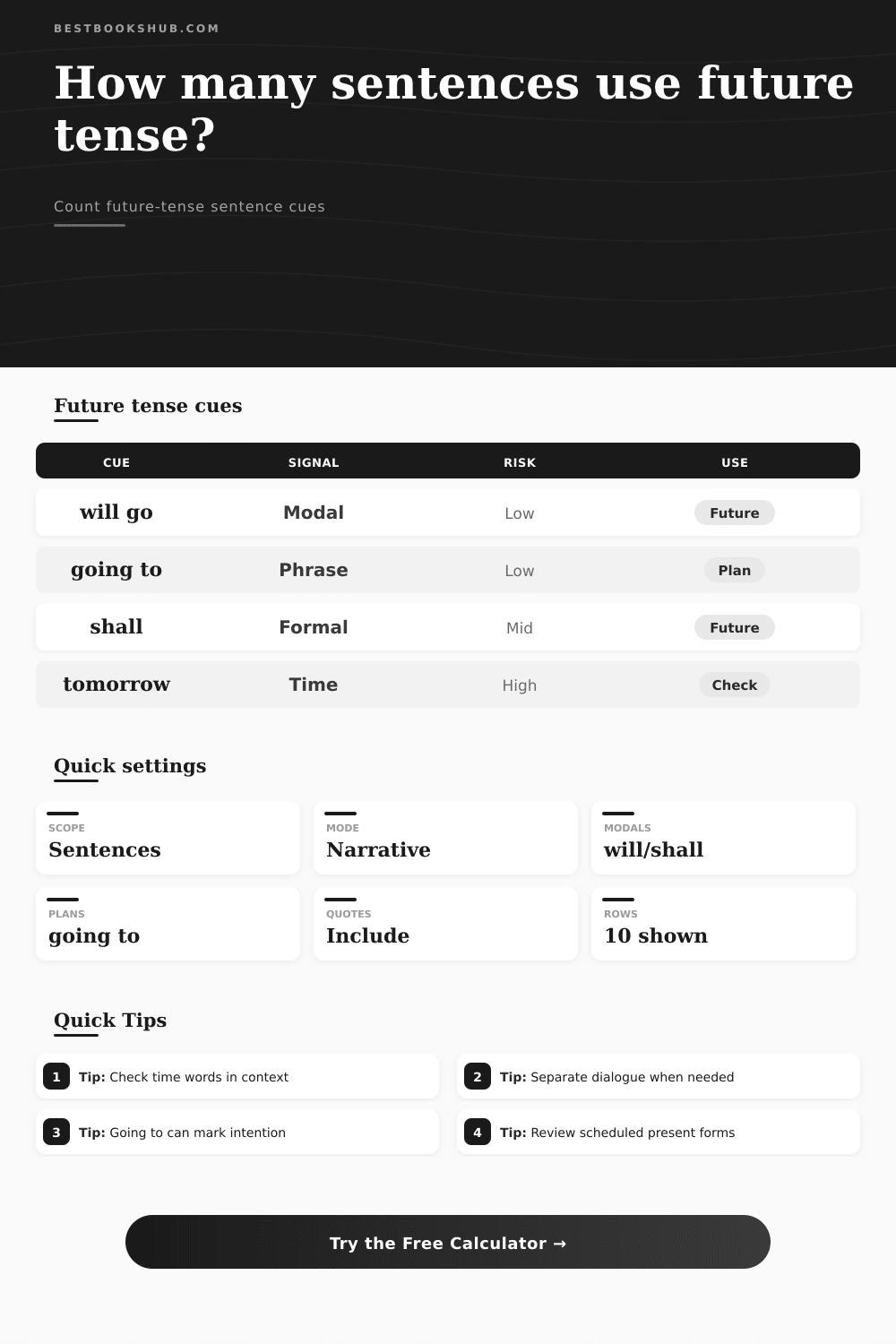
The counter uses sentence boundaries plus future cue patterns. Time words and scheduled present forms are marked as review signals because they often need human context.
| # | Status | Matched cues | Score | Sentence |
|---|---|---|---|---|
| No sentences analyzed yet. | ||||
| Future cue | Typical pattern | Count strength | Review note |
|---|---|---|---|
| Will or shall | will read, shall revise | Strong | Usually direct future tense. |
| Going to | is going to submit | Strong | Common planned future phrase. |
| About to | is about to begin | Strong | Near-future action signal. |
| Future perfect | will have finished | Very strong | Future point looking backward. |
| Planned action | plans to, intends to | Medium | Intent rather than tense form. |
| Profile | Best boundary mode | Quote setting | Why it helps |
|---|---|---|---|
| Narrative prose | Standard punctuation | Include | Tracks forward-looking narration. |
| Dialogue page | Standard punctuation | Separate | Shows promise and threat patterns. |
| Schedule notes | Line breaks | Include | Each line may be one planned action. |
| Grammar sheet | Strict end marks | Include | Avoids answer-key fragments. |
| Future share | Band | Common reading | Editing check |
|---|---|---|---|
| 0-20% | Light | Mostly present or past | Check if forward motion is missing. |
| 21-50% | Mixed | Plans appear between current events | Review tense transitions. |
| 51-80% | Future led | Forecast, outline, or promise-heavy text | Check overuse of will. |
| 81-100% | Strong future | Most sentences point ahead | Confirm the passage target. |
| Ambiguous signal | Example | Why ambiguous | Suggested mode |
|---|---|---|---|
| Time adverb | tomorrow, soon | Can appear with past or present verbs | Flag for review |
| Scheduled present | the train leaves | Present form can mean future event | Count only in schedules |
| Conditional modal | would, could | Often hypothetical rather than future | Flag unless needed |
| Plan verb | hopes to revise | Intent may not be tense | Use balanced scan |
The number of future-pointing sentences in any piece of writing reveal the nature of work: Is it deadline-based? Is it immediately urgent? Knowing this ratio can reveal momentum when drafting an outline or analyzing an essay. The balance between sentences looking back versus forward is slight, but crucial to clarity and pacing.
Commonly, writers write about “going to” and “will”, etc. Not all futures are grammatical; some are predictions, others intentions. For example, a statement about a train leaving at noon may be in the present, but it describe an event in the future. So for purposes of quantifying a text’s concentration on the future, looking at such basic verb forms isn’t enough. This page let you decide what should count, and whether or not to include scheduled present forms, for instance, or any other ambiguous time words.
How to Count Future Sentences
The tool then trains itself on your writing style and genre by having you paste in some text. For example, if it’s dialogue, you may want to split out quotes, since a character saying they’ll do something doesn’t necessarily mean the narrator think it will happen. Perhaps you’re analyzing a business prediction and would prefer all mention of intentions and plans counted as good signs for what is coming.
The tool lets you dial up or down how sensitive it should be to those sorts of things. You can run a broad intention pass, flagging everything from plans to hopes, or go strict modal, counting only things like “shall” and “will.” The output will change depending on what you pick. That is why it shows you the breakdown of the cues it was picking up on. The explanation tables also help with understanding how some words might get different treatment.
For example, some words like “soon” and “tomorrow” can indicate the future but have other uses. Those will be tagged for review because they could show up in past-tense sentences where they does not reflect the future. It’s about context. You might say that she thought tomorrow would of been better. That has a time word, but is still a past tense statement. Without being aware of those distinctions, you’ll make a noisier analysis. The tool flags things which aren’t clear cut and lets you determine whether it aligns with what you consider forward-looking. That’s why it’s important to include this manual step in the process, in order to ensure accuracy.
There’s also another kind of profile: the narrative prose profile. A high percentage of sentences in future tense in a novel suggest that the writer is relying too much on exposition and predicting, stalling the immediate action. A high percentage is good for a project plan, since it means the document centers around the deliverables and outcomes. It gives you a quick benchmark to measure against your goals.
Below twenty percent? You may not be driving the story forward enough. Above eighty percent? Then you’re forgetting about the here-and-now. Editing for temporal direction means you may find yourself leaping back and forth through time, mixing past reflections with future plans. But this could make the timeline confusing even though your grammar is on point. Looking at it line-by-line allows me to see precisely which lines are pulling the reader forward. In the example, you can notice spikes in future language (shifts into outline mode), signifying an abrupt change from narrative mode. That affects the reader’s experience. I want the tense to drive the reader, not confuse him.
Presets let you push limits. Push the mixed draft button and observe how the analyzer responds to transitions from dialogue to narrative. Next, push the formal “shall” button and watch how it deals with more serious future forms in legalistic contexts or other places where language sounds traditional. Notice that the numbers change to match as you alter the settings. Why? Because future tense isn’t one category. It’s a continuum of scheduling, certainty, and intent. That’s a feature, not a bug.
Future tense sentences can also show you when your document is focused. Are you anchored in the past? The present? The future? The numbers do that work. And then it’s up to you to judge if it’s balanced for what you want to achieve. Whether you are editing a report into final shape or polishing a novel, you know how the timing of your words influences the reader’s expectations and sense of urgency. The numbers tell you how things are distributed, and your ear tells you if it’s working. Actualy, the balance is more moddern than people think. It can be naturaly difficult to get right when writing luxurius prose or big books.