📝 First person voice scan
First person pronoun counter
Paste prose, dialogue, memoir notes, essays, or draft text to count first-person singular and plural pronouns with density, spread, and voice balance.
Load a preset to compare private narration, group voice, reflective memoir, academic wording, quoted speech, and service copy.
DISCLOSURE: This post may contain affiliate links, meaning when you click the links and make a purchase, I receive a commission. As an Amazon Associate I earn from qualifying purchases.
The scanner matches whole first-person tokens, can expand common contractions, and reports whether the passage is led by I voice, we voice, ownership, or self-reference.
Private narration and direct experience.
Shared action, team stance, or collective memory.
Useful for claim, responsibility, and viewpoint checks.
Emphasis, reflection, or repeated internal focus.
Rows sort by the number of first-person matches, then by density. Use them to inspect the lines or sentences driving the result.
| # | Band | Hits | Density | Context |
|---|---|---|---|---|
| No text analyzed yet. | ||||
| Family | Included forms | Voice cue | Typical use |
|---|---|---|---|
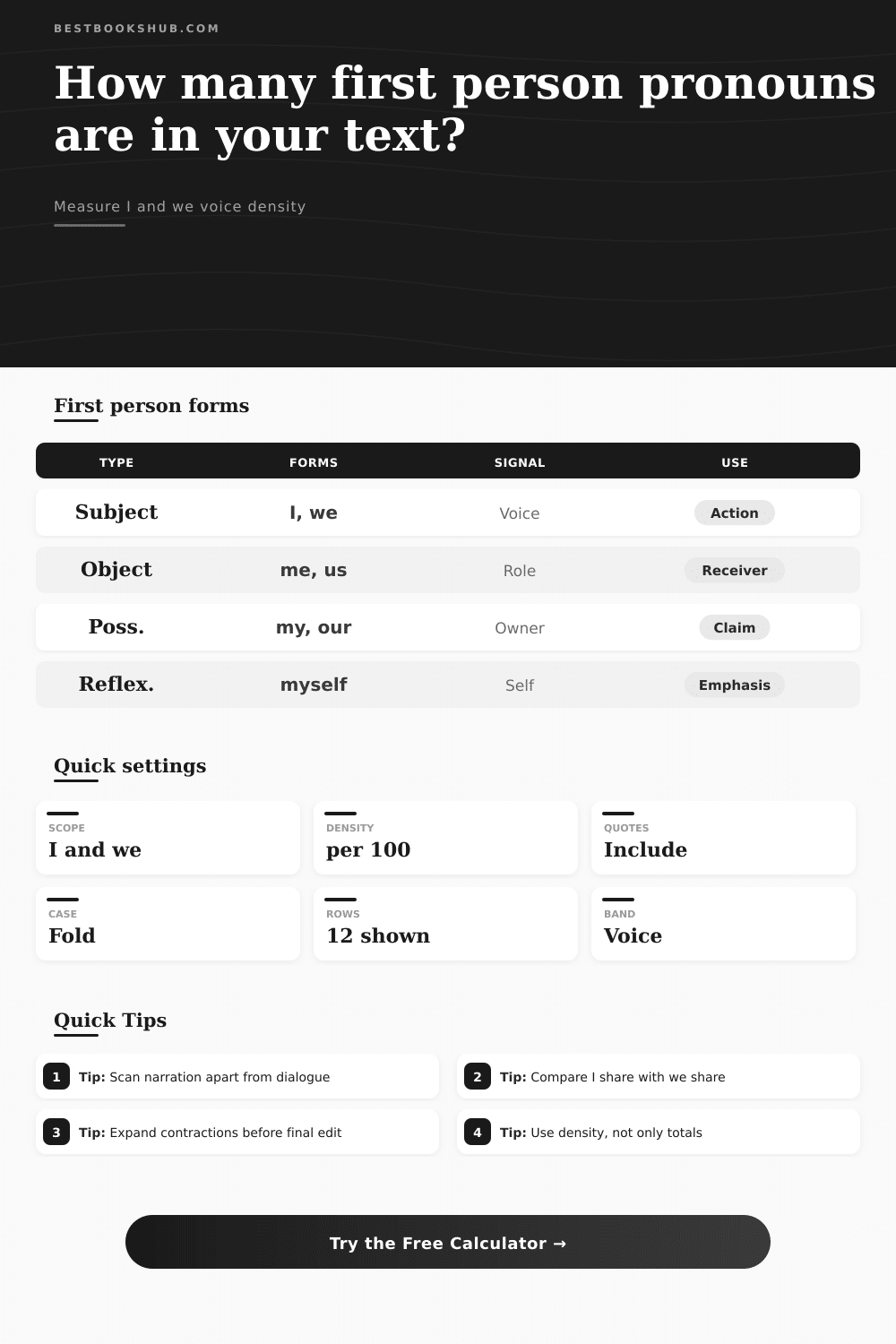
| Singular subject | I | Private actor | Memoir, essay, journal, testimony |
| Singular object | me | Received action | Dialogue, reflection, report detail |
| Singular possessive | my, mine | Personal claim | Ownership, memory, responsibility |
| Singular reflexive | myself | Self emphasis | Reflection, correction, emphasis |
| Plural subject | we | Group actor | Team update, shared narration |
| Plural object | us | Group receiver | Requests, actions, outcomes |
| Plural possessive | our, ours | Shared claim | Policy, collaboration, memory |
| Plural reflexive | ourselves | Group emphasis | Collective reflection or accountability |
| Density band | Per 100 words | Common reading | Review action |
|---|---|---|---|
| Sparse | 0-3 | Detached or objective | Check whether personal voice is intended. |
| Moderate | 4-9 | Visible but controlled | Compare I and we balance. |
| High | 10-18 | Personal voice leads | Review clustered sentences. |
| Heavy | 19+ | Strong self or group focus | Trim repeated forms if rhythm feels crowded. |
| Text type | Expected pattern | Best setting | What to compare |
|---|---|---|---|
| Memoir paragraph | Higher I voice | All forms | I share against sentence spread |
| Team update | Higher we voice | Compare I and we | Group claim against object forms |
| Academic method | Low to moderate we | Subject forms only | We forms against total words |
| Dialogue scene | Depends on speakers | Separate quoted text | Quoted hits against narration hits |
| Author note | Moderate I and we | All forms | Ownership against subject forms |
| Support reply | Usually we and our | Plural focus | Team stance against direct action |
| Mode | Counts | Omits | Use when |
|---|---|---|---|
| All forms | I, me, my, mine, myself, we, us, our, ours, ourselves | Other pronouns | You need a complete first-person pass. |
| Subject only | I and we | me, us, possessives, reflexives | You want narrator or speaker agency. |
| Object only | me and us | Subject and possessive forms | You want receiver-role patterns. |
| Possessive only | my, mine, our, ours | I, me, we, us, reflexives | You are checking claims and ownership. |
| Reflexive only | myself and ourselves | All other first-person forms | You need self-emphasis checks. |
Tone is also visible in first person pronouns. First person pronouns function as camera angle of a piece of writing. Do they pull us into the writer’s experience, or do they keep us back, observing what happens from afar?
Counting pronouns tell you how much of yourself you’re putting onto the page. That gives you a mechanical mechanism for detecting tonal trouble, which is otherwise largely hard to see.
How Pronouns Change Your Tone
The singular versus plural distinction are a matter of voice. Writing with “I” indicate that it’s your experience and your doing. It invites the reader into someone’s head, specifically yours. Writing with “we” imply a collective doing or a common background. It creates community, but it can mask who did what. Separating the two help you see the balance.
You might tell yourself you are writing about something that happens to everyone. However, using too many “I” statements suggest you are working alone while hiding behind idea of teamwork. A slight adjustment like this alter how the audience will recieve it.
Many analyses miss this. Quoted text handled incorrectly will throw off the narrator’s voice profile if you’re scanning a dialogue-heavy scene. A quick fix: separate the speech from the narration so you can get a true read of how present author is. Why? This prevents you from making the false assumption that a scene is more personal than it realy is.
It’s simple math, but it require careful interpretation. Don’t think that you’re simply counting words. You’re auditing perspective.
It is better to have density. There are three “I” forms in a short paragraph. It is intense. Maybe there are thirty “I” forms in a chapter long enough to be a chapter, it might be sparse. The count-per-hundred-words normalizes your data so that you can see clusters of self-reference, which may throw off the rhythm.
High density isn’t necessarily bad. You need it for memoirs. Usually, academic writing shun it. It’s all about context: Is this voice an asset or a distraction?
The possessives (“my,” “our”) tells us who has ownership, who claims what’s going on. The reflexives (“myself”) indicate whether something is being emphasized or defended. By breaking them down individually, you can hone in on the difference in nuance.
Maybe you use the possessives too much for assertion of authority (and the story doesn’t need it). Or maybe you’re using reflexives to fill out your sentences without adding any real value.
Usually they’re not trying to get rid of all the first person pronouns. They’re trying to use them on purpose. They are also trying to make the voice serve the story, rather than dominate it.
Start to make conscious choices after you see the breakdown. Pull back or do you want to step forward and clarify whose story this is? Is there a moment when you should of let the action speak for itself?
The numbers aren’t writing your story for you. They’re showing you who’s pointing the camera.
A lot of editing is subtraction. Add in what you think is missing: proof that you realy did go there, and felt this and saw that. Add in details for safety and reassurance. This ensures the reader knows you meant it to be them, too. But sometimes, less is more.
One way to tell if you’re on track is to check your pronouns. This makes you look not only at what’s on the page, but also how it work together; a structure, not just a transcript of thought. Look at the form; when you see the form, you can break it.
Next time you’re not sure what tone to write in, glance down at the pronouns. They are the scaffolding of your narrative stance. They holds up the entire building. And adjusting them shifts that building.
Find your voice. It’s already there. You just have to know where it stands now.