📝 Manuscript analysis
Third Person Pronoun Counter
Paste prose, notes, dialogue, or article copy to count he, she, it, they, object forms, possessives, reflexives, and third-person density.
This counter uses visible word forms, so it is ideal for drafting, style checks, and quick editorial comparisons. Ambiguous her is counted and flagged separately.
| Family | Count | Share | Common forms found |
|---|---|---|---|
| Run the counter to fill this table. | |||
| Role | Count | Share | Examples |
|---|---|---|---|
| Run the counter to fill this table. | |||
| Form | Family | Role | Count |
|---|---|---|---|
| Run the counter to fill this table. | |||
| Sentence | Third-person hits | Density note | Preview |
|---|---|---|---|
| Run the counter to fill this table. | |||
| Family | Forms counted | Typical signal | Editing watch point |
|---|---|---|---|
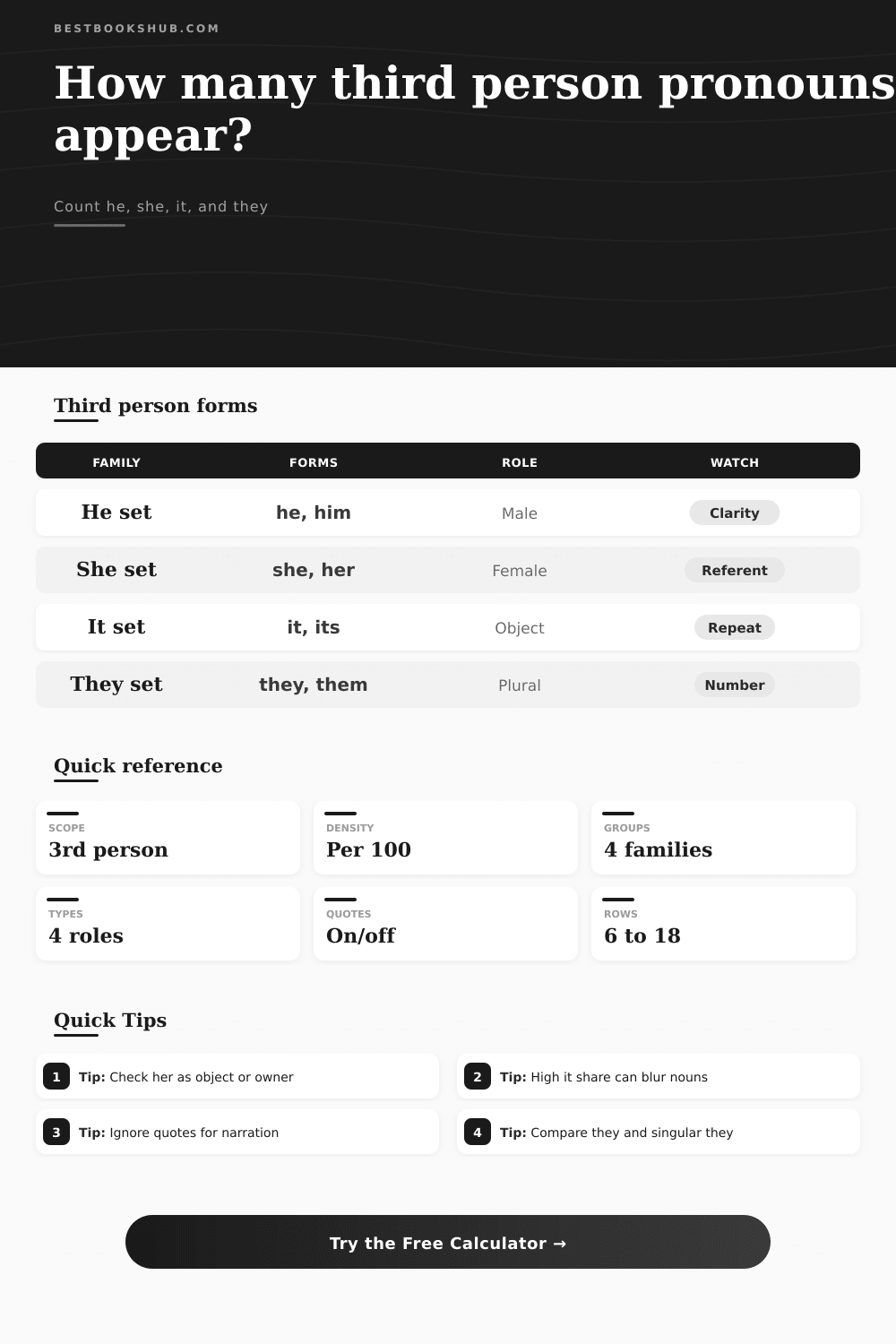
| He family | he, him, his, himself | Masculine third-person reference | Check repeated sentence openings and unclear antecedents. |
| She family | she, her, hers, herself | Feminine third-person reference | Her can be object or possessive, so context still matters. |
| It family | it, its, itself | Object, idea, setting, or animal reference | High density can make abstract paragraphs feel vague. |
| They family | they, them, their, theirs, themself, themselves | Plural or singular they reference | Compare number cues when several groups are nearby. |
| Density band | Per 100 words | Common use | Interpretation |
|---|---|---|---|
| Light | 0 to 3 | Summary, exposition, source notes | Pronouns are present but nouns probably carry most references. |
| Moderate | 3 to 7 | Close narration, reviews, classroom prose | Usually readable if referents remain close and distinct. |
| High | 7 to 12 | Dialogue, action scenes, anecdotal writing | Review sentence clusters for repeated he, she, it, or they openings. |
| Very high | 12 plus | Transcript, dialogue run, rough draft | Check whether readers can still track every antecedent. |
| Scan option | Best for | What changes | Useful caution |
|---|---|---|---|
| Count quotes | Whole passage review | Dialogue and narration are combined | Speaker patterns can dominate the total. |
| Ignore quotes | POV and narration checks | Quoted spans are removed before tokenizing | Unclosed quotation marks may remove too much text. |
| Quoted text only | Dialogue voice checks | Only quoted spans are scanned | Attribution outside quotes will be excluded. |
| Expand contractions | Drafts with speech or informality | He's, she'd, it'll, and they're become countable forms | The added verb pieces are ignored by the pronoun counter. |
DISCLOSURE: This post may contain affiliate links, meaning when you click the links and make a purchase, I receive a commission. As an Amazon Associate I earn from qualifying purchases.
Counts are based on surface word forms, not full grammatical parsing. Use the tables as editorial signals, then inspect the surrounding sentence before revising.
Sometimes pronouns gets knotted up and your story line breaks. Or at least I lose my place in the story.
This happens when we leave a character in limbo by failing to name him (or her) and then expecting readers to keep that person in mind for the next sentence. It’s easy enough to remedy, you don’t have to become a linguist… Just be aware of the references in question.
Use This Tool to Fix Pronoun Problems
Counting’s easy with this tool (the one up top), which leaves you free to get to work on style, not syntax. Paste in your draft chapter, and let it scan through for he, she, it, they, and any of their reflexive or possessive relatives.
You don’t want to avoid all third person pronouns, doing so will lead to wooden writing. What you do want is to tune into the rhythm of your writing until the references seem comfortabley. Paste in your chapter draft, and the system will break it down by family. Did you use a lot of he? Or did it get spread out between it and they? That makes a difference.
A lot of “it” are usually a sign of vague ideas. A lot of “he” might be a sign of a close point of view losing focus.
While most writers think about word count, this counter thinks about referent density: how many pronouns appear in each hundred words? If the number is between three and seven you’re probably in the safe zone for readable narration: the antecedents are close enough that the reader won’t have to reread the last paragraph.
But when you go over seven (into the high density band) then you’d better pay attention. That’s when the reader starts to strain. Too many invisible threads is left hanging in their head.
With the calculator you can see this number right away, so there is no need to count by hand. It is yet another way to get a quick check on your writing.
Also review the roles. Too much her and him strung out in a row isn’t always bad grammar, but it’s not good style either. The breakdown is divided into possessives, objects, reflexives, and subjects.
Is your object column bloated? That means too many indirect references. You’re talking around people more then having people do things. Try using their names or switching some to subjects and you’ll pick up the pace.
For fiction, being able to set aside quoted material is essential. Often dialogue increases the number of pronouns since characters talk about other people who aren’t there. Remove the quotes, and you get a look at actual narrative voice.
The word her is a classic example of a pitfall: it’s both a possessive and an object, and it may throw off analysis unless you’re familiar with the potential muddiness. This tool reminds us: it’s context that matters most.
So a high it score on a piece of expository writing could simply be because you are talking about ideas (nothing wrong with that). But in fiction, it can signal that you’ve dropped a key noun that identifies the setting or some other prop and left the reader to guess.
In the reference section, you’ll find bands of density so you can calibrate what to expect. Low density indicates nouns is doing too much of the work, good for exposition, bad for the flow. Very high density means the draft are crying out to be trimmed.
Ultimately, it is all a matter of trust. You want the reader to know who you’re talking about. The counter provides you with the information to develop that trust. It doesn’t rewrite your sentences, but shows you where the hard parts might be based off the data.
If you notice an increase in a particular role or even family, there’s your clue to intervene: maybe restate a name. Perhaps make it clear which antecedent you mean. Perhaps split a long sentence into two parts.
The numbers are just the map. The writing is the territory.
You should of seen that coming. You’re guiding the reader across the scene, and well-referenced words are like street signs that prevent them from getting lost along the way.
Keep the focus tight, check the density and balance. The best prose feels effortless because we don’t see the mechanics… And this tool can help you make sure we never do. It is actually quite simple once you get used to it. Use modern tools to avoid mistakes that dissapears in a good draft.