📊 Text balance tool
Gendered pronoun ratio calculator
Paste a passage to measure masculine, feminine, neutral, and nonpersonal pronoun balance, then compare density and role signals across your text.
The calculator counts explicit pronoun tokens only. It does not infer gender from names, titles, occupations, or characters outside the words you paste.
| Family | Included forms | Calculator role | Editorial note |
|---|---|---|---|
| Masculine | he, him, his, himself | Numerator in M:F ratio | Can concentrate around one character or cited source. |
| Feminine | she, her, hers, herself | Denominator in M:F ratio | The word her may be object or possessive; both are counted. |
| Neutral personal | they, them, their, theirs, themself, themselves | Neutral share | May be singular, plural, or group reference. |
| Nonpersonal | it, its, itself, one, oneself | Context signal | Useful for separating objects from people. |
| Inclusive extension | xe, xem, xyr, ze, hir, fae, faer | Optional neutral set | Only counted when inclusive scope is selected. |
| Ratio band | M:F reading | Sample warning | Useful follow-up |
|---|---|---|---|
| No paired data | One side is zero | Small passages often land here | Inspect counts before interpreting the ratio. |
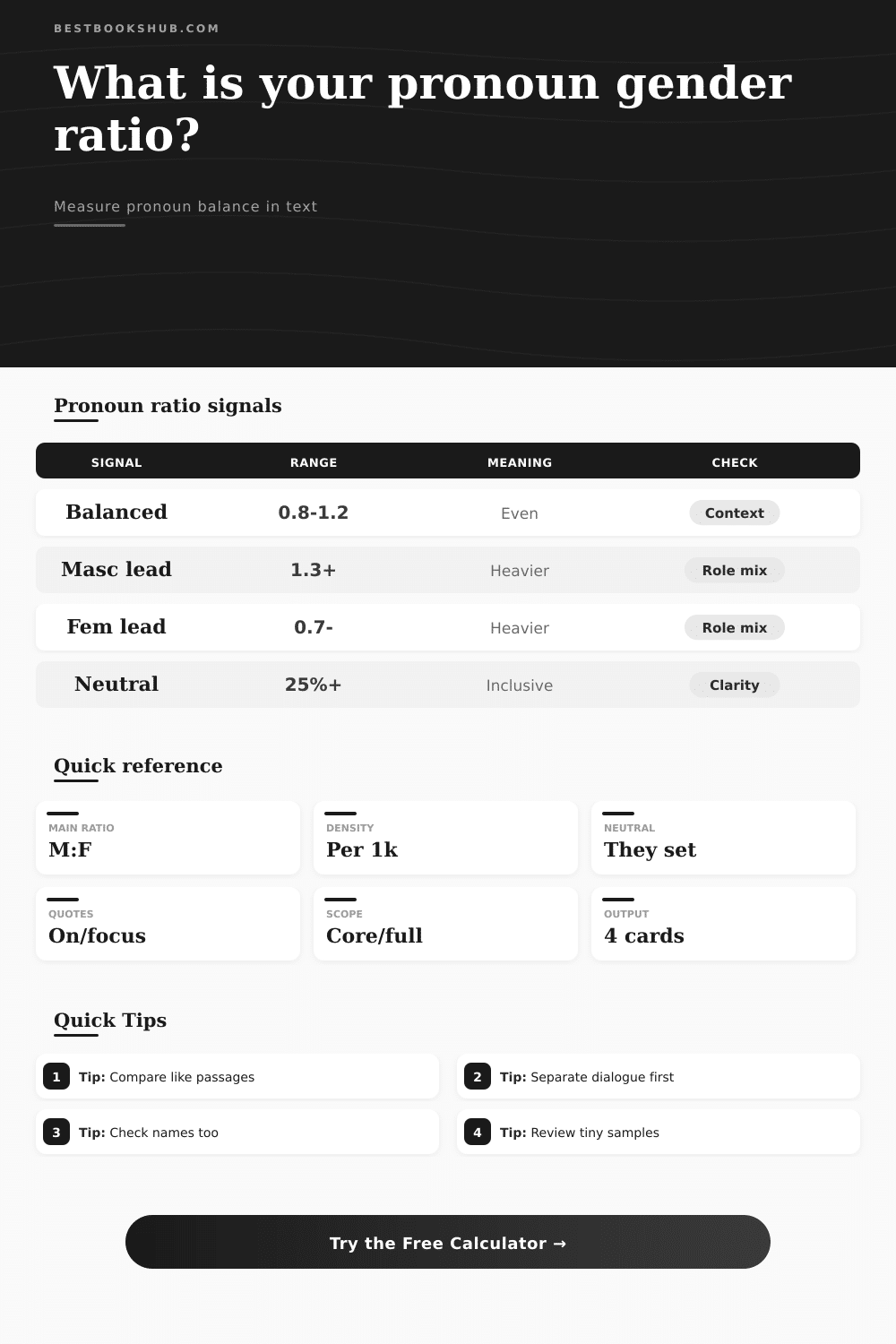
| Balanced | 0.80 to 1.25 | Works best after minimum mentions are met | Compare by scene, section, or speaker role. |
| Masculine-led | Above 1.25 | May reflect subject matter or point of view | Check whether one role dominates the passage. |
| Feminine-led | Below 0.80 | May reflect subject matter or point of view | Check whether one role dominates the passage. |
| Neutral-heavy | Neutral share above 25% | They may be plural or singular | Review clarity if antecedents are crowded. |
| Text type | Typical signal | Common reason | Best comparison method |
|---|---|---|---|
| Fiction scene | Can swing strongly | Point of view and dialogue control pronoun mix | Compare adjacent scenes or chapters. |
| Author bio | Often third person | The subject may be one named person | Separate bio from review copy. |
| Interview transcript | Neutral and second person can rise | Question and answer patterns repeat people references | Use quote focus for speaker-only checks. |
| Academic summary | Usually low density | Nouns and citations often replace pronouns | Compare by word-normalized density. |
| Support thread | They and it may dominate | Teams, accounts, and objects are referenced repeatedly | Separate people pronouns from object pronouns. |
| Preset | Main context | Expected lean | Why it helps |
|---|---|---|---|
| Balanced Profile | Book profile copy | Near even | Checks the ratio math with both core families. |
| Hero Chapter | Action narration | Masculine-led | Shows one-character focus and density. |
| Mentor Scene | Close third person | Feminine-led | Tests object and possessive her counts. |
| Inclusive Guide | Policy or guide text | Neutral-heavy | Shows how they and inclusive scope change totals. |
| Dialogue Sample | Quoted speech | Mixed | Useful for quote handling comparisons. |
DISCLOSURE: This post may contain affiliate links, meaning when you click the links and make a purchase, I receive a commission. As an Amazon Associate I earn from qualifying purchases.
In revising manuscripts, editors tend to pay attention to things like vocabulary richness, sentence length, or word count.
Pronouns? They rarely does.
How to Use the Pronoun Ratio Calculator
It’s a quiet hum that doesn’t register until there is a problem: maybe a character is missing three uses of a particular gendered pronoun and now feels invisible on the page. Maybe your narrator changed the balance without meaning to, making their voice feel far too dominant.
This gendered pronoun ratio calculator review pasted text for its pattern of masculine, feminine, neutral and nonpersonal pronouns. It helps editors gauge voice balance between drafts. It takes a subjective gut feeling about representation and makes it something you can see, and then adjust.
It scans by explicitly counting tokens with pronouns. It doesn’t infer gender from job titles or names; it simply counts the words. A name (such as Sam or Alex) hold no grammatical weight here. So the raw data remains free of assumptions.
Paste in a transcript, a sample of dialogue, or an excerpt from an article. Then let the calculator do the math above. It breaks out the counts. Separating them between masculine, feminine, neutral and nonpersonal. And then it gives a ratio that indicates if the text is skewed toward one gendered perspective or if there’s more even distribution.
You also need to think about the input: How do real writers and speakers talk? In general, they refer to themselves and other people in ways that don’t match a narrator’s perspective. And then there’s exposition: They’re likely to use “they,” “them” etc., which aren’t realy neutral words. It just comes from talking about groups or abstract thing.
Because you can split out quoted material, the calculator is a tiny feature that will save you a ton of headaches. Do you want to count the quotes as separate from the narration? Or do you want to focus on only the quotes? This way you can see if your dialogue is balanced even when your narration are not.
This is where the reference table on the page come in handy. It outlines what tends to happen for various kinds of texts. Point of view make a big difference for fiction scenes; they’ll skew heavily toward whichever pronouns are being used by the POV character. Nouns and citations crowd out personal references, so academic summaries tend to be low in pronouns as well. Why? Because this helps put it into context.
Having an uneven pronoun ratio isn’t necessarily a bad thing. If you’re telling a story through the eyes of just one character, their pronouns will naturaly come out more frequently. You don’t need to strive for a 50/50 split in each sentence or paragraph. Rather, you want to make sure the overall weight of the story match your intention.
Another wrinkle is neutral pronouns. While used correctly, this may reflect an inclusive tone, but it can also leave you wondering which person or thing the author is talking about. The calculator tallies neutral share as well. You can then look at how much of the conversation are neutral. If neutral makes up most of your writing, this could be a sign that you’re avoiding using gendered pronouns in general. That’s certainly a stylistic decision. But it can also suggest that you’re overusing vague pronoun references, leaving the reader guessing about who’s doing what.
Lastly, think about what level of scan you want to run. It has multiple sets available. These include core gendered forms and an inclusive set with neopronouns. The type of text you are working on and your expected audience determine the scope. For a general audience edit, perhaps the core is enough. For a diverse language community where language inclusivity matters, try out the inclusive scope which will give you a more accurate representation.
What can go wrong? You could analyze too small of a sample. For example, one sentence might have an unbalanced ratio, but the numbers even out over a page. To determine how often these pronouns appear, always look at the density (per thousand words). Is the number low? The ratio could mislead you. The calculator shows the total number of gendered pronouns, which lets you determine if it’s statistically significant or not.
At its core, this tool is a diagnostic, not a prescription. The results show you where the imbalance may lie, so you can use that information to make smart decisions regarding your narrative voice and characters’ presence. Use it to tweak your text so that it more accurately reflects what you want. This ensures every voice on the page has the right amount of weight. It gives you clarity in what was once invisible work. Helps you craft a story that feels complete.
You should of used it sooner.