📝 Self-reference scan
Reflexive Pronoun Counter
Paste prose, dialogue, notes, transcripts, or essays to count myself, yourself, himself, herself, itself, ourselves, yourselves, themselves, themself, and oneself.
Load a preset to compare narration, dialogue, academic phrasing, instructions, memoir, singular they, repeated emphasis, and copy editing examples.
DISCLOSURE: This post may contain affiliate links, meaning when you click the links and make a purchase, I receive a commission. As an Amazon Associate I earn from qualifying purchases.
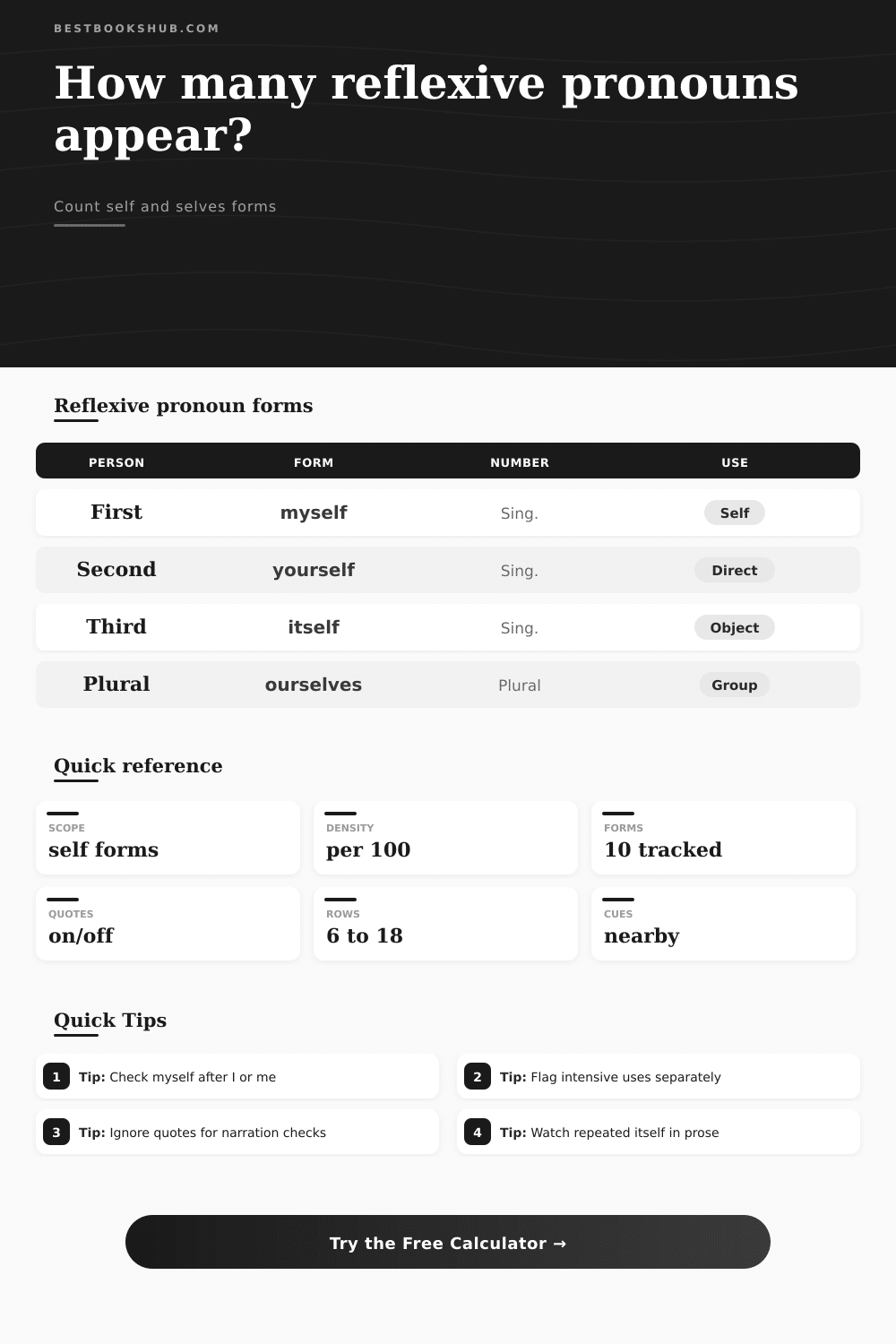
The counter matches visible whole-word reflexive forms and labels likely reflexive, intensive, idiomatic, quote, and near-cue usage for closer review.
| Form | Person | Number | Uses | Share |
|---|
| Line | Form | Likely use | Nearby cue | Context |
|---|
| Use type | Pattern cue | Example form | Editing signal |
|---|---|---|---|
| Reflexive object | Subject and object refer to same actor | myself | Usually grammatical when the subject matches. |
| Intensive emphasis | Can be removed without changing core grammar | himself | Useful sparingly; repeated emphasis can feel heavy. |
| Fixed phrase | by itself, for herself, to themselves | itself | Often idiomatic; review only if dense or unclear. |
| Ambiguous object | Self form used after a nonmatching subject | yourself | May need a regular object pronoun instead. |
| Singular they | themself or singular themselves | themself | Check house style and intended referent. |
| Band | Per 100 words | Typical passage | Review focus |
|---|---|---|---|
| Very light | 0 to 0.2 | Objective article, summary, or report | Usually no action needed. |
| Light | 0.2 to 0.8 | Balanced prose with occasional self-reference | Check only repeated nearby forms. |
| Moderate | 0.8 to 1.8 | Memoir, instruction, dialogue, or analysis | Review clusters and intensive emphasis. |
| Heavy | 1.8 or more | Reflective, procedural, or speech-heavy text | Inspect whether self forms are doing real work. |
Counts are based on visible text forms. Grammar classification is a close editing aid, not a full syntactic parser.
Sometimes a manuscript simply feels too self-centered. Everything is about writer. Maybe the writing isn’t wrong so much as off. One of the culprits here are the use of reflexive pronouns. Themself. Himself. Myself.
These words has their place in clear writing. But sometimes insecure writers uses them as hiding places. They use them to much. And the result is a hall of mirrors. It is a book where the subject gaze at its own reflection rather than moving story forward.
Check Your Reflexive Pronouns
Here’s the calculator, running the math for you. How many times did it say they? He? She? We? Me? How many were just right? How many weren’t? Editorial instinct tells you what those numbers represent.
The first difference is between intensive and reflexive use. Reflexive pronouns is used as objects of a preposition or verb, referring back to the subject. When you learn to code yourself, then the act turn in on itself and circles back around to you. That’s good grammar; sometimes it’s needed.
Intensive pronouns add that emphasis. Say I myself taught class, and you can remove the word itself without changing sentence. So why write it? Writers do to make themselves sound authoritative. Too many of these create an uneven rhythm in your writing.
Using the tool, you can see where intensive form has been used. It will flag probable ones so you can see whether they do any real work structurally (self-referencing) or not (just adds weight). And it’s little things like these that matter for readability.
Are they right? That depends on context. First-person reflexive forms is common when a piece is highly reflective, such as a memoir. Self-reflection is part of the genres fabric. Nothing wrong with seeing me-me-me a lot. Those same words stick out like a sore thumb in more objective pieces (reporting, technical writing).
The embedded examples in the tool demonstrate the range. These word tend to clump in dialogue scenes. Academic abstracts keeps them sparse. How do you know whether the number is okay? Because you compare it to what readers expect within that genre.
If yours is high, ask yourself: Does the reader need to be told the actor is equal to the object? Often, the link will be implied by the verb itself.
Then there is the use of they/themselves and similar terms: they complicate things, but language changes. And so do pronouns, becoming more flexible. Always be consistent.
Here’s how it works. The counter runs both of them separately. It is good for editors who has a house style to stick to. It’s about clarity, not enforcing rules on someone. You wouldn’t want your character to appear as she does in this paragraph and then as herself in the next.
The sentence spread function show where those kinds of words cluster or get sprinkled around. When they’re clustered, that often means repetition. That turns good writing into something that sounds like it’s been repeated too many times.
The trick with these words isn’t so much to get rid of them as it is to make sure they’re earning their keep. Each one stops the reading process. Each demand that the reader work hard to be certain what’s meant. Is the reference clear? Does it clarify an otherwise confusing act? Clutter if it’s obvious; essential if it clarifies.
And this is where the reference table comes in handy (see page). It maps out the pattern and helps you tease apart reflexives from the idiom. Generally, most writers overestimate the frequency with which they must re-state the subject. Trust the verbs. Let the action tell its own story.
This isn’t a hit-the-magical-low-number exercise in counting pronouns. This is an audit of where you’re focusing. If some of the intensive forms go away, does the sentence structure open up? Can the idea breathe? Did the tool give you the data? Does your ear make the judgment?
Use the numbers to identify clusters, then read those passages out loud. Stumble over a word? Cut it. Keep the rhythm, keep the word.
There’s a balance between showing yourself and allowing the story to stand on its own. Rarely do the best pieces of writing should of point to themselves to prove they exist.