📝 Demonstrative reference scan
Demonstrative pronoun counter
Paste prose, essays, dialogue, notes, or web copy to count this, that, these, those, such, and same with density, distance, number, role, and context rows.
Load a preset to compare narration, academic reference, editorial argument, dialogue, instructions, and marketing copy with different demonstrative patterns.
DISCLOSURE: This post may contain affiliate links, meaning when you click the links and make a purchase, I receive a commission. As an Amazon Associate I earn from qualifying purchases.
The scanner matches whole demonstrative tokens, estimates pronoun-like versus determiner-like use from neighboring words, and reports whether the passage points near, far, singular, plural, or abstract.
Rows update after calculation. The role estimate is a surface reading based on nearby words, so use the context column for editorial decisions.
| Form | Role | Distance | Number | Context |
|---|---|---|---|---|
| Paste text or choose a preset to list demonstrative contexts. | ||||
| Form | Distance | Number | Typical role | Example signal |
|---|---|---|---|---|
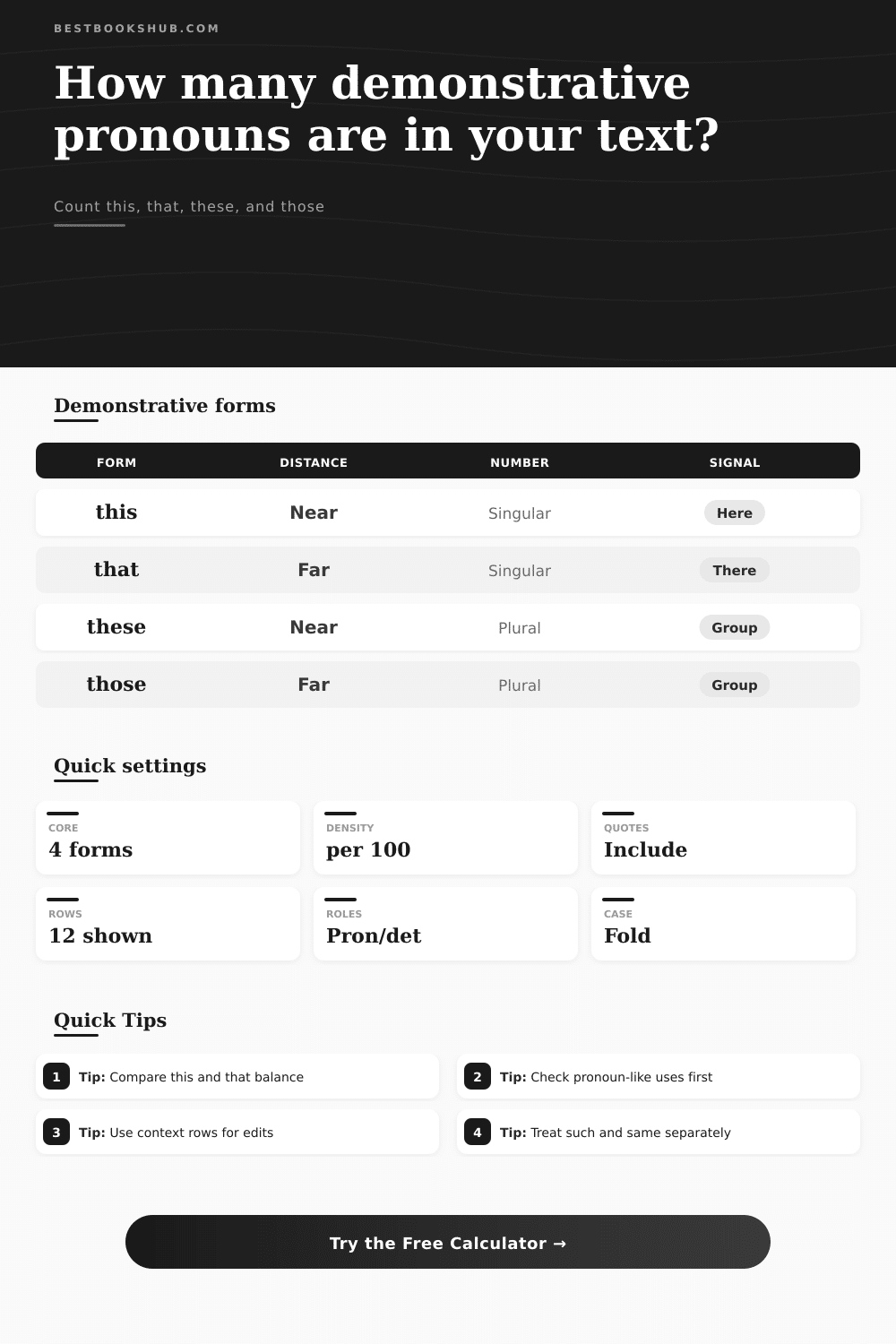
| this | Near | Singular | Pronoun or determiner | Current item, idea, line, or moment |
| that | Far | Singular | Pronoun or determiner | Previous claim, distant item, or contrast |
| these | Near | Plural | Pronoun or determiner | Nearby set, examples, reasons, or notes |
| those | Far | Plural | Pronoun or determiner | Distant set, prior examples, or categories |
| such | Abstract | Qualitative | Expanded demonstrative | Kind, degree, or type reference |
| same | Abstract | Referential | Full demonstrative set | Identity or repeated reference |
| Density band | Per 100 words | Common reading | Editorial check |
|---|---|---|---|
| Light | 0 to 2.9 | Few pointing words | Check whether references are too sparse |
| Moderate | 3.0 to 6.9 | Normal reference load | Scan unclear this or that references |
| High | 7.0 to 10.9 | Strong deictic pattern | Confirm each form has a clear antecedent |
| Heavy | 11.0+ | Dense pointing language | Consider replacing vague forms with nouns |
| Pattern | What it may signal | Useful in | Watch for |
|---|---|---|---|
| Many this forms | Close attention to current claim | Close reading, instructions, analysis | Unclear referents after paragraph breaks |
| Many that forms | Backward reference or contrast | Argument, review, dialogue | Overuse as a filler connector |
| Many these forms | Grouped examples nearby | Lists, summaries, academic prose | Plural noun missing after the demonstrative |
| Many those forms | Distant category or group | Comparison, critique, dialogue | Vague people or ideas being grouped |
| Many such forms | Kind, type, or degree reference | Formal and academic prose | Stiff phrasing in casual passages |
Probably, you say these, those, this, that and don’t even realize it. These is the invisible glue that make your sentences stick together and help the reader know what you’re talking about, actualy. But this glue can obscure clutter, as well. Too much reliance on demonstrative pronouns, and your writing points in all directions. What’s near? What’s far? The reader doesn’t know.
And with the tool above, you can see that in clear detail: we not only count words, but also how far apart they seem to be. A hazy feeling of repetition becomes a concrete density score, one you can handle.
Stop Using Words Like This and That
Writers assume that if a noun need repeating, then pronouns are better. Half-true. Pronouns do provide flow, but they makes readers work harder to understand. When I say this is the problem, you have to search your memory to find what I am talking about. Scroll up two paragraphs? Connection broken.
The scanner will separate these (near) and this (near) from those (far) and that (far). More than most people realize, that distinction count. Near references anchor the reader to the immediate clause/sentence. Far references extend outward, to contrasting ideas, or backward into earlier arguments. Mixes between these keep things moving along. Skews in one direction often indicate a structural issue.
For example, if your text stay mostly in the middle ground with many near forms, it may show you are obsessed with the present moment and failing to connect this one point to the larger context. On the other hand, if your text is too much in the far forms, that may signal that you’re always looking back rather then moving the argument ahead.
Plug in your text into the calculator above and it does the math for you. No more counting out each occurrence of that across a long draft. And no more hunting them down on your own. Simply copy/paste an excerpt from your chapter or paragraph and let the process do its thing.
Also, it guesses if something is being used as a determiner (usually fine) vs. It is a form of pronoun, which is more risky. Determiners have the noun following right away, like this book. Pronouns, such as this is important, don’t have a noun, which is why it’s more risky. So this shows up in the report too so you know where your references are strong and where they’re just kind of hanging in the air.
Language is all about context, and one number won’t do it. That’s why I normalize your count to a percent of total words. What does it mean? Now we have a rate per hundred words, so we’re comparing an email to an essay, for example, on equal footing.
In general, a good range for analytical or academic writing is around seven or eight words per hundred words. When you see that many, you know you’re actively referring back to the source. Anything over ten start feeling repetitive and choppy. The tool highlights that for you. It alerts you when you might want to swap out a vague pointing phrase with something more concrete.
For example, say you wrote that shows the decline. By replacing that with The data shows the decline, you not only get rid of the pronoun, but you also get more precise.
Editing demonstrative pronouns is less about removing them and more about making sure our intentions are clear. Do you want to drag the reader along, or guide her? If you have a buildup of vague pointers (that’s what a demonstrative is) in the context rows, stop and identify: Who/what are these words pointing at? Does it point back to the previous chapter? Paragraph? Is it a sentence? If it doesn’t immediately jump out, rephrase. Turn that pointer into a proper noun. Yes, it may lengthen the sentence; but it’ll solidify the meaning.
Writing’s a conversation, and demonstratives are the hand gestures you use when having one. Use them to highlight something, not as a replacement for anything substantive. You should of used them more carefully. Get the balance right and your writing will become invisible. The ideas will be lit up, and nobody reading it will ever notice the words supporting them.