📝 Grammar analysis tool
Indefinite pronoun counter
Paste a passage to count indefinite pronouns, compare categories, catch repeated vague references, and inspect sentence-level spread.
| Rank | Pronoun | Category | Count | Share |
|---|---|---|---|---|
| No pronouns counted yet. | ||||
| Sentence | Matches | Count | Cluster read |
|---|---|---|---|
| Sentence spread appears after calculation. | |||
| Category | Included examples | Count | Share |
|---|---|---|---|
| Universal | all, each, every | 0 | 0% |
| Assertive | some, somebody | 0 | 0% |
| Negative | none, nobody | 0 | 0% |
| Choice | any, either, another | 0 | 0% |
| Pronoun family | Singular examples | Plural examples | Typical check |
|---|---|---|---|
| Universal | each, everyone | all, both | Agreement |
| Assertive | someone, something | several, many | Reference |
| Negative | nobody, nothing | none | Double negative |
| Choice | anyone, either | others, several | Ambiguity |
| Compound | no one, one another | each other | Spacing |
DISCLOSURE: This post may contain affiliate links, meaning when you click the links and make a purchase, I receive a commission. As an Amazon Associate I earn from qualifying purchases.
You’ve heard it before: Don’t use vague words. It make sense; being specific allow you to paint pictures, and using precise language builds trust. However, imprecise terms aren’t lazy phrases, they’re building blocks of structure… They permit us to discuss things and people without mentioning their names. “Anyone” and “somebody” weighs as much in the sentence as any other word.
What’s problematic is piling on this type of reference within one paragraph. Checking everything one by one will show how crowded your writing realy is. That’s preferable to assuming something vaguely feels clunky. You plug in your text to this calculator, and it do the rest: It spares you having to hunt through your document for every single occurrence of words such as somebody or nobody or whatever.
Why You Should Use This Writing Tool
Most people think they has an idea about how frequently they use these kinds of phrases. They typicaly don’t. It breaks the analysis into categories. Universal vs. One distinction is assertive. Some and anybody are assertive: they confirm something exists but say nothing about what that thing might be. All and each is universal; they make a sweeping claim. While grammar is still technically correct, mashing these two up muddies your argument. By looking at reference table on the page, you can see which side dominates. If you’ve got way more negative than assertive, for example, then perhaps your writing comes across defensively, though that wasn’t your intention.
Depending on your pluralization setting, the word none will be counted different. There’s an option to manage “no one” in compound structures and possessive forms too. Language is messy. You can choose to exclude speech in quotes if you’d like to check a student understanding of a concept independent of any quoted speech in their essay. Or perhaps you’re marking up a novel and would only like to have the dialogue scanned so you can make sure there’s a consistent voice? The scope filters allows you to select which part(s) of text should be examined. Adjusting the repeat threshold ensures that only words that occur frequently enough will be flagged so you aren’t bothered by each individual instance of word.
Know where it clusters. Readable prose avoids clustering. Using one indefinite pronoun per sentence is no problem. Three in a row? Readers gets confused. The sentence spread metric show this effect. Sentences containing matches indicate that your writing may be to abstract. Abstract topics are hard for people to connect with. Readers want to understand what’s happening and who’s doing it. Using an indefinite pronoun instead of a specific noun grounds the scene.
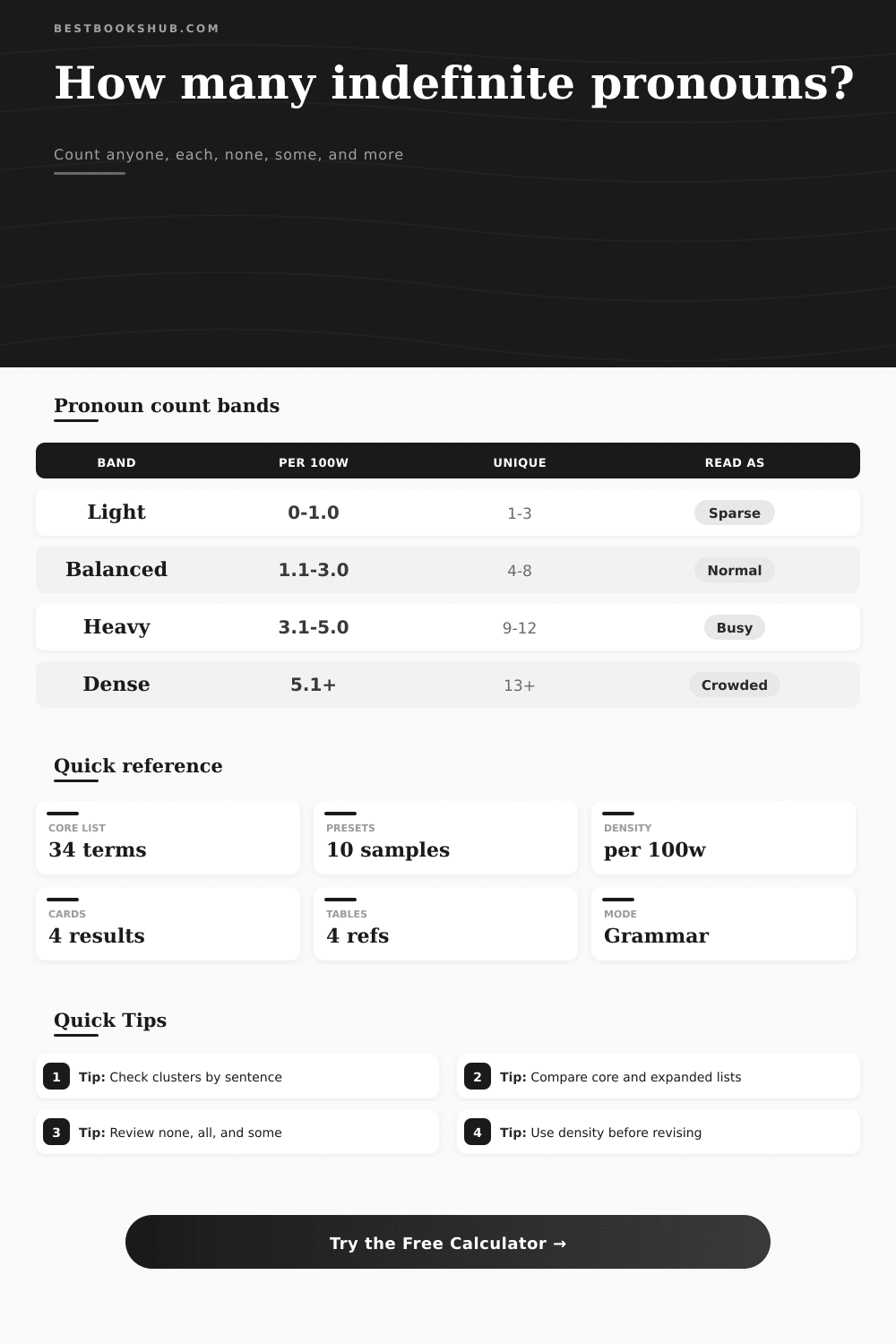
The challenge is knowing what these numbers realy mean. High density isn’t necessarily bad. A legal contract should of high density of precise terms. A mystery novel may benefit from vague pronouns to increase suspense. It depends on context. The bands shown in tool provide a rough guideline. Low band usage means sparse reference. High band usage means a crowded text that may require some thinning. Think of the results not as a verdict but as a diagnosis. If there’s a lot of universal pronoun, that may mean you tend toward overgeneralizing. A spike in negative forms could signal a writer who is more focused on what is not happening then what is. Those tendencies gives insight into your own subconscious style. They show you what you do without thinking about it, and then you decide whether to continue doing it or shift gears.
It isn’t about getting rid of indefinite pronouns altogether. To do so will result in a writing that’s too precise and stiff. It’s about using them intentionaly. You should let the reader feel someone is missing when it helps the argument or story. In the end, editing is about subtraction but also about replacement. When the tool highlights a cluster, examine nearby sentences. Who is the character? What’s the object? And if you don’t know, ask yourself why not. Is it for effect, is the mystery part of the message? Or do you just use vague words because you are used to them? The difference is important though slight.
Using this tool while scanning a few paragraphs alters what you hear when reading your writing. You notice where clarity fails; you anticipate where the fog begins. You’re no longer at its mercy; you have some grasp on the feel of what you write. That hazy blurriness recedes and the image comes into focus. That’s the power of the measurable in an immeasurable thing.