📖 Grammar density tool
Definite article density calculator
Paste prose, academic notes, a blurb, or a manuscript passage to measure how often the definite article appears and whether it creates repetition pressure.
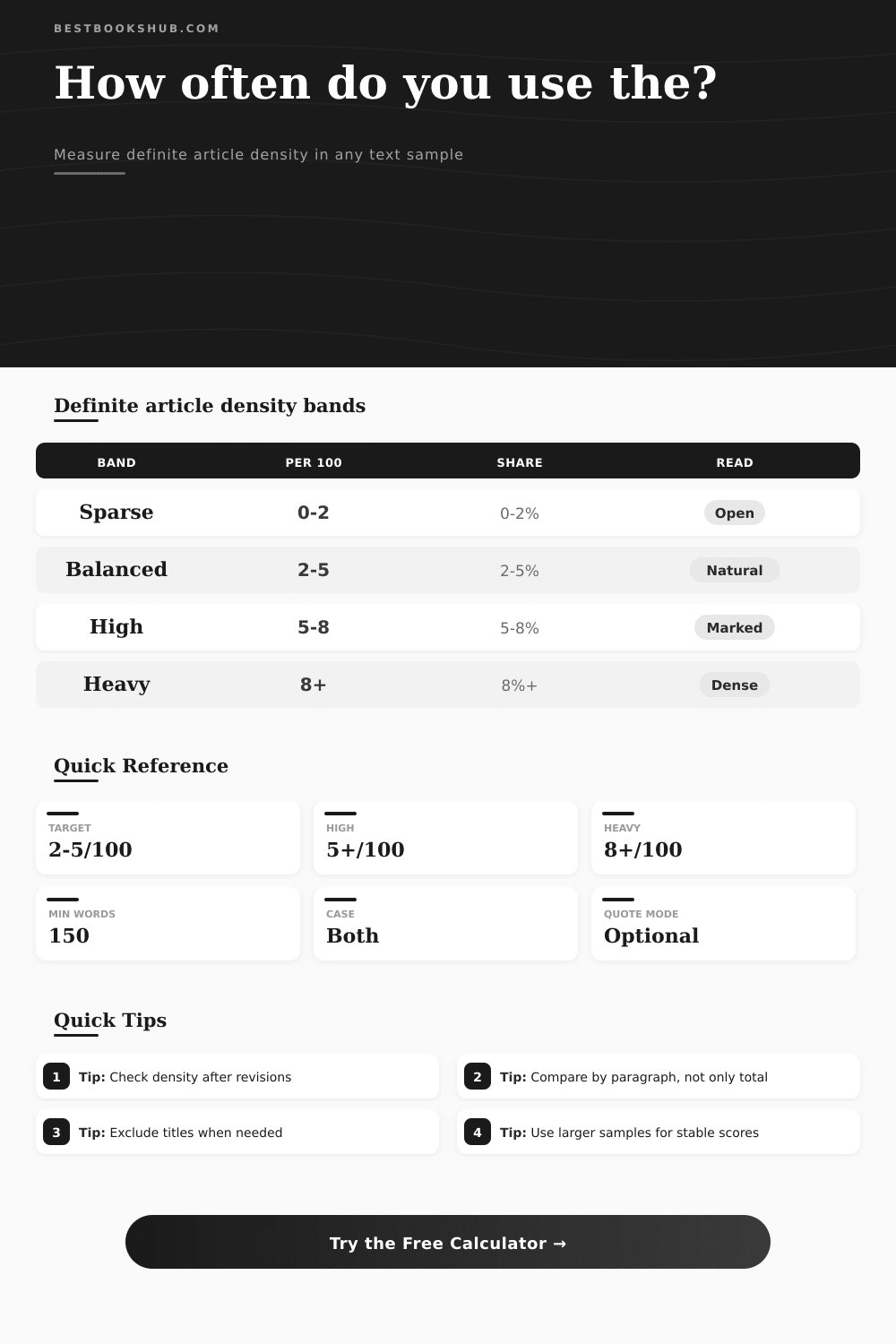
| Band | The per 100 words | Article share | Common signal |
|---|---|---|---|
| Sparse | 0.0-2.0 | 0-2% | Open phrasing, more proper nouns, or clipped notes. |
| Balanced | 2.1-5.0 | 2-5% | Natural prose with a mix of named and general nouns. |
| High | 5.1-8.0 | 5-8% | Repeated scene nouns, object chains, or explanatory prose. |
| Heavy | 8.1+ | 8%+ | Possible overuse of the same noun frame or title wording. |
| Text type | Typical density | Why it shifts | Best check |
|---|---|---|---|
| Fiction scene | 2.0-5.0 per 100 | Objects, setting, and repeated spatial cues add the. | Review paragraph clusters. |
| Academic essay | 3.5-7.0 per 100 | Abstract nouns and defined terms repeat more often. | Compare introduction and body. |
| Book review | 2.5-5.5 per 100 | References to the author, the plot, and the ending add article load. | Check headline and body separately. |
| Catalog note | 1.0-4.0 per 100 | Short fragments, proper names, and metadata reduce article use. | Exclude field labels if needed. |
| Children's prose | 3.0-7.5 per 100 | Repeated concrete nouns are common for clarity and rhythm. | Judge by page, not whole book. |
| Paragraph result | What it means | Likely cause | Revision check |
|---|---|---|---|
| One spike only | One local cluster raises the total. | A described room, object list, or repeated title. | Rewrite that paragraph first. |
| Even high spread | The whole sample leans article-heavy. | Repeated noun frames across many sentences. | Vary subjects and pronouns. |
| Low total, high title count | Titles or headings distort a small sample. | Book titles beginning with the. | Use the quoted-title exclusion. |
| Low density | The text uses more names, pronouns, or fragments. | Dialogue, notes, lists, or catalog wording. | Check clarity before adding articles. |
| Sample size | Reliability | Use case | Reading caution |
|---|---|---|---|
| Under 75 words | Low | Titles, captions, short blurbs. | One article changes the score sharply. |
| 75-150 words | Moderate | Back-cover copy or one scene paragraph. | Compare with another sample. |
| 150-500 words | Strong | Reviews, pages, abstracts, chapter notes. | Paragraph spikes still matter. |
| 500+ words | Very strong | Sections, essays, manuscript excerpts. | Use paragraph spread to find local issues. |
Sentence rhythm
High article density can make sentences feel locked to repeated noun phrases, especially when several clauses begin with the same construction.
Noun specificity
DISCLOSURE: This post may contain affiliate links, meaning when you click the links and make a purchase, I receive a commission. As an Amazon Associate I earn from qualifying purchases.
The definite article often signals known objects, places, or ideas. A high score may simply mean the passage is tightly focused.
Title distortion
Book titles such as The Trial or The Waves can inflate short samples, so quoted title exclusion helps with reviews and bibliographic notes.
Paragraph spread
A balanced total can hide one heavy paragraph. Use the flagged paragraph count to find the exact place that needs attention.
Invisible grammar glue: that’s how the definite article so often appears to be. Without it, nouns don’t stick; but with it, no one notices. Only copy editors and fiction writers knows that “the” has heft. Too much of a good thing will cause a rhythmic drag on a paragraph. That make for linguistic static, even if each single sentence follow proper grammar.
Counting by hand isn’t necessary; the tool above measures its density for you. Writers use their ears for rhythm. If a sentence trip you up when you say it out loud, you fix it. However, our ears aren’t good at picking up on subtle repetition throughout a page. This is because we’re familiar with sound of our own words.
How to Use the Definite Article Calculator
That’s where quantitative analysis come in. It turns prose into something measurable: a density score that takes away the bias of familiarity. Just paste in your text and let the calculator handle the math (above). Then you won’t have to guess whether you are just tired or if the paragraph is actualy hard to read.
Ultimately, though, it’s the inputs that matter, not the final number. You can’t tell if a text has too many instances of word “the” until you know how it is being used. For example, informal fiction is going to have far fewer definite articles than an academic article which discusses concrete, pre-defined ideas. Simply copy-pasting a thick abstract and seeing a high score doesn’t mean the writing is poor. It shows differences in register based off context.
With that said, one thing the tool lets you do is adjust for that: you can pick your own baseline (e.g., academic essay vs. Fiction) to give context to the score. Because purpose of a novel differs from a technical manual, it’s important to compare apples to apples.
Headings and titles can skew things For instance: say you post a review that includes title The Great Gatsby three times. Now all of a sudden your density score spikes; you have three uses of that exact same title in an article. But it’s not the words themselves, just the title of the book used over and over again.
That’s where quoted titles and headings come into play: they are options for exclusion that strip out these false positives and provide you with a truer view of how you actualy construct sentences. It removes the noise so you can get a clear look at its structure.
What about when results are in? Examine the breakdown. If you see a lot of density, that can point to repetition of the same phrase (noun). An example is: “The room,” “the chair,” “the window,” and “the door. Overuse of the definite article indicate something is known. It signals the object is familiar. Perhaps you’re specifying too much.
See if you can’t replace some nouns with pronouns. Instead of saying “the door,” say “it.” Instead of saying “the room,” say “there.” These small changes will ease the load, provide the reader’s eye a resting spot.
The other trap is sample size. If you feed it 50 words in a single paragraph, it may appear super dense. But maybe that’s a single weird sentence? Five hundred words are a stable sample and will give you an average. The tool warns you if what you fed it was not long enough for a reliable sample. Only trust the data when there is enough sample size to even out outliers.
But finally, this calculator is not a judge; it is a tool for diagnosis. It points out the friction. It flags the paragraphs where you’re tightening up syntax. But then what? Do you need that tightness? Will a heavy, grounded feeling be right for this scene? That’s the skill: knowing when the tightness is an accident (clutter), or on purpose. The numbers will only help show you what’s going on.
Your first move is to trust your ear; your last is to check your work with your eyes. You should of checked it twice.