❗ Draft punctuation and voice tool
Interjection counter
Paste dialogue, narration, notes, or manuscript excerpts to count interjections, separate fillers from exclamations, find repeated bursts, and review voice intensity.
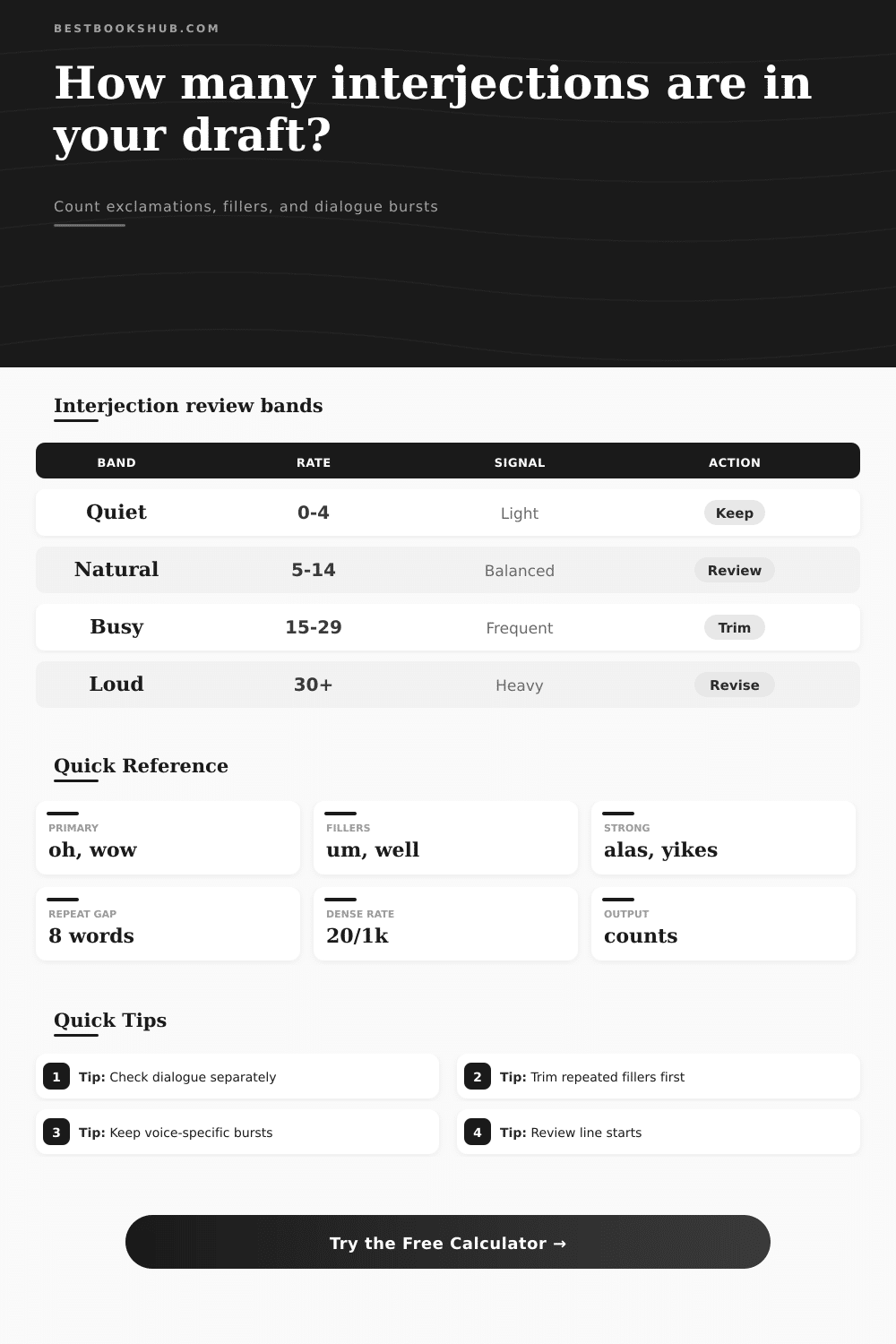
| Band | Interjections per 1,000 words | Typical signal | Best fit | Review action |
|---|---|---|---|---|
| Quiet | 0-4 | Low visible burst rate | Narration, formal prose, reflective scenes | Keep unless one character needs more vocal texture. |
| Natural | 5-14 | Moderate conversational rhythm | Most dialogue, casual essays, interviews | Read aloud and remove only repeated filler. |
| Busy | 15-29 | Frequent expressive beats | Fast scenes, comic panels, emotional exchanges | Check whether punctuation and tags already carry the reaction. |
| Loud | 30+ | Heavy burst load or repeated catchphrases | Stylized scripts, transcripts, intense action | Trim repeated words unless the voice needs the pressure. |
| Category | Examples scanned | Common role | Overuse signal | Useful setting |
|---|---|---|---|---|
| Primary words | ah, hey, oh, wow | Quick emotional cue or address | Every reply starts with the same beat | All interjections |
| Fillers | um, uh, er, well | Hesitation, discomfort, live speech | Dialogue slows without adding voice | Fillers and hesitations |
| Strong exclamations | alas, yikes, hooray, ouch | Shock, pain, triumph, dread | High intensity repeats in calm passages | Strong exclamations only |
| Multiword phrases | oh no, good grief, dear me | Set-piece reaction or idiom | Catchphrase appears too often | Multiword interjections |
| Line starts | Well, I mean, oh | Turn-taking and spoken rhythm | Paragraphs open with identical sounds | Line-start interjections |
| Text context | Expected tolerance | What to count closely | What to preserve | Best check |
|---|---|---|---|---|
| Dialogue-heavy fiction | Medium | Repeated fillers and same-line bursts | Character-specific verbal habits | Quoted dialogue only |
| Narration and exposition | Low | Stray oh, well, or alas in summary prose | Deliberate narrator attitude | Outside quotation marks |
| Comics or script panels | High | Stacked shouts and sound-like reactions | Panel pacing and readable emphasis | All interjections |
| Essay or formal prose | Very low | Casual discourse markers near claims | Quoted speech or cited dialogue | Line-start interjections |
| Transcript or interview | High | Filler density and repeated hesitation | Meaningful speech patterns | Fillers and hesitations |
| Review choice | Use when | Do not use when | Check after editing |
|---|---|---|---|
| Keep the interjection | It reveals voice, timing, surprise, pain, or social friction. | The same word repeats out of habit without changing the scene. | Character consistency and punctuation strength. |
| Replace with action | The reaction matters but the spoken burst feels flat. | The line needs quick speech rhythm or comic timing. | Beat length and sentence flow. |
| Trim filler | Um, uh, well, or like appears repeatedly in clean dialogue. | You are preserving transcript accuracy or nervous voice. | Whether the speaker still sounds distinct. |
| Split a loud line | Several interjections and exclamation marks crowd one sentence. | The line is intentionally frantic, scripted, or stylized. | Line-start count and repeated bursts. |
DISCLOSURE: This post may contain affiliate links, meaning when you click the links and make a purchase, I receive a commission. As an Amazon Associate I earn from qualifying purchases.
If one teacher has told you to remove interjections from your dialogue, it can seem like this: that your conversation is dead. Perhaps you’ve labored for weeks on conversations that sound real, only to get back a manuscript riddled with “wows” and “ohs,” circled in red. It’s not pretty. Too many burst make the prose feel breathless.
Here’s the thing: Most authors lump all interjections together. Any short, exclamatory word is noise to be removed. Wrong. An “alas” performs a different function than an “um” uttered by a character in a state of nerves. Treating these the same way will reduce your characters tones to a dull murmur of proper uncertainty.
How to Use Interjections in Your Writing
With this tool (above), you get the breakdown of which layer contribute how much toward the intensity of the scene. Which means you know what’s just filler, and what’s a real primary burst: a quick hit of emotion that says, “Something happened here!” vs. It is something like hesitation or the pattern of someone speaking live.
Why does it matter? Fillers tend to bunch up in dialogue that signals a character isn’t sure what they’re saying, but stronger exclamations flag something delightful or shocking. You may wish to keep high volume of a panic scene with its thick load of bursts if you’re cutting a thriller. But for some kind of formal narration, those same words would sound awkward.
Let the calculator (above) do the tallying; you go ahead and listen for rhythm instead of doing all that math.
The metric that throws off most drafters? The metric is density. Quiet, reflective tones are a couple of interjections to a thousand words. That’s good stuff for an interior monologue or exposition. Go past fifteen per thousand words and you enter a busy zone. It becomes energetic, maybe too much so. You begin to question whether the punctuation is doing all the work that words ought to be handling.
The reference tables on the page allow you to benchmark your draft against what’s expected in the genre. A comic script will run louder then an essay will. Context gives you key to knowing not to “fix” something with a voice that intends to be chaotic.
Another mistake is cutting out all words that are used more than once. Most of the time, when a character uses “well” over and over again in a scene, it’s a crutch. But what if they’re anxious? What if the repetition itself is key? By having the scanner flag repeated bursts in a certain window of time, you can highlight the places where their speech rhythm has grown monotonous. From there, you can determine which word stays (to maintain voice) and which gets swapped out for an action beat. Reading the lines out loud will also help you here. Are you catching your breath between each sentence? Chances are good that it’s too dense.
The tool also has context settings that enable you to select just the dialogue being quoted, as opposed to whatever surrounds the quote. Generally, speakers do not include fillers like “er” or “um” when they speak, though a narrator might choose to include them for style. It is important to isolate the dialogue so you do not penalize the narrator’s voice based on a character verbal tics.
If your protagonist speaks loudly, then analyzing the entire chapter won’t give an accurate read: The numbers will be skewed by the loudest person. Separating out the sources gives a better idea of which characters is doing the talking, and whether their speech patterns serve the scene?
More editing isn’t about cutting; it’s about cutting down to exactly what needs to be said. An interjection can carry full emotional impact of an exchange in one word. Cut the interjection, and you’re left with a statement that needs an adverbial explanation for the emotion behind it. Leave the word. Lose the tag. It is cleaner.
That doesn’t mean eliminating all interjections. It means making sure those you include truly deserve their position in the sentence. Once you grasp the distinction between a burst and a filler, you no longer need to fear the count. Instead of stumbling over your words, they become tools instead of trip hazards. Your dialogue will breathe again, not from sparseness but from purpose behind each sound. Knowing precisely why every burst belongs is how the red ink dissapears.