📝 Auxiliary grammar scan
Auxiliary Verb Counter
Paste prose, dialogue, lesson text, or manuscript notes to count be, have, do, modal auxiliaries, semi-modals, contractions, negatives, and stacked verb chains.
Load a realistic sample to compare narrative, academic, dialogue, worksheet, review, passive-heavy, modal-heavy, and edit-note auxiliary patterns.
DISCLOSURE: This post may contain affiliate links, meaning when you click the links and make a purchase, I receive a commission. As an Amazon Associate I earn from qualifying purchases.
The analyzer matches whole-word auxiliaries, expands common contractions for counting, separates auxiliary families, and flags sentences where helping verbs may need an editor's eye.
| Family | Common forms | Main job | Watch for |
|---|---|---|---|
| Be auxiliaries | am, is, are, was, were, be, been, being | Progressive and passive verb phrases | Passive candidates and be-only repetition |
| Have auxiliaries | have, has, had, having | Perfect tense and completed action | Long perfect chains or repeated had |
| Do auxiliaries | do, does, did | Questions, negatives, emphasis | Do-support density in dialogue |
| Modals | can, could, may, might, must, shall, should, will, would | Ability, advice, obligation, and future meaning | Hedging or stacked uncertainty |
| Semi-modals | going to, have to, ought to, used to, need to | Plan, obligation, habit, or necessity | Phrase matches that need context |
| Auxiliary | Family | Count | Share |
|---|---|---|---|
| Paste text to see the most common auxiliary verbs. | |||
| # | Sentence context | Hits | Signal |
|---|---|---|---|
| Sentence-level matches will appear here. | |||
| Band | Density per 100 words | Likely reading effect | Best next pass |
|---|---|---|---|
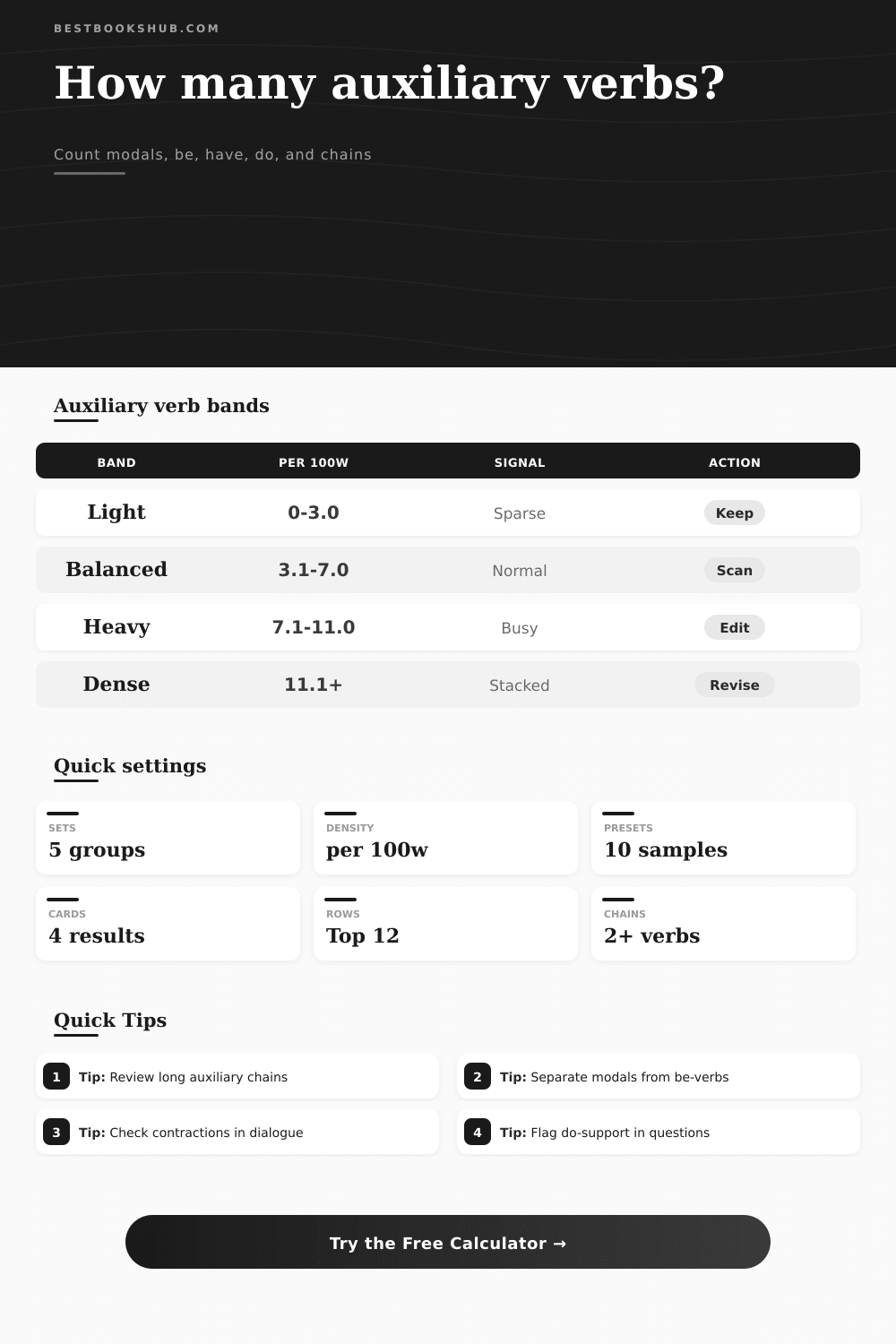
| Light | 0 to 3.0 | Simple verbs, sparse helping structure | Check that tense and questions are still clear. |
| Balanced | 3.1 to 7.0 | Normal prose, study text, reviews, and dialogue | Review only repeated forms or tense shifts. |
| Heavy | 7.1 to 11.0 | Noticeable support verbs or modal reasoning | Inspect passive candidates and long verb phrases. |
| Dense | 11.1 or more | Stacked auxiliaries may slow the sentence rhythm | Revise chains, repeated modals, and weak be phrasing. |
| Example chain | Auxiliary count | Pattern | Editor note |
|---|---|---|---|
| will read | 1 | Modal plus main verb | Clear future or intention cue. |
| has been reading | 2 | Perfect progressive | Useful, but repeated chains can feel heavy. |
| should have been revised | 3 | Modal perfect passive | Check whether a direct active form is clearer. |
| does not need to be changed | 3 to 4 | Do-support plus semi-modal plus be | Good negative example for careful review. |
This tool estimates grammar signals from visible text. It is a practical editing aid, not a full syntactic parser, so final decisions should consider context.
Counter is an auxiliary verb counter. Before helping verbs becomes a habit in your writing, Counter shows them to you.
At first, one or two be-verbs or modals is barely noticeable; they simply help the sentence along. You only take notice when there’s a stack of them in a paragraph, that’s when the prose sags. Helping verbs don’t require attention. But when you stack several in a row, they hides the meaning underneath a layer of auxiliary support.
How to Count Helper Verbs
This tool scans your paragraphs for modals, primary helpers, semi-modals and contractions to report their density. The calculator above does the math for you. It converts raw numbers into a per-hundred-word number that’s helpful in editing choices. Each one pulls the sentence in a slightly different direction so the tool parses these helpers into families.
These helpers (the workhorses of grammar) include primary auxiliaries (be, have, do), which handle tense and aspect. They also includes modals (will, shall, should etc.), which introduce ideas of future intent, obligation, or possibility. Finally, they include semi-modals (going to, have to etc.) which sit in a gray area between phrases and helpers.
By finding this pressure point through the input settings, you can choose a particular family. You may see that your draft overuses be-verbs, for instance, which is generally a signal that there’s too much passive voice or weak static description. Or maybe it are full of modals. This usually shows hedging. That is fine in academic peer review, but it kills momentum in a thriller novel. That is where the difference matter most.
When auditing grammar, contractions can be tricky, so the counter offers to either expand them (as in I’ll → will), separate them (I’ll → I, ‘ll), or just ignore them. You may not want the latter option to make your dialogue sound artificially sparse, though expanding I’ll to will does allow the tool to accurately count that modal.
Naturaly, dialogue tends to run hotter on contractions, and if you’re editing a manuscript where lots of people is speaking, you likely want to toggle the text scope to scan quotes separately. That way, the conversational rhythm of your characters won’t mess up the analysis of the narrative description around them. That’s all laid out in the reference table on the page which shows how various presets address these details. It’s a small setting, but one that could of saved you from false alarms.
A score of three to seven per hundred words is typically healthy. This is about what you’d expect from a mixture of complex and simple structures. The density bands serves as a fast sanity check.
A higher number (like eleven) suggest a sentence containing multiple stacked chains, like the ones that were doing this. They are grammatically correct, but they forces the reader to hold several layer of meaning and tense in their mind while waiting for the main action. For that reason, these sorts of chained sentences is hard to process; the tool highlights them for you, and then lets you judge for yourself if the exactness justifies the effort. In certain kinds of writing, like technical or legal work, it often does. But creative nonfiction? Typically nope.
Finally, let’s turn our attention back to the negative auxiliaries, and track their corresponding no/not counters as well. When helpers and negatives pile up in phrases like does not, the tone get muddled. Read these dense chains out loud. If your voice stumbles, the syntax is too heavy. Replace the helper with a stronger main verb where possible. For example, revise he was being difficult to he was difficult; revise it had to be done to it required doing. You’ll trim the fat but keep meaning.
Now, I don’t mean any of this to suggest that helping verbs are evil words to banish from your writing; they’re a necessity when we write clearly in English. What I do mean is: you may not realize how heavy-handed you are with these supporting structures, and you’d like to know. That’s where the counter comes in to give you visibility. It makes something that feels vague (your prose “feels” wordy) into something concrete: numbers.
Now you know which paragraphs to go back and edit with purpose instead of just blindly guessing what might need work. Trust your ear… That’s always going to be your last pass. But use those numbers as a guide, and you’ll have a clearer idea of which paragraphs to adjust. The densest ones first. Tweak them till the lightness returns and your sentences become sharper and more direct. Your helper words will be doing their jobs without drawing attention to themselves at all.