📝 Sentence type tool
Imperative sentence counter
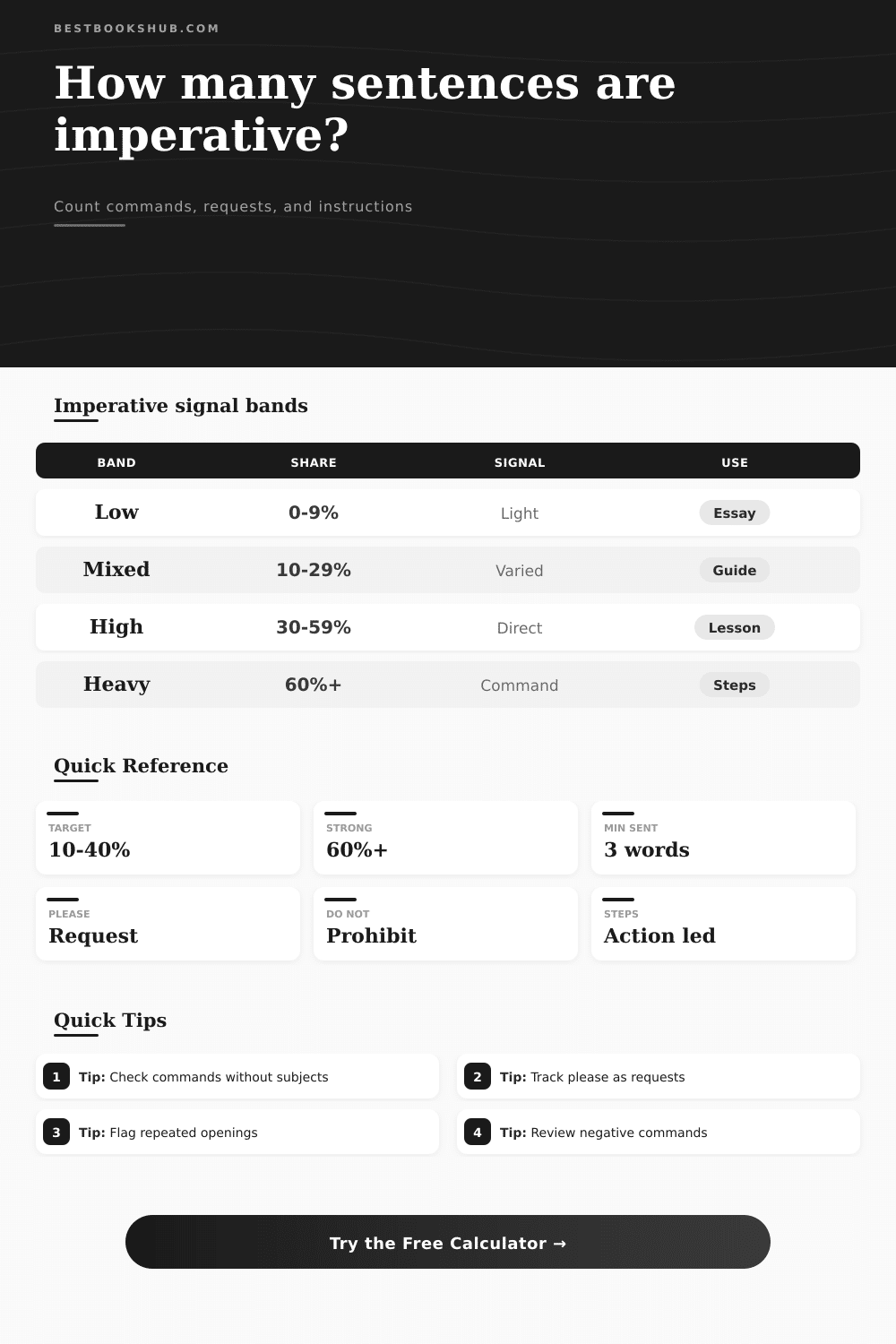
Paste instructions, classroom copy, manuscript notes, or web text to estimate commands, polite requests, prohibitions, and action-led sentence patterns.
| Signal | Typical pattern | Counter treatment | Example form |
|---|---|---|---|
| Base verb opening | Verb starts sentence | Strong command evidence | Read the passage. |
| Please or kindly | Request marker plus action | Polite imperative evidence | Please compare both editions. |
| Do not or never | Negative marker plus action | Prohibition evidence | Do not skip the citation. |
| Make sure phrase | Guided action phrase | Instruction evidence | Make sure the title fits. |
| Second-person cue | You plus modal/action | Weak or optional evidence | You should revise this note. |
| Sentence type | Main clue | Likely punctuation | How this counter scores it |
|---|---|---|---|
| Imperative | Action is directed at the reader | Period or exclamation | Counts when command evidence beats statement evidence. |
| Declarative | Subject states information | Period | Tracked as non-imperative unless it has request cues. |
| Interrogative | Question word or inverted auxiliary | Question mark | Usually excluded from imperative totals. |
| Exclamatory | Emotional emphasis | Exclamation mark | Counts only if an action command is present. |
| Writing type | Useful range | Review when | Common reason |
|---|---|---|---|
| Instructions | 35-80% | Below 25% | Steps may be buried in explanation. |
| Classroom task | 20-60% | Above 70% | Directions may feel too compressed. |
| Editorial checklist | 45-90% | Below 35% | Action items may need clearer verbs. |
| Fiction dialogue | 0-25% | Above 35% | Characters may sound overly directive. |
| General prose | 0-20% | Above 30% | The passage may read like instructions. |
| Setting | Best for | What changes | Possible false match |
|---|---|---|---|
| Strict direct commands | Final grammar checks | Requires strong action opening | Short labels may be skipped. |
| Balanced signals | Most drafts | Combines command, request, and context clues | Some headlines may count. |
| Inclusive mode | Guides and worksheets | Counts softer instruction phrasing | Advice can look imperative. |
| Revision audit | Editing passes | Adds flags for repeated or mixed openings | Extra flags need human review. |
Direct command
Begins with a base-form action verb and usually has an implied subject: you. It receives the strongest imperative score.
Polite request
DISCLOSURE: This post may contain affiliate links, meaning when you click the links and make a purchase, I receive a commission. As an Amazon Associate I earn from qualifying purchases.
Softens the command with please, kindly, try to, or remember to. It still directs reader action.
Negative command
Tells the reader not to do something. The counter tracks do not, never, stop, avoid, and similar markers.
Non-imperative
States, asks, or describes without directing action. The counter keeps these in the denominator for sentence balance.
Here’s one example: You’re creating step-by-step instructions for a new piece of software. Ten sentences in, seven begin with a verb. Click here. Read this next. Don’t skip ahead. This pattern continues. You feel satisfied when your directions is easy to understand. A beta tester calls and says the writing sounds aggressive. It sounds like you’re giving orders, like a drill sergeant.
Oops! That’s the gentle power of the command sentence at work… Telling someone what to do (and how to do it). But when used too often, it becomes a source of friction. This tool will let you measure the friction before anyone else notice.
How to Use Command Sentences in Writing
Classroom assignments, recipes, and technical writing rely on imperative sentences to get the job done. They’re stripped-down constructions, leading with the action and dropping the usual subject (the word you). It’s an efficient construction; it gets the job done. And yes: That’s not the same thing than being readable. Packed with commands, a paragraph forms a staccato beat that can tire out a reader.
The counter counts how many sentences in your draft are command rather than questions or statements. It searches for words like do not and please, but it also look for missing subjects and base-form verbs at the start of sentences. The calculator above runs the numbers for you.
To understand what it’s counting, though, you need to think about texture of your prose, not just the rules of grammar. This leads into one of more difficult aspects in this analysis: What should be counted as a command? Technically, any sentence that tells someone to do something (e.g., “Please review the document”) is considered imperative. But it’s not as hard as, say, “Review the document now.” How picky the system gets at this level depend on which of the two settings… Called modes for detection, you pick.
Inclusive mode picks up all of those soft sentences (“please”), while strict mode does not. Why does that matter? Well, in a newsletter for a community, you may want the softer tone; in a user manual, the harder tone of straight commands. Pick your tone before judging the density of your commands.
A high share of imperatives also depends on context. For example, if you’re composing a safety checklist for readers, you don’t want anyone wondering whether they should put on hard hats, and you certainly don’t want them wondering! This is why you’d like almost all of your sentences to be imperative: you want people to put on hard hats.
In other kinds of writing, however, such as when you’re writing a blog post or an essay, using too many commands is a problem, because it shows you’re trying to tell your reader what to think instead of showing them why your idea matters. The reference tables included with the tool outline this and explain which shares is typical for various kinds of writing. For instance, instructional text does well with a high command share, whereas a more general kind of prose can get away with a lower one.) Knowing where your text falls into that spectrum will help you edit with intent.
Secondly, you may have observed that the tool distinguishes between positive and negative commands. For example, the command “do not press the button” requires the reader to think about a negation, which takes more mental effort than the command “press the button. Having a lot of negative imperatives in your instructions could potentially make them more difficult to execute than necessary (if you perform an audit). It is a subtle distinction, yet one that impacts clarity.
When done well, authors will combine sentence types in natural ways because they employ imperatives to prompt action, declarative statements to set the scene, and questions to invite curiosity. There’s no magic number when it comes to editing, and there’s definitely no magic number with this tool. Instead, it’s about understanding your audience’s reading rhythm and adjusting to match.
When it says your writing contains lots of commands, stop and consider how many instructions require a command in each sentence. Can you merge a couple small commands into one? Perhaps insert a transition sentence explaining why the next command is important. These changes decrease the number of commands while keeping things clear. It’s not about removing commands entirely; it’s about putting them in places that pack maximum punch.
Ultimately, we want readers to follow our content, not to be marched through an obstacle course. The bottom line is that this is a diagnostic tool, not a kind of literary style police. It tells you something about the structure of your writing, which isn’t the same thing as its personality or muscle. Consider it a way to identify patterns that may not be jumping out at you during a quick reading.
Identify the runs of back-to-back commands and break them apart. Smooth out the language where appropriate. Next, read it out loud. Are the directions clear? Does the flow feel natural? If so, then you’ve hit a sweet spot.
Yes, the words will still guide the reader, but they’ll do it gracefully rather than forcefully. That’s what sets a good guide apart from a mere list of orders.