📖 Sentence type analysis
Declarative sentence counter
Paste a passage to estimate how many sentences are statements, how many need sentence-type review, and where questions, commands, or exclamations may interrupt the pattern.
Each preset loads a different editing situation: academic claims, narration, dialogue, instructions, mixed punctuation, and short fragments.
| # | Type | Confidence | Evidence | Sentence excerpt |
|---|---|---|---|---|
| Choose a preset or paste text to populate sentence-level classifications. | ||||
| Signal | Why it matters | Typical outcome | Review note |
|---|---|---|---|
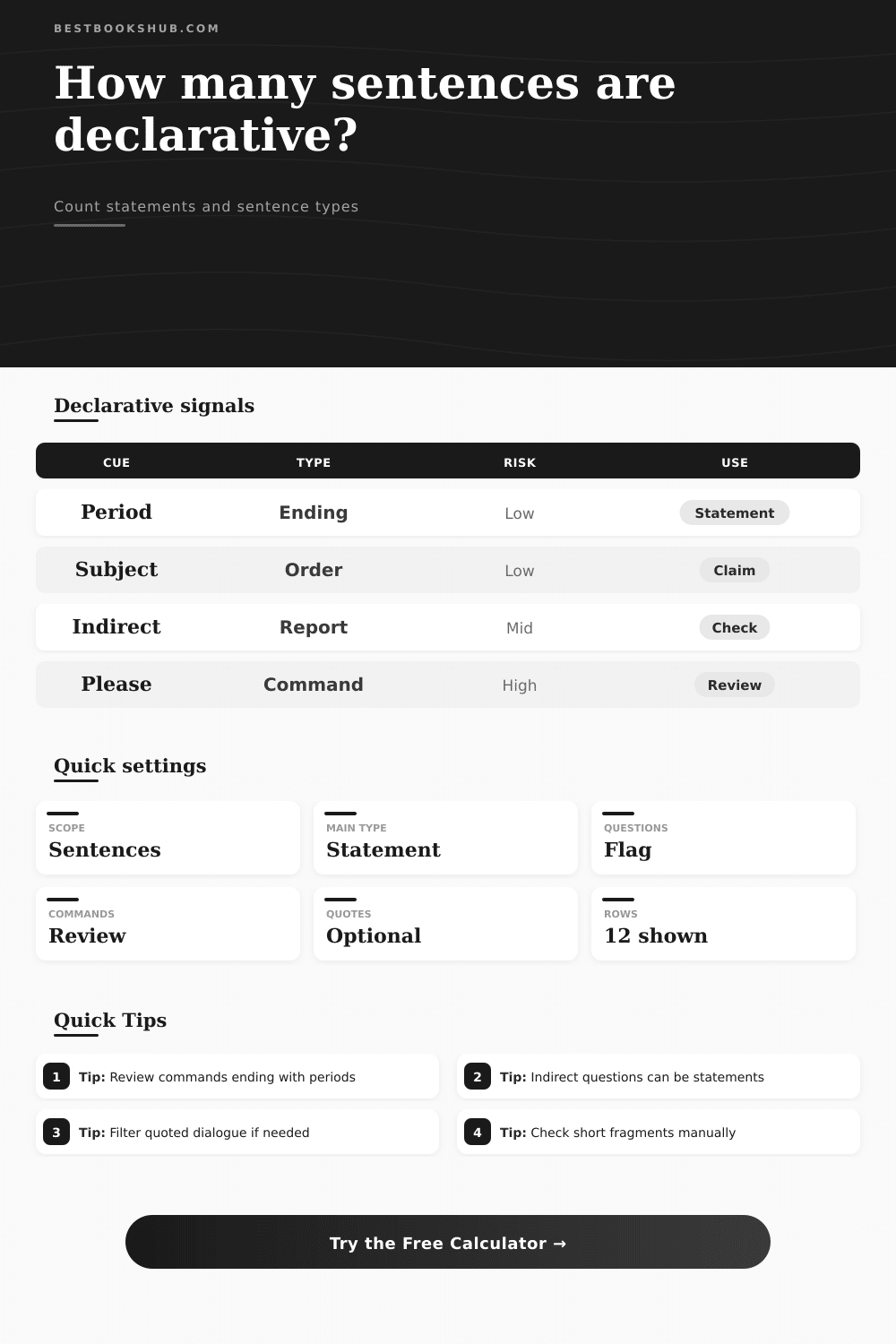
| Period ending | A full stop commonly closes a statement. | High declarative score | Commands can also end with periods. |
| Subject-first wording | Sentences that begin with nouns, pronouns, or articles often make claims. | Statement likely | Very short fragments may need context. |
| Linking or finite verb | Verbs such as is, are, was, has, and shows support clause structure. | Statement or report | Questions invert the verb and subject. |
| Indirect question | Phrases like I wonder why can still be declarative when they end with a period. | Statement with embedded question | Review if the passage teaches question forms. |
| Imperative opening | Verbs such as read, compare, choose, and write can signal commands. | Command review | Soft requests may be counted separately. |
| Ending | Default type | Declarative chance | Example pattern |
|---|---|---|---|
| Period | Statement or command | High | The chapter closes quietly. |
| Question mark | Question | Low | What does the narrator know? |
| Exclamation mark | Exclamation or command | Low to mixed | The ending changes everything! |
| No mark | Fragment or note | Depends on mode | Chapter three turning point |
Declarative
DISCLOSURE: This post may contain affiliate links, meaning when you click the links and make a purchase, I receive a commission. As an Amazon Associate I earn from qualifying purchases.
Makes a statement, report, claim, or observation. It usually ends with a period and has a subject plus predicate.
Interrogative
Asks a direct question. It usually ends with a question mark or begins with a question word or inverted auxiliary.
Imperative
Gives a command, request, or instruction. The subject is often implied, so period endings can be ambiguous.
Exclamatory
Expresses strong feeling or emphasis. It often uses an exclamation mark, but some emotional statements still remain declarative.
| Declarative share | Likely feel | Best use | Editing focus |
|---|---|---|---|
| 0% to 39% | Question or command heavy | Worksheets, interviews, prompts | Check whether statements are missing. |
| 40% to 69% | Mixed sentence types | Dialogue, lessons, active essays | Review shifts in tone and purpose. |
| 70% to 89% | Statement led | Reviews, summaries, exposition | Check variety and clarity. |
| 90% to 100% | Highly declarative | Reference notes, reports, abstracts | Add questions only when useful. |
| Input mode | Strict behavior | Balanced behavior | When to use |
|---|---|---|---|
| Commands | Exclude verb-first orders | Flag likely commands | Instructional copy or worksheets |
| Indirect questions | Review embedded question words | Count as statements if period-ended | Essays and book analysis |
| Fragments | Exclude below word minimum | Review short period-ended rows | Notes, outlines, and drafts |
| Quotes | Exclude or separate dialogue | Include quoted sentences | Fiction pages and interviews |
Rhythm: Rhythms often leads us to believe our writing feels flat, even when grammar is impeccable. Prose has a heartbeat, and it’s found in sentences. When all beats sounds the same, the reader hears a machine reading off a list. To avoid falling into statement mode and vary one’s rhythm enough to hold a reader, we counts our declarative sentences. This will help you visually see whether you’re getting out of sentence shape enough to engage a reader.
The tool on this page break down the rhythm for you, separating commands and questions and claims so you can visualize how your draft shapes up. Most serious writing consist of declarative sentences. Declarative sentences state something (a fact, opinion, scene description, etc.). Declarative sentences typically have a subject-verb structure and conclude in a period. And that’s exposition: the default mode for explaining stuff.
Why Rhythm Matters in Writing
Are you writing an essay, a report, or a news article? That’s mostly what you’re doing; declaring stuff. The calculator figures out math for you, marking where each line conforms to this pattern or differs from it.
Why is this helpful? It’s easy to get carried away and have too many declarative sentences, this isn’t necessarily bad; sometimes, though, it become monotonous. You don’t want your reader scrolling through a wall of statements without feeling the force of your claims. But punctuation does not always match its purpose.
You might instruct someone to do something, “Tell him to leave.” That’s not a declarative statement; that’s a command. You can change how the tool treats those command statements. You can also choose to count them in your total or tag them for manual inspection.
Why? Because if you’re authoring a piece of narrative fiction, there’ll be plenty of dialogue and declaration going on; if you’re crafting a lesson plan, you’ll likely include many more commands. And you wouldn’t of want to distort your sense of sentence structure by overlooking those.
Another gray area is indirect questions. Technically, the indirect-question sentence “I wonder why he left” includes a subject and verb, ends with a period, so it’s declarative. Yet it sound like a question (and you get to choose whether to mark these as such). For academic writing, where you frequently have embedded questions and reported speech, that flexibility is crucial. Marking all indirect questions as purely statements can cause you to overlook a recurring pattern in the way you phrase your uncertainty. The reference table on the page explains how various cues affect classification, which helps you see why the tool would flag any given sentence as ambiguous.
Then there are wild cards called the pieces. These is usually mistakes in formal writing; but in journalism or other creative nonfiction, they’re sometimes the power of emphasis. For example, if you write with a lot of short punchy sentences, you’ll want to set the calculator’s threshold for words above the minimum. This is because it will consider those short phrases when calculating your average sentence length and remove them if they are below the threshold.
Essentials you has to tell the tool what constitutes a complete thought in your situation. So, balance is the goal. Too few questions or commands, and you risk lecturing; too many, and you risk interrogating. Find the combination that suits your needs.
Examine what percentage of your sentences were declarative, and if it’s anywhere close to a hundred percent, consider whether you’re missing chances to talk straight to the reader. If it’s too low, consider whether your claims are getting lost in the noise. It’s not rocket science: these stats provide only a beginning, but ultimately your ear will be the judge. Still, when you know the distribution you can edit with intent instead of guesswork; the data makes the invisible visible. And once you begin to see the beat, you can begin to sculpt it.