📝 Grammar analysis tool
Compound-complex sentence counter
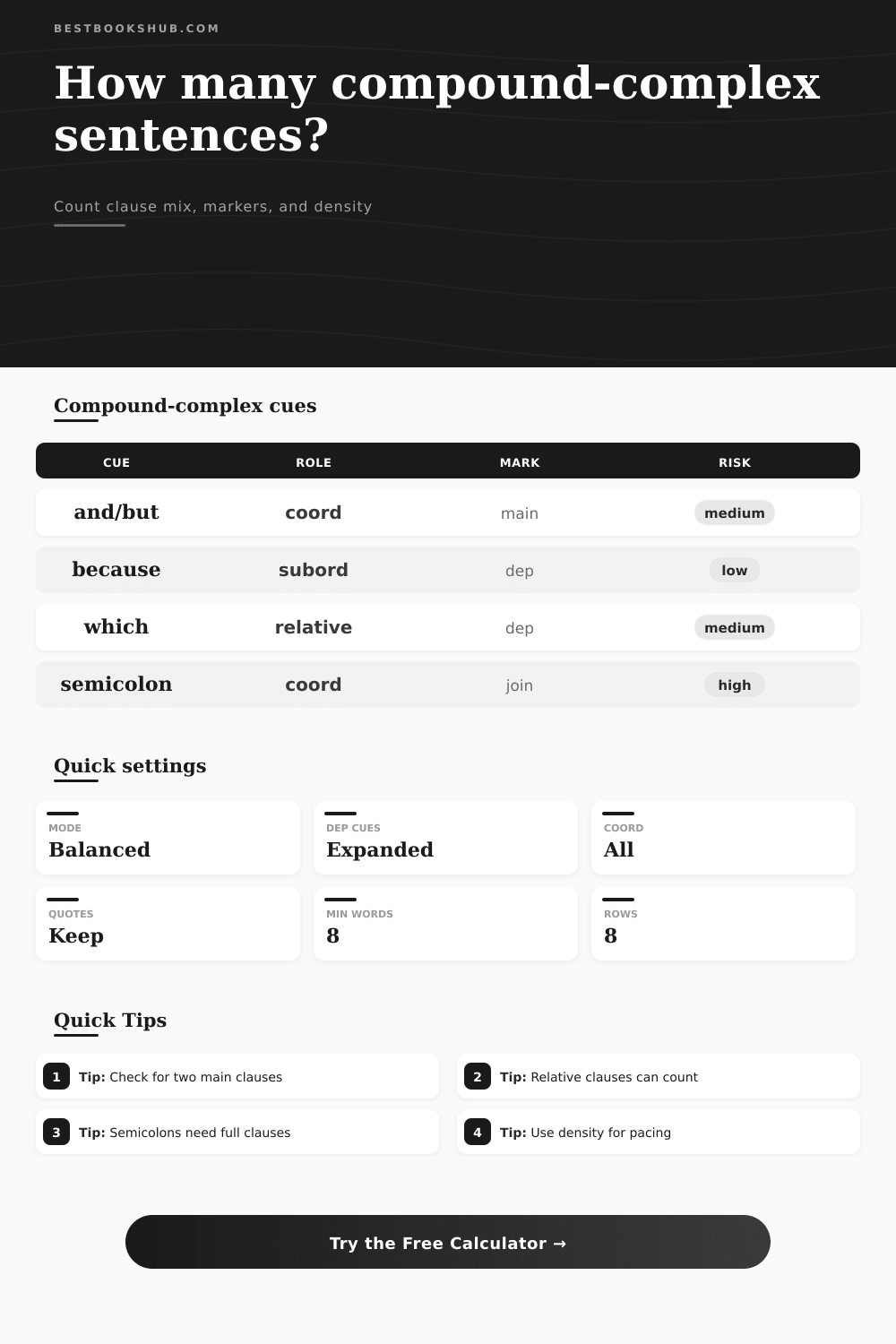
Paste prose, essays, manuscript pages, or classroom samples to estimate which sentences combine coordination with at least one dependent clause.
| # | Pattern | Dependent cue | Compound cue | Score | Sentence sample |
|---|---|---|---|---|---|
| Run the counter to see matched compound-complex sentences. | |||||
| Marker group | Examples | Typical clause role | Counting note |
|---|---|---|---|
| Time | after, before, when, while, until | Adverb clause | Usually strong when paired with a subject and verb. |
| Cause | because, since, as | Reason clause | Since can be temporal or causal, so strict mode scores it lower. |
| Condition | if, unless, provided that | Conditional clause | Often reliable, especially near a comma boundary. |
| Concession | although, though, even though | Contrast clause | Common in polished compound-complex sentences. |
| Relative | who, which, that, whose | Adjective clause | That can be ambiguous, so scope settings matter. |
| Purpose | so that, in order that | Purpose clause | Often appears after an independent clause. |
| Connector | Examples | Strength | Review note |
|---|---|---|---|
| Comma plus FANBOYS | , and / , but / , so | Strong | Usually marks a second independent clause when both sides have verbs. |
| Semicolon | ; the point continues | Strong | Counts only when the boundary is not split into separate sentences. |
| Conjunctive adverb | ; however, / ; therefore, | Strong | Broad mode recognizes these as compound joins. |
| Dash join | clause - clause | Medium | Useful in narrative prose but can overcount fragments. |
| Comma splice | clause, clause | Weak | Broad mode flags likely splices for review, not certainty. |
| Coordinated predicate | ran and shouted | Low | Usually not compound unless a second subject is present. |
| Density band | Share of sentences | Likely effect | Best use |
|---|---|---|---|
| Light | 0% to 5% | Direct, quick rhythm | Action scenes, summaries, instructions |
| Moderate | 5% to 18% | Varied but readable | Essays, articles, polished narrative |
| Dense | 18% to 35% | Layered reasoning | Analysis, argument, academic paragraphs |
| Heavy | 35% plus | Potentially slow | Grammar lessons or deliberately formal prose |
DISCLOSURE: This post may contain affiliate links, meaning when you click the links and make a purchase, I receive a commission. As an Amazon Associate I earn from qualifying purchases.
If you went to high school, do you remember grammar drills? You had to identify if each sentence was simple, compound, or complex. Your teacher circle it with a red pen. It always felt like busywork.
It felt like you were learning something that didn’t apply to real writing because the structure seemed too rigid. But the truth is that these are the skeletons of your prose. They shape the way your argument marches or wanders. Knowing the distinction between compound and compound-complex sentences mean more than just being able to list out your ideas; it allows you to weave them together.
Why Compound-Complex Sentences Matter
The tool will tell you what it sees. But knowing what to see alters how you read what you write.
The structure of a compound-complex sentence is this: At minimum, it needs two independent clauses connected through coordination and a dependent clause. Not every long sentence fit here. A compound-complex sentence does two things at once. It joins two equally important thoughts, and it also connects a third thought that provides context or a cause for the others.
Think about it like a three-act play condensed down into a single breath: you’ve got the main action, you’ve got the parallel action, and you’ve got the background info that helps explain the reason behind any of it. And when written with skill, it creates a sense of control: you don’t simply relay the events; you help the reader see how those events are related to each other.
Here’s the kicker: Overdoing it on compound-complex sentences is the ruin of the drafting process. Every single sentence in your essay are compound-complex? The reader gets tired. Too many clauses fighting for attention make them lose the thread. That’s what I mean by density. That’s what calculator measures with its density metric.
Often (usually) the sweet spot is around five and eighteen percent. It is enough to vary things up but not enough to overwhelm the syntax. In the heavy category, thirty-five percent or more, you may feel like your writing is academic and dense. Time to break some of those chains and let the reader catch his/her breath.
The tool will be different depending on what kind of writer you are. When working on a formal research paper, you may prefer a stricter setting where it only flags obvious subordinating conjunctions (like “although” or “because”). There’s no debating that those words mark dependency.
If you’re working on some creative fiction though, you may prefer a wider setting. While these might sound more informal (“which,” and “who”), relative clauses opening with them is also frequently used as dependent elements in narrative context. You can also choose how sensitive you want the tool to be here. Ultimately it isn’t about answering one question correctly, but rather about adjusting the lens to fit your text.
For example, a polished manuscript may only require the strongest cues flagged, whereas a student essay may benefit from flagging every possible clause.
Complexity is not the same as coordination. People confuse those things. Adding a comma and an “and” doesn’t suddenly create a complex sentence. It simply creates a compound one. They miss the thing that adds a layer of subordination to take it to the next level: the compound-complex.
They believe that sophisticated = long. No. Sophisticated = deep. You can write a brief, compound-complex sentence that is far more effective then a lengthy, simple one. “She lied, he knew, because trust was gone.” That’s the structure. And it feels calculated, purposeful. It doesn’t require fifty words to demonstrate skill with handling clauses in relation to each other. You just need proficiency with handling them clearly.
So what about looking at your matched sentences? This will actualy help you review them. What kind of example does the tool pick out? Is it the sentence in which you make your point? Or do you see yourself getting tangled up in explanation? If there seems to be no pattern to the matches, perhaps your syntax is inconsistent. If they all bunch up at the end, perhaps you’re trying too hard to sound smart towards the close. The breakdown will give you clues as to how you’re speaking for yourself.
Perhaps you’re relying on particular connectors (e.g., “therefore,” “however”) to link clauses together. That’s a stylistic fingerprint. It will help you change it on purpose.
At the end of the day, grammar isn’t about rules but clarity and rhythm. A compound-complex sentence is one that builds rhythm. It makes the reader slow down. It makes them think about relationships and gives texture to your writing. However, as with all tools, there should be a reason behind using it. Writing better doesn’t require counting out each sentence. Instead, you want to know what you’re building. Know the skeleton then dress it in whatever flesh suits your purpose.
You should of known that. Don’t aim to hit the right number. Aim to feel the rhythm of your sentences and know which ones to let carry the weight of your argument and which ones to speed up. This is what takes you from writing sentences to writing style.