✍ Grammar analysis tool
Run-on sentence detector
Paste prose, essays, dialogue, reports, or notes to flag likely run-ons, comma splices, fused clauses, long chains, and pacing-heavy sentences.
Start with a realistic text type, then adjust the detection mode and length limits to match your draft.
DISCLOSURE: This post may contain affiliate links, meaning when you click the links and make a purchase, I receive a commission. As an Amazon Associate I earn from qualifying purchases.
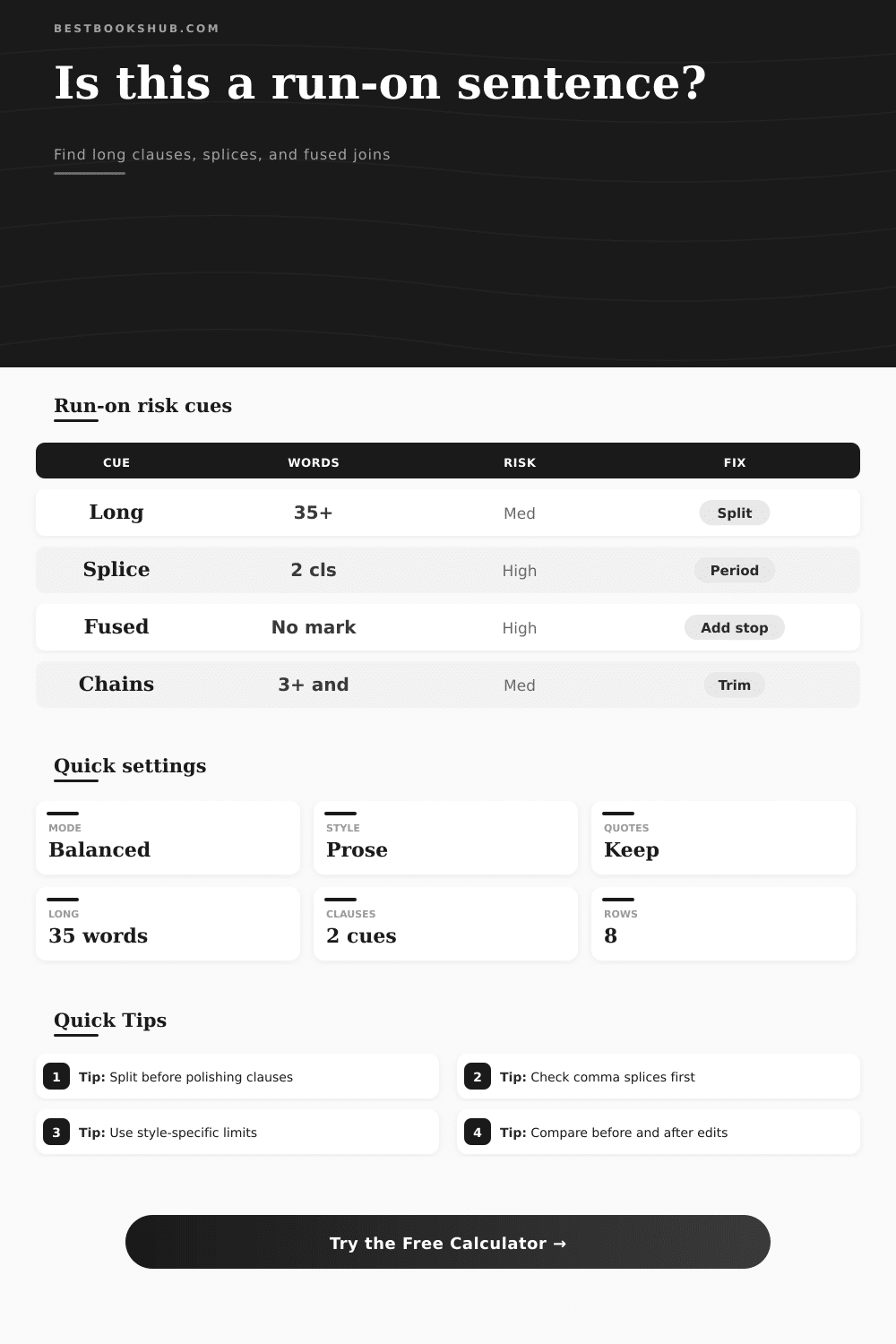
The detector scores each sentence from length, independent clause cues, comma joins, missing stop signs, coordinating chains, and semicolon load.
Use the tables to interpret sentence length, clause joins, and repair options across different types of writing.
| Risk band | Typical score | Main signal | Review action |
|---|---|---|---|
| Clear | 0-24 | Short clauses | Keep structure |
| Watch | 25-49 | Long or joined | Inspect rhythm |
| Likely run-on | 50-74 | Several cues | Split or punctuate |
| Severe | 75-100 | Heavy chain | Rewrite first |
| Trigger cue | What it suggests | Common example | Best repair |
|---|---|---|---|
| Comma splice | Two clauses joined by comma | I read, I marked | Period or semicolon |
| Fused clause | Two clauses with no joiner | It ended he left | Add stop or joiner |
| Chain joins | Many and, but, so links | Clause after clause | Cut one link |
| Semicolon load | Stacked independent ideas | Three clauses | Make two sentences |
| Text style | Long limit | Strictness | Notes |
|---|---|---|---|
| Fiction | 35 words | Balanced | Allows cadence |
| Essay | 32 words | Strict | Favors clarity |
| Business | 28 words | Strict | Shorter is easier |
| Legal | 45 words | Broad | Clauses may be long |
| Dialogue | 30 words | Balanced | Quotes shift rhythm |
| # | Risk | Words | Cues | Sentence sample |
|---|---|---|---|---|
| Run the detector to list the strongest findings. | ||||
Reading is hard when your sentences run on. That’s what happens when a writer connects more than one idea in a single breath. A lot of writers does that. They use conjunctions and commas to link point A to point B to point C. By then, the sentence has run completely off the rails.
This page finds them for you before a reader trips over them. Instead of simply counting words, it look for structural failures. Paste in an essay fragment, a business memo, or even draft chapter. Then it will scan for chains of coordinating conjunctions, fused clauses, and comma splices. How many of those signal does it find? That’s its risk score.
How to Fix Run-On Sentences
Sometimes long isn’t bad, just like sometimes short is bad. The tool tells the difference between intentional and unintentional longness. While both Shakespeare and Hemingway crafted long sentence, their intent was clear. If you’re building your sentence’s rhythm into a peak and stopping at the right place, then that’s a good sentence. But if you didn’t know how to stop, then no.
But it’s flexible enough to work with your writing style; and that makes a big difference. It’s fine to get a little out of control with sentence structure when writing fiction: You’re dealing with a character having a panic attack; she says things in fragments! For regular narrative prose, then, you want to put it on “balanced” mode, where it will accept longer clauses provided they’re properly punctuated.
When you have something like an academic or business document where clarity is most important, you want to go sterner. In those situations, the detector will tighten up its thresholds (it’ll flag sentences that might be acceptable in a novel but would of been rejected in a technical report).
If you write legal briefs, you might want to loosen things up just a hair. Legal writing tend to be pretty complicated based off using conditional constructions that appear to be run-on sentences, but really aren’t.
To correct this issue you should know the distinction between a fused sentence and a comma splice. A comma splice involves simply placing a comma in between two independent clauses. This is a frequent mistake because it sounds like how we naturaly pause our speech.
A fused sentence is even more problematic: Two independent clause have been smooshed together without any punctuation whatsoever. Both mistakes cause confusion for the reader as to where one idea stops and another starts.
The table on the page lists which types of mistake carry the biggest risk. Easy-to-fix comma splices score a high risk rating here (just add a semicolon or period). And while fused clauses also scores a high rating, they’re often so messed up that they need to be completely restructured to make any kind of sense.
Look up your result. If there’s a high-risk score, check out the main issue noted. Is it a chain of conjunctions? Or does the problem lie with too-long sentences? See if you can cut the middle links by breaking up the chain; if not, split at the first conjunction.
The idea isn’t that all sentences must be short, but that all sentences ought to be clear. Long ones don’t necessarily need to be chopped; short ones can be choppy so managing the flow is what matters. Identify where you have lost control using the calculator, then edit for rhythm, not just according to rules.
When you’re finished, read the text aloud. If you didn’t end up gasping for air in mid-sentence, you’ve probably done it right.