📖 Grammar analysis tool
Sentence fragment counter
Paste manuscript pages, essays, notes, or worksheet answers to flag likely sentence fragments, phrase-only lines, dependent clauses, and complete-sentence matches.
Load a sample to test different fragment patterns: fiction beats, academic notes, dialogue, headings, student answers, and heavily clipped prose.
| # | Classification | Score | Primary cue | Text sample |
|---|---|---|---|---|
| Choose a preset or paste text to populate review rows. | ||||
| Fragment pattern | Typical signal | Why it is flagged | Review action |
|---|---|---|---|
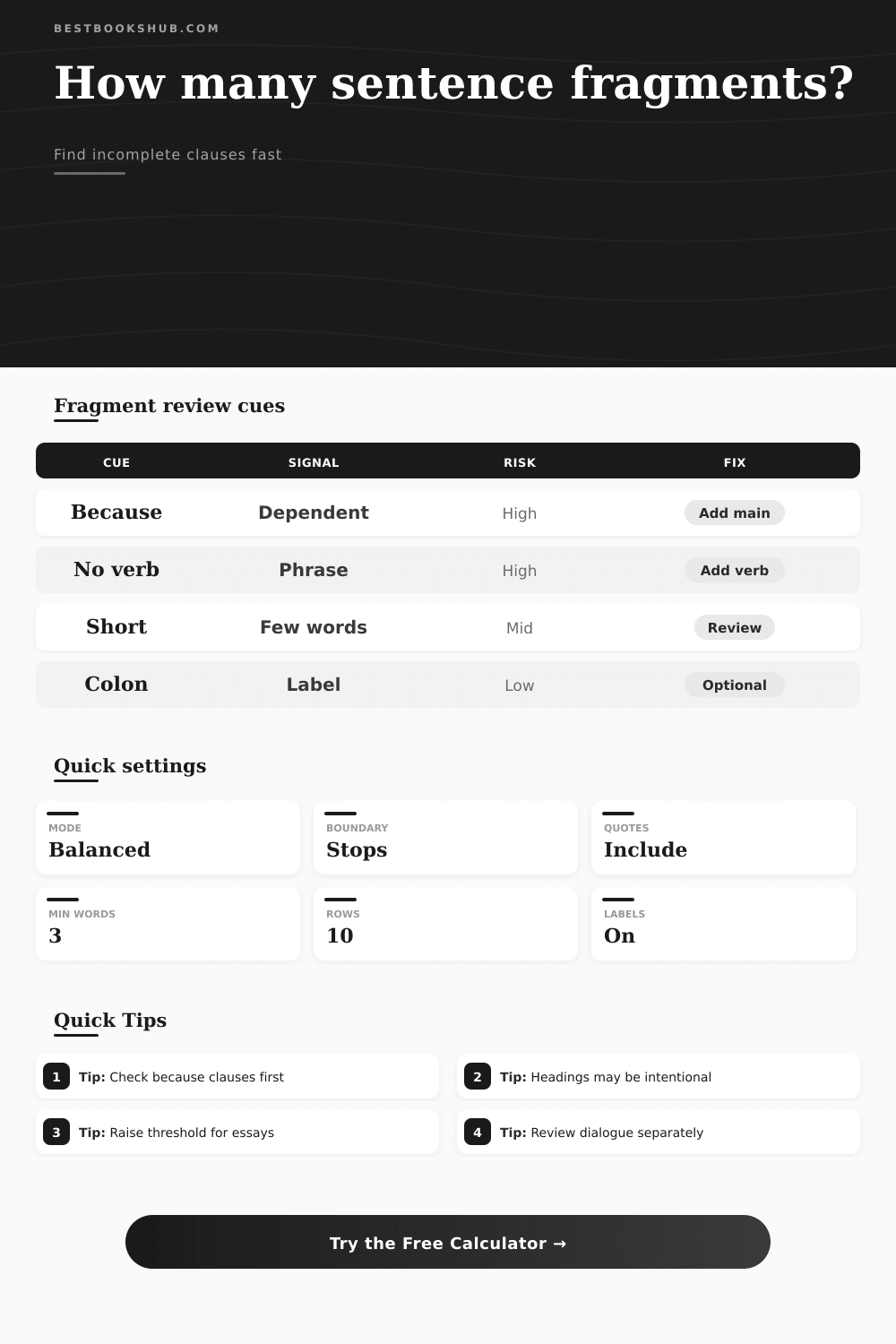
| Dependent clause | Because, although, if | Starts with a subordinator and lacks a clear main clause. | Add an independent clause or attach it to the previous sentence. |
| Phrase fragment | Noun or preposition phrase | Has words but no strong finite verb evidence. | Add a subject and predicate if it should stand alone. |
| Afterthought | Especially, such as, including | Looks like an extra detail separated from its sentence. | Join to the nearby sentence or revise as a full sentence. |
| Intentional fragment | Title, label, dialogue beat | May be correct in creative or outline contexts. | Keep only when the style or format needs it. |
| Evidence | Score effect | Balanced mode | Strict mode |
|---|---|---|---|
| Finite verb signal | Lowers risk | Strong completion cue | Required for low risk |
| Subject starter | Lowers risk | Supports complete clause | Needs verb evidence too |
| Dependent opener | Raises risk | Flag unless main-clause cue appears | Flag even with weak completion |
| Very short unit | Raises risk | Review below word limit | Review more aggressively |
| No final punctuation | Raises risk | Small review bump | Large review bump |
| Context | Suggested mode | Common false positive | Best review setting |
|---|---|---|---|
| Academic essay | Strict grammar scan | Cited titles and labels | Threshold 65% or 75% |
| Fiction draft | Balanced editor scan | Intentional rhythm fragments | Track quotes separately |
| Worksheet answer | Broad fragment sweep | Short correct answers | Line break boundary mode |
| Outline notes | Broad fragment sweep | Headings and bullet labels | Minimum words at 2 or 3 |
| Book review | Balanced editor scan | Book titles without verbs | Stops only boundary mode |
Complete sentence
DISCLOSURE: This post may contain affiliate links, meaning when you click the links and make a purchase, I receive a commission. As an Amazon Associate I earn from qualifying purchases.
Usually contains an independent clause with subject and finite predicate evidence, even when the sentence is short.
Dependent fragment
Begins with a subordinating word and does not clearly resolve into a main clause within the same unit.
Phrase fragment
Looks like a noun, verb, or prepositional phrase standing alone without enough clause structure.
Intentional fragment
May be acceptable in headings, dialogue, notes, ad copy, fiction rhythm, and deliberately clipped style.
Even when your draft is punctuated correctly, you may still sense that something isn’t right about it. Often that’s a sentence fragment, a partial thought that goes unnoticed because it sounds like natural pause.
Writers of fiction use sentence fragments to interrupt lengthy text. They can be used for emphasis. That’s less of an issue in business or academic prose which is meant to be clear. Maybe you’re thinking you’re being succinct. What you’ve done is withheld the verb or subject that would make this a meaningful clause.
How to Find and Fix Sentence Fragments
How do you find these holes? Use the tool on this page. It reads through your units to determine if each can stand by itself. Every good sentence require a subject and a finite verb. Any sentence that lacks either component are flagged as being problematic.
Why? Not all short phrases is wrong. Labels and titles is meant to be short. The system scans for dependent starters: Although, because, etc. Those words start a thought but they don’t finish a thought, unless they connect back to a main clause.
There are detection modes you can tweak too. For most prose the balanced setting is a fine place to begin. This mode assumes you’re going to use fragments for stylistic purposes. It flags potential errors while avoiding the assumption that every short line constitute an error.
If you need something stricter, such as when writing an academic paper, switch to strict grammar scan. This setting require a main clause before it pass a sentence through. Finally, there’s the broad sweep option that gives you more leeway in your creative draft that includes dialogue. There you can control whether the tool counts quotes against you. Chances are you will be using fragment within dialogue. Turning off this unit will prevent false alarms.
That’s a percent of density. That’s telling you what percent of your text is not complete. It doesn’t imply bad writing. It may be because you’re using a short, choppy style. Look down through the review rows and see what’s listed as an example. Is it lacking a verb? Is the flagged word part of a complete sentence? For instance, the door remained shut is a complete sentence. The door remaining shut are a fragment. Does the fragment add energy or confusion? Decide for yourself.
Many writers struggle with dependent clause. These are thoughts that begin with a subordinating conjunction; they provide context but cannot stand on their own. It might say, “Because it began raining,” or “Then it stopped.” It will trail off. The reader won’t supply what comes next. They’ll know your train of thought has derailed.
If you attach that clause to an idea, you’re home free. Because it began raining, we stayed inside. That is it. The logic is complete. The tool flags them for you so you can make sure they connects.
Fragments show how well author controls the reader’s experience. Does it pause intentionally? Or does it confuse unintentionally? Careless errors gets sorted out from style. Keep what works. Fix what doesn’t. A vague feeling becomes a clear task. Identify the places where the flow halts. Decide whether or not that halt serve a purpose. This isn’t about eliminating all fragments. This is about making sure each one does its job. Why is this sentence short? Answer and control the pace. You should of answer and get controlled by grammar.