✍ Sentence structure analyzer
Comma splice detector
Paste prose, essays, reviews, notes, or dialogue to find likely comma splices: two independent clauses joined by a comma without a coordinating conjunction, semicolon, or full stop.
Load realistic samples from student essays, book reviews, manuscripts, dialogue, summaries, blurbs, academic notes, email edits, catalog copy, and clean controls.
| Band | Score range | Evidence pattern | Likely action | Example signal |
|---|---|---|---|---|
| Clean | 0-24 | No strong clause pair | Keep the comma | Intro phrase, date, or simple list |
| Watch | 25-44 | One side looks clause-like | Read in context | Short phrase after comma |
| Review | 45-64 | Two possible clauses | Try a period or conjunction | Subject and verb on both sides |
| High | 65-84 | Strong independent clauses | Revise before publishing | No connector after the comma |
| Severe | 85-100 | Repeated splices or long clauses | Run a sentence-level edit | Multiple full clauses in one sentence |
| Fix type | Pattern | Best when | Result | Watch out for |
|---|---|---|---|---|
| Period split | Clause. Clause. | Both ideas can stand alone | Fastest clarity repair | Too many choppy short sentences |
| Semicolon | Clause; clause. | The ideas are tightly related | Keeps the comparison close | Overusing formal punctuation |
| Coordinating conjunction | Clause, and clause. | The relationship is additive or contrastive | Shows logic explicitly | Choosing the wrong connector |
| Subordination | Because clause, clause. | One idea depends on the other | Creates hierarchy | Changing meaning accidentally |
| Common false positive | Why it happens | Detector control | Manual check |
|---|---|---|---|
| Serial list | Multiple nouns before a final and/or | List and date commas | Ask whether both sides contain verbs |
| Direct address | A name follows or precedes the comma | Detection strictness | Look for dialogue address |
| Introductory phrase | Opening phrase has no finite verb | Minimum words per side | Check whether the first side can stand alone |
| Quoted speech | Dialogue punctuation follows speech rhythm | Quoted text handling | Preserve voice when grammar is intentional |
| Date or number | Commas separate date/place parts | Ignore likely lists and dates | Do not split dates into sentences |
DISCLOSURE: This post may contain affiliate links, meaning when you click the links and make a purchase, I receive a commission. As an Amazon Associate I earn from qualifying purchases.
A comma splice is one of those errors where if you see one, you know what you’ve got. It’s when two independent thoughts collide without any connection between them. For example: “The archive was locked, Mara kept the key.” It seems like it should work. It sounds okay, until you realize that it doesn’t have structural integrity.
Comma splices is the number-one grammatical error among early drafts, because people mix up pause with connection. They assume the comma will connect two whole clause together. It won’t. The detector above helps you spot these moments before they become habits.
What is a Comma Splice and How to Fix It
That’s not rocket science, but that doesn’t mean it can’t be used wrong. Independent clauses must be joined by a comma when there is a coordinating conjunction at the entrance. Those are and, but, or, nor, for, yet, and so. Those are the FANBOYS.
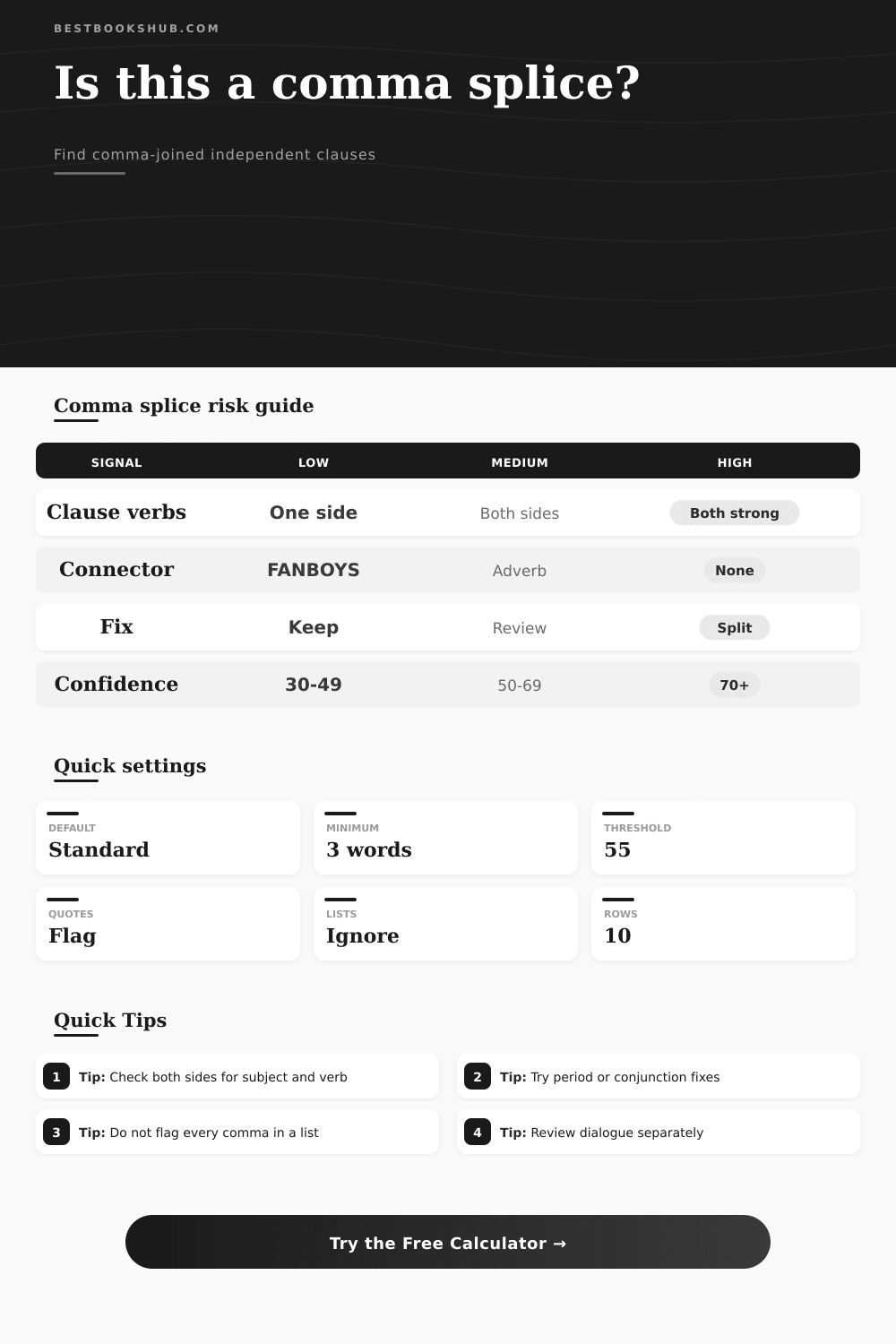
Now here’s where most people go off the rails: If there’s no FANBOY and two subjects and two verbs on each side of the comma, you’re in trouble. They focus on the comma, not what’s going on around it based off sentence weight. It look for those subject-verb combinations to see whether the comma is carrying more than its share of the load.
Not all of those commas between nouns will be errors. Directly addressing someone, listing items, adding dates, these all require commas, but they’re legitimate uses of commas. Tell the system this; after all, you’re probably writing a dense academic paper or document. You can tweak strictness of settings and also train it on list patterns so it doesn’t catch each serial comma in your bibliography as a structural fail. That’s a little thing but it makes a difference.
What you want is to find the splices that break the flow, not the ones that organize data. That’s when the system has flagged a risky splice, when it says: this isn’t quite right, but instead of saying no, it suggests fixes. This is where it gets interesting.
Split the sentence with a period. That makes for clarity and emphasis. It forces the reader to pause and breathe.
Use a semicolon. That maintains a visual connection between the two clauses. However, it recognizes they are independent. It shows that the two ideas is closely linked.
Add a conjunction. It states how the ideas relate. The choice of repair alters the meaning slightly, though. A period is decisive. A semicolon is reflective. A conjunction is explanatory.
Sometimes writers don’t want to fix their splices, because they like the speed of that original sentence. It feel urgent. But broken grammar isn’t what makes something urgent. Pacing and word choice do.
So read it out loud if you’re not sure. Did you stumble? Did you need to take an unexpected breath? Then the structure is probably wrong.
The calculator above will run the math for you. But the last judge is always your ear. The numbers gives you a map. You’ve got to walk the path.
In fiction, where a character frequently runs on or speaks in fragments, consider that you may want to immitate their breathless speech or confusion and use a comma splice deliberately. To account for these cases, the detector does have modes for handling quoted text. You can instruct it to scan quotes strictly or skip over them completely to maintain the voice.
Grammar rules are guidelines for clarity; they aren’t laws of nature. Clarity is king in formal writing. Voice could take precedence in creative writing. It’s as important to know when to break the rule as it is to know the rule itself.
The next part is the reference tables that explain the risk bands. A low risk band suggests you may want to tolerate the comma in an informal setting. A high risk band suggests it’s a structural issue with the sentence. And a severe risk band suggests there are multiple issues and they’re pulling you out of the text.
Use those risk bands to determine where you should of spend your editing time. Focus on the severe first because those are the ones that take the reader out of the story. Refine the rest later. You can’t fix everything all at once. Editor fatigue will set in if you try.
In the end, writing is all about control. How fast or slow you go? What tone do you want? Which way does the info flow? And punctuation, that’s your steering wheel. Driving with no brakes is like a comma splice. It’ll get you down the straightaway, but when there’s a hill it won’t cut it.
The detector lets you test-drive your brakes before going public. It points out where the lines are weak. After a while, you begin to see the pattern, and then you stop making the error. You learn to feel the load of the clause.
Let’s go back to the key and the archive example. Why did that first splice felt hurried? The time break allows each fact its space. The semi-colon connects it with uncertainty. The conjunction brings contrast and clarification. Every decision makes another narrative possible.
This isn’t about the tool writing the narrative. It’s about making sure you have the right foundations. Let the content shine when the structure holds strong. That’s what editing does. Clear the gears to let the message live. The lock stays shut on the archive, but now your sentence has swung open.