📖 Phrase grammar scan
Prepositional Phrase Counter
Paste prose, essays, reading notes, or manuscript excerpts to count prepositional phrases, compound starts, object length, sentence stacks, and density hotspots.
Load a realistic sample for fiction, academic, review, lesson, catalog, description, or editing work. Each preset fills every setting and recalculates.
DISCLOSURE: This post may contain affiliate links, meaning when you click the links and make a purchase, I receive a commission. As an Amazon Associate I earn from qualifying purchases.
The analyzer looks for whole-word prepositions, multi-word compound starts, and a likely object span after each start. Use the settings to focus the scan.
| Phrase start | Family | Count | Share | Object signal |
|---|---|---|---|---|
| Phrase rows appear after calculation. | ||||
| Sentence | Words | Phrases | Flags | Context |
|---|---|---|---|---|
| Sentence rows appear after calculation. | ||||
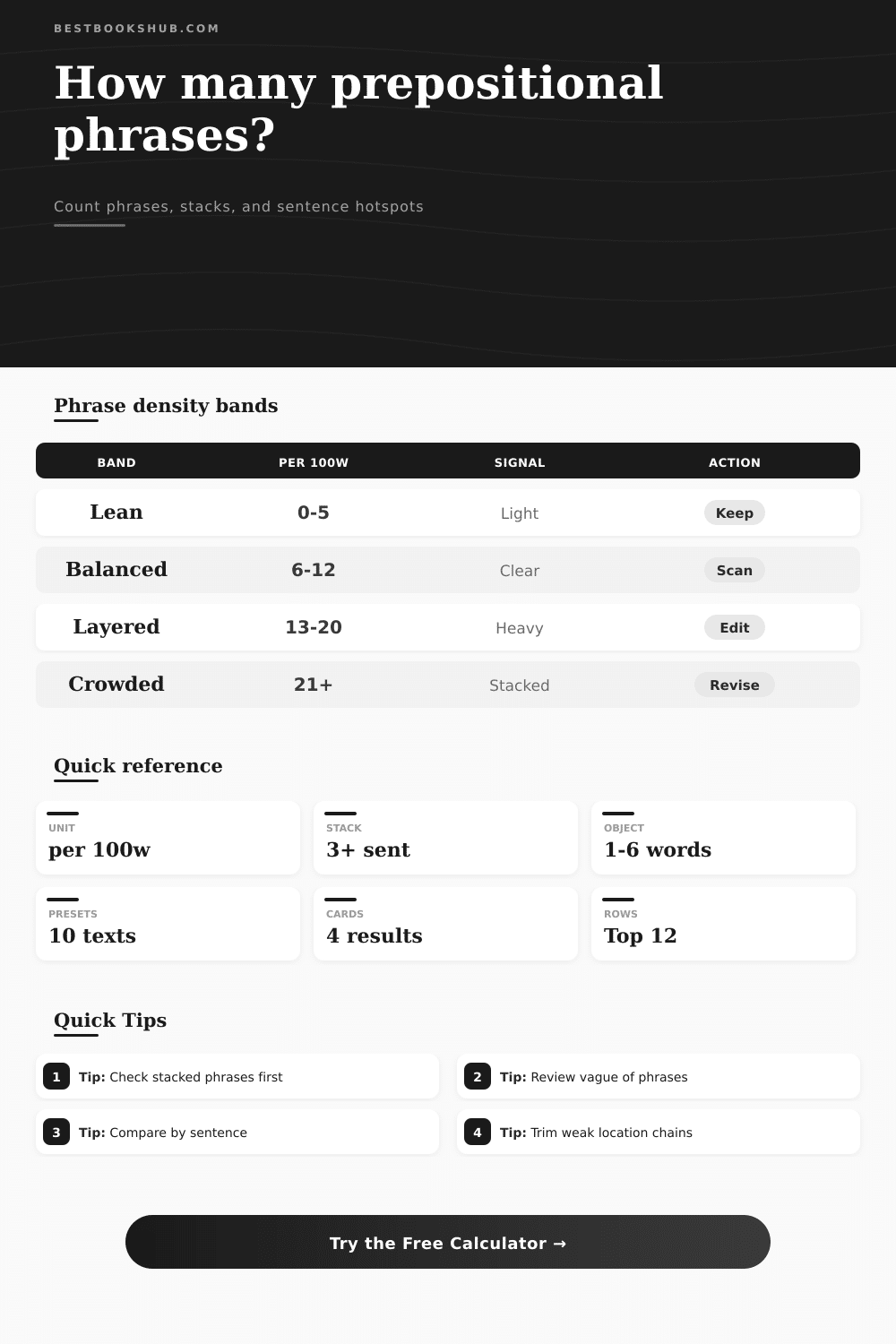
| Density band | Per 100 words | Common signal | Editing priority |
|---|---|---|---|
| Lean | 0 to 5 | Direct phrasing | Usually leave alone |
| Balanced | 6 to 12 | Natural detail | Review only long sentences |
| Layered | 13 to 20 | Heavy modifiers | Check stacked locations and of phrases |
| Crowded | 21 or more | Dense links | Revise sentence structure first |
| Phrase family | Examples | Common role | Review cue |
|---|---|---|---|
| Place | in, on, under, beside | Position and location | Watch long setting chains |
| Direction | to, from, into, through | Motion or source | Check repeated route wording |
| Time | after, before, during | Sequence and duration | Keep timelines clear |
| Relation | of, for, with, about | Link or association | Trim vague of strings |
| Compound | because of, in front of | Multi-word start | Confirm the whole phrase is needed |
This grammar calculator uses pattern matching and object-span heuristics. Treat results as an editing guide, especially when words like as, to, and since can serve more than one role.
With this approach, Counter scans for starts to prepositional phrases, possible objects, stacked sentences, compound structures, and other elements of density. You get an idea of how much you’re packing into a piece of prose, and then you go back and edit out overwriting.
Now, here’s the thing: Counter doesn’t merely count phrases. It classifies them. Why? Because not all prepositions is created equal. For example, a phrase that begins with “because of” have a very different function from a phrase that begins with “in.” By separating relation phrases from time phrases from place phrases, the tool lets you understand whether you’re mired in ambiguous relationship language or drowning in too many location.
How to Use the Tool to Edit Your Writing
That’s where the calculator can help with editing. One preposition phrase isn’t normally a problem, two usually aren’t either. But three or more in one sentence is something that makes the reader store way too much information in their working memory before they get to the core action. This tool will flag those stacked up sentences right away for you to notice.
You might think you are writing active prose by using powerful verbs. However, if each verb is hidden under four layers of prepositional phrases, sentence is still passive in effect. The reader will not find the point until they have been lost among all the details.
Looking at the big picture, your average density band gives you an idea of what kind of writer you are as a whole. Lean = direct, so good for fast-paced action and clear instruction. A balanced style gives you space to let details and description flow naturaly. Crowded or layered writing is not wrong but it shows you need more sentence variation. Academic writing tends toward a lot of qualifiers, and thus tends to has higher density. Fiction needs less density (too much kills the momentum).
You can see how all this fits together in table below on the page. It will help you determine whether you’re carrying the appropriate amount of weight for the type of writing you want to do.
Finally, note that the number of words following each preposition is important. How many words the calculator thinks there are after a preposition can give an idea of how far away the object is from the verb. That distance matters: a long phrase can build an image and make an argument, but it can also muddy the waters. And the further away the object gets from the verb, the weaker the link. That’s where filtering by long object phrases becomes useful: perhaps your trickiest sentences aren’t actualy those with lots of phrases; maybe they’re just ones with a single really long complicated one that hides what is going on.
Rhythm is more important then rules when it comes to editing. There are plenty of examples of great writers using lots of prepositional phrases because that’s how the rhythm needs to fall on page. The trick is doing so intentionaly. Don’t lop off words/phrases for the sake of reducing the count. Lop them off if they muddy the sense or slow down the flow of writing. Read the sentences out loud to the spots where the tool is pointing you, and see if it flows well. If it does, let it be. Stumble on the reading? Simplify the sentence. Think of the math as the guide; let your ear be the one who decides what goes where.
First, examine those stacked sentences. That’s the easiest way to make something better right away. Next, look at how densely you have related phrases and eliminate as many as possible without changing any meaning. Eliminate “of” strings whenever possible and substitute strong verbs for weak prepositions. It’s a subtle change in direction but it greatly clarifies things.
Mostly, it’s about knowing what you’re really keeping track of. This isn’t about word counts. It’s about measuring how much effort is required from the reader. Now you know where there’s an excessive load and you could of reduce it while still conveying the same thing.