📖 Prose texture tool
Adjective density calculator
Paste fiction, nonfiction, reviews, blurbs, or classroom prose to measure adjective load, descriptive clusters, intensifier pressure, and repeated modifiers.
| Adjective | Count | Category | Signal |
|---|---|---|---|
| Paste text or choose a preset to show the most frequent adjectives. | |||
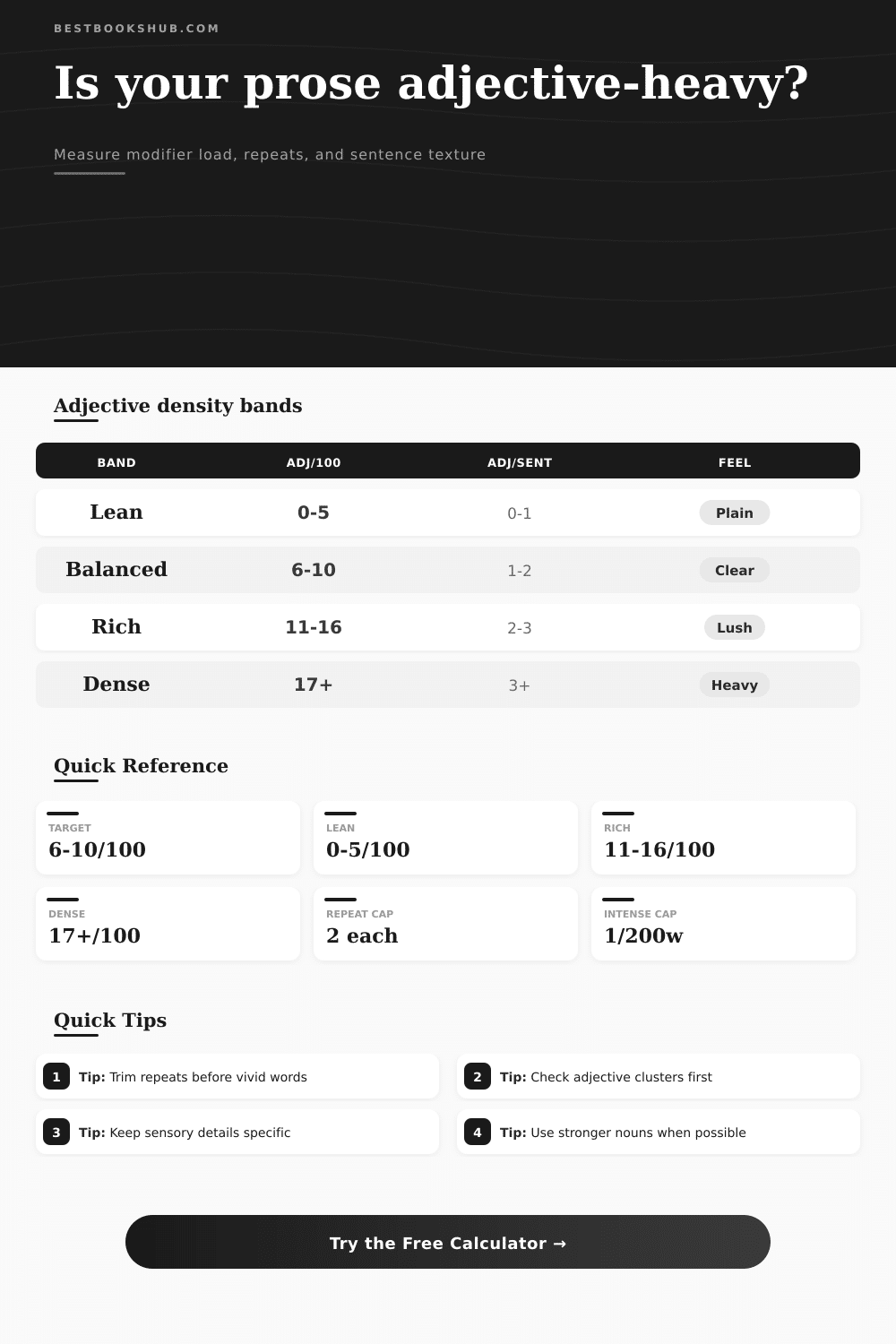
| Density band | Adjectives per 100 words | Usual prose feel | Editing move |
|---|---|---|---|
| Lean | 0 to 5 | Plain, fast, noun and verb driven | Add detail only where readers need orientation. |
| Balanced | 6 to 10 | Clear description without heavy drag | Keep specific modifiers and trim repeated vague ones. |
| Rich | 11 to 16 | Textured, sensory, or promotional | Check clusters and swap some modifiers for stronger nouns. |
| Dense | 17 and above | Heavy, ornate, or compressed | Revise sentence by sentence before cutting all description. |
| Passage profile | Useful target | Higher range can work when | Watch signal |
|---|---|---|---|
| Fiction scene | 6 to 12 per 100 | Description carries setting, mood, or focal voice. | Too many stacked modifiers before one noun. |
| Book review | 5 to 10 per 100 | The review compares tone, structure, and audience fit. | Vague praise repeats without evidence. |
| Jacket copy | 9 to 16 per 100 | The copy needs compressed genre and mood cues. | Several adjectives compete in one sentence. |
| Academic paragraph | 3 to 8 per 100 | Terms are technical and necessary for precision. | Abstract modifiers replace concrete claims. |
| Children or middle grade | 4 to 9 per 100 | Sensory words support quick mental pictures. | Long adjective strings slow read-aloud rhythm. |
| SEO summary | 4 to 9 per 100 | Modifiers clarify search intent or format. | Generic adjectives bury the keyword phrase. |
| Modifier type | Examples | Calculator signal | Revision cue |
|---|---|---|---|
| Sensory | dark, bitter, velvet, silent | Often useful when tied to scene evidence. | Keep the ones readers can picture or feel. |
| Evaluative | good, weak, useful, important | Can become vague when repeated often. | Replace with a reason, example, or precise noun. |
| Relational | historical, urban, academic, digital | Often necessary for category or subject clarity. | Keep if it changes the noun's meaning. |
| Intensified | very quiet, deeply strange | Adds pressure to the texture score. | Use sparingly or choose a stronger base word. |
| Compound | slow-burning, character-driven | Counted by the selected compound mode. | Check whether the phrase has become shorthand. |
Lean prose
Best for action, explanation, instructions, and passages where nouns and verbs should carry most of the meaning.
Balanced prose
DISCLOSURE: This post may contain affiliate links, meaning when you click the links and make a purchase, I receive a commission. As an Amazon Associate I earn from qualifying purchases.
Best for reviews, essays, and scenes that need description without turning every noun into a decorated phrase.
Rich prose
Best for close description, atmospheric fiction, lyric paragraphs, and compressed book copy with clear image work.
Dense prose
Best treated as a revision flag unless the passage deliberately uses ornate rhythm, parody, or catalog-like compression.
The Texture: How Adjective Density Impacts Your Writing Adjective density make your words feel heavy. The more adjectives you use, the heavier your sentences becomes. They begin to drag. Instead of absorbing the image, reader tally the words. And when you force yourself to check the density, you’re also forced to ask, “does each word earn its space?”
With the Density Calculator, you don’t even need to count modifiers by hand. Just copy/paste your draft, and let the calculator crunch the numbers. Adjust detection mode. Use it if you are writing academic text that needs to be exact, or fiction that uses many compound words. Then you’ll get a density score based off every hundred words (plus a band classification).
Understanding Adjective Density
What’s that mean? Think of it like your compass. If you fall into the dense category, then your writing is probably either compressed or flowery. Maybe it works for poetry. Probably not a mystery scene. The reference table explain all of this, showing texture demands of any given genre. A blurb on the back of a jacket can afford to be rich, whereas a book review should of be clear.
Intensifiers in writing are sign of uncertainty. It’s likely that if you’re using a booster word to help your adjective perform its job, then your adjective isn’t doing all that well. The tool show you these patterns, which reveals how often you may be relying on crutches rather than creating structure. You may discover that you say the same words over and over again, and not even know it.
Perhaps you adore the word beautiful and throw it into any sentence about face, sunsets, etc. Repetition robs an effect. This section shows you those repeats so you can replace them with particular verbs or nouns that pack a stronger punch.
Sensory details anchor the reader in a moment. A dark room sounds better than a mysterious one because now we have something for our eyes to grasp on to. But even these senses aren’t limitless. Too much on top of each other, though, and you lose the picture, reduced to noise.
What this thing measures, though: that’s the secret. It doesn’t say ugly, it says modifiers. How does it know? It doesn’t. The artistry part remains your area. It gives you information so you can choose skillfully, knowing what’s going in.
Maybe you want to have a lot of words all together because it fits some character’s voice. Sure. Fine. Know it, though.
Editing means taking things away. Subtraction is a powerful force. And editing can often be just that. First drafts are about discovering your voice. Editing’s about honing it. One way to improve is through adjective density. It exposes places you may trust your reader too little (under-explain) or try to explain too much (over-explain).
Most readers likes to do some reading. Letting them piece together mood from setting and action is part of the fun. Don’t take that away by describing everything from every angle. If you’re uncertain whether your writing leans more wordy, aim for that sweet spot in between. It’s still descriptive enough to get the job done, but not so draggy as to feel like a slog. Plus, it’s easier to add details back later than remove clutter.
Think about who you’re writing for. Is this a student essay? Then make it precise, no need for poetry here. Is this an SEO summary? Then go for keywords, no need for fluff there either. The tool includes a feature to choose these profiles. That shifts the target ranges to match industry standards. So you won’t fall into the trap of treating technical content like novel-writing. Keep your objectives in line with those of your audience.
Writing is rhythmic. Adjectives is color and add pauses to that rhythm. Too many and it’s frantic; too few and it’s flat. It takes time to find the sweet spot, to learn from feedback how to do it well. This calculator provides objective feedback, a baseline you can count on.
Still, you’ll need to read your work out loud to catch its music. But once you know the number, you’ll be able to hear it better. Begin with the data. Then listen to what the sentence have to say.
That’s where good editing lives: in combining instinct with analysis. Cut the repeats. Replace the vague words. Leave in place those that sing. Your readers will thank you for guiding them clear through your writing.