📖 Clarity editing scan
Weasel Word Counter
Paste manuscript pages, reviews, essays, jacket copy, emails, or nonfiction drafts to count vague wording, unsupported claims, soft qualifiers, and sentence-level credibility flags.
Load a realistic sample to see how different genres use vague source words, hedge phrases, filler qualifiers, passive cover, and overgeneral claims.
DISCLOSURE: This post may contain affiliate links, meaning when you click the links and make a purchase, I receive a commission. As an Amazon Associate I earn from qualifying purchases.
The scanner uses curated weasel-word groups, phrase matching, and sentence flags. It helps focus an edit pass; it does not decide whether a word is always wrong.
| Sentence | Matches | Density | Top forms | Flag | Context |
|---|---|---|---|---|---|
| No text analyzed yet. | |||||
| Group | Typical words | Why it weakens text | Revision move |
|---|---|---|---|
| Vague source | many, some, experts, people say | Hides who is making the claim. | Name the source or remove the claim. |
| Soft proof | clearly, obviously, undoubtedly | Asserts certainty without showing evidence. | Add proof or make evidence carry the point. |
| Hedge | may, might, seems, tends to | Blurs the level of confidence. | State the condition or narrow the claim. |
| Filler | very, really, quite, basically | Adds pressure without adding meaning. | Use a precise verb, noun, or measure. |
| Generalizer | most, everyone, always, never | Overextends a claim beyond support. | Use the actual group, range, or exception. |
| Passive cover | it is said, is believed, was shown | Can detach action from the actor. | Put the actor or source back in the sentence. |
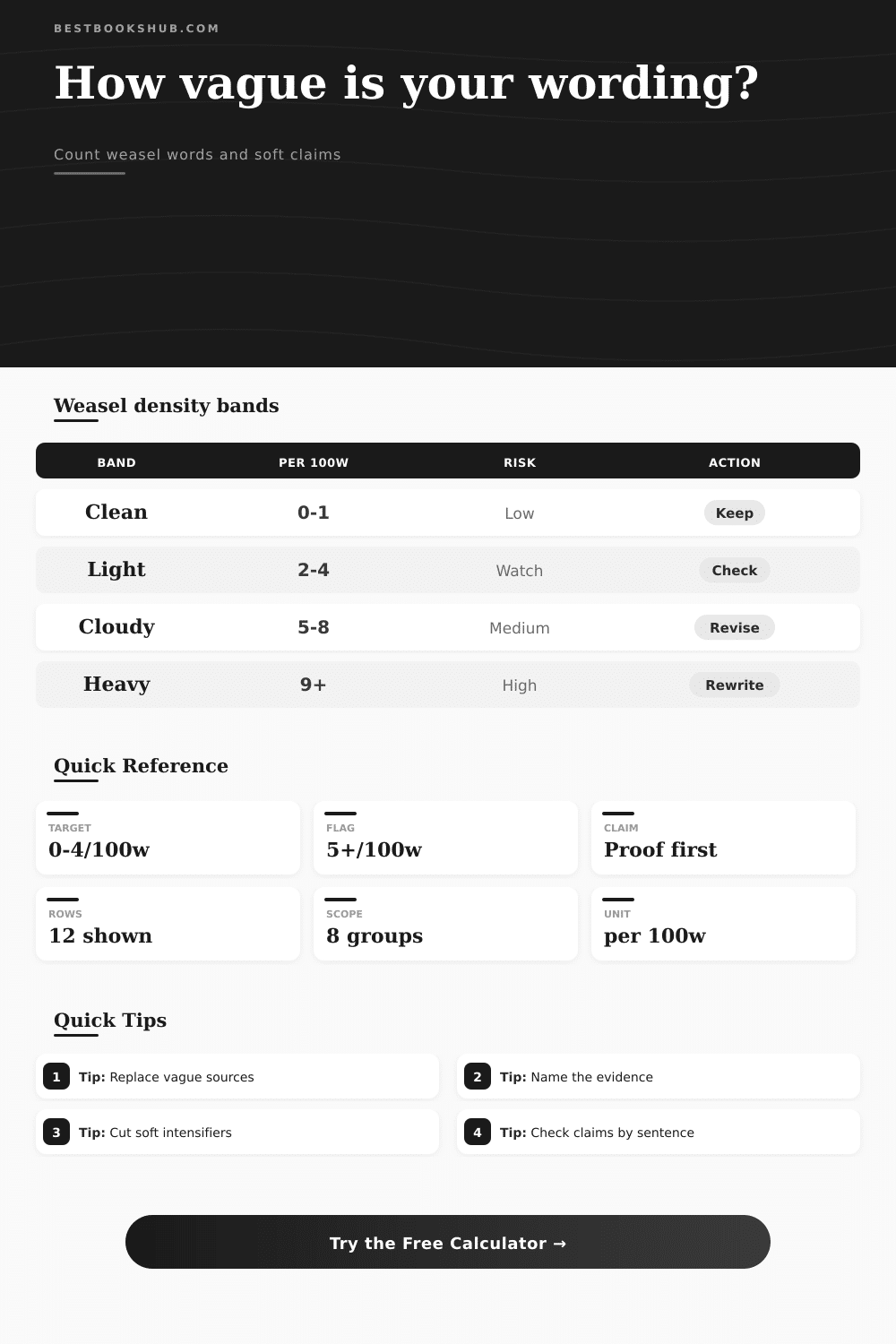
| Band | Matches per 100 words | Typical signal | Best next step |
|---|---|---|---|
| Clean | 0 to 1.9 | Claims are mostly direct and supported. | Keep the edit focused on meaning. |
| Light | 2.0 to 4.9 | Normal draft softness or genre-appropriate caution. | Check repeated terms and key claims. |
| Cloudy | 5.0 to 8.9 | Readers may feel the prose is evasive or padded. | Revise flagged sentences first. |
| Heavy | 9.0 or more | Vague authority and soft claims dominate. | Rewrite claims around evidence and actors. |
| Profile | Target density | Allowed softness | Watch closely |
|---|---|---|---|
| General prose | 0 to 4 per 100w | Light qualifiers for nuance. | Vague sources and filler. |
| Fiction or memoir | 0 to 5 per 100w | Voice-driven uncertainty. | Repeated filler in narration. |
| Book review | 0 to 4 per 100w | Measured judgment. | Soft praise without examples. |
| Academic note | 2 to 6 per 100w | Careful uncertainty. | Passive cover and vague evidence. |
| Marketing copy | 0 to 3 per 100w | Minimal hedging. | Unsupported superlatives. |
| Memo writing | 0 to 3 per 100w | Specific risk language. | It is believed and people say. |
We all know what it’s like when someone says, “Oh my gosh! You should watch this movie. It’s AMAZING.” But then you ask them, “Why?” And they respond? “Well, I don’t know. I mean, everyone love the cinematography. People go crazy over it. Or characters are pretty cool too, I think. Oh, and there’s lots of action.” It sounds great, right up until you realize they haven’t given you one concrete reason to believe it.
Weasel words. From afar, they appear substantial; up-close, they’re nothing but empty calories. To save yourself the shame of publishing fluff, this calculator do the hard work of finding these vague sources and soft claims for you. Because these are the tell-tale signs of weak writing, it scans through your content looking for those slippery phrases that mask themselves in words like experts, some, or many.
How to Fix Weak Writing
Of course, some hedging isn’t terrible. A certain amount of careful uncertainty is what give credibility to academic writing. Would you rip out every single example of might or may in an academic paper? No; then it’d sound like straight-up dogma. And so that’s where the tool comes in: via its profile settings, you can choose which kind of content it analyzes, e.g., marketing copy vs. Academic notes, and to match, it will dial up or down strictness of its analysis. After all, a memoir can afford more atmospheric ambiguity, but a press release need to be punchy and direct. Genre matching, not adhering to some rigid standard.
The system will break down its findings into groups when you paste your draft in. Words that are vague sources is especially dangerous. They borrow authority without delivering proof. Saying experts say is not the same as citing Dr. Smith from the university. Not the same than saying Dr. Smith at the university said. The tool highlights those differences and lets you visualize where you’re relying on other people’s authority rather than your own evidence.
Or it finds filler claims such as really or very. These add emotional weight but no meaning. You may feel like you’re highlighting an idea but you’re watering it down. The reader isn’t going to have to be told that this was a very bad storm; they want to hear about roof flying off.
It gives you a density score to show how many weak term you use every hundred words. The higher it gets into those bands up top, the more evasive your writing seem. That’s not a moral judgment about what kind of style that is. It’s a practical signal that you’re using persuasion instead of information. And from there, you can look at the flagged sentence table to see which ones are the worst offenders. Those will be the ones where you’ll get the biggest reward for your editing time.
This exercise could of been thought of as a kind of clarity audit. It isn’t about making your prose sound like something out of 2001: A Space Odyssey. Rather, it’s about ensuring that each claim have a backbone. Eliminating the weasel words forces you to ask: Who says this? What’s the evidence? The answer might be that you don’t have the evidence, in which case get rid of the claim altogether. That too is a valid revision move. A sentence may be better cut than propped up with weak language.
The tool also helps you spot patterns you wouldn’t spot if you read through once by yourself. Maybe you see that you keep using same set of hedge terms because you’re afraid of coming off as too assertive. Or maybe you realize you keep stuffing your marketing copy with superlatives that fall apart under scrutiny. Knowing your habits is the first step to correcting them.
From there, you can begin trusting your facts more, and trusting your intensifiers less. Your writing will feel confident, because it is confident. It’ll stand on its own merits instead of hiding behind vague authority. And so, you produce sort of clarity that keeps readers engaged (and convinced).