📖 Abbreviation scan
Acronym Density Calculator
Paste manuscript notes, jacket copy, academic prose, technical book sections, course material, or editorial feedback to measure acronym density, repeated short forms, definition gaps, and sentence-level concentration.
Load realistic book-adjacent samples with different acronym loads. Each preset fills every setting and recalculates instantly.
DISCLOSURE: This post may contain affiliate links, meaning when you click the links and make a purchase, I receive a commission. As an Amazon Associate I earn from qualifying purchases.
The analyzer catches uppercase acronyms, dotted initialisms, plural short forms, custom terms, and known book or academic abbreviations while filtering ordinary capitalized words.
The table updates after calculation and ranks the top acronym or initialism matches by frequency, category, definition status, and edit priority.
| Acronym | Category | Count | Share | Definition | Priority |
|---|---|---|---|---|---|
| Run the calculator to see matched acronyms. | |||||
Use this table to find short passages where several acronyms land close together and may need expansion or recasting.
| Rank | Acronyms | Density | Sentence excerpt |
|---|---|---|---|
| Run the calculator to see sentence concentration. | |||
| Band | Weighted hits per 100 words | Typical reader effect | Best next edit |
|---|---|---|---|
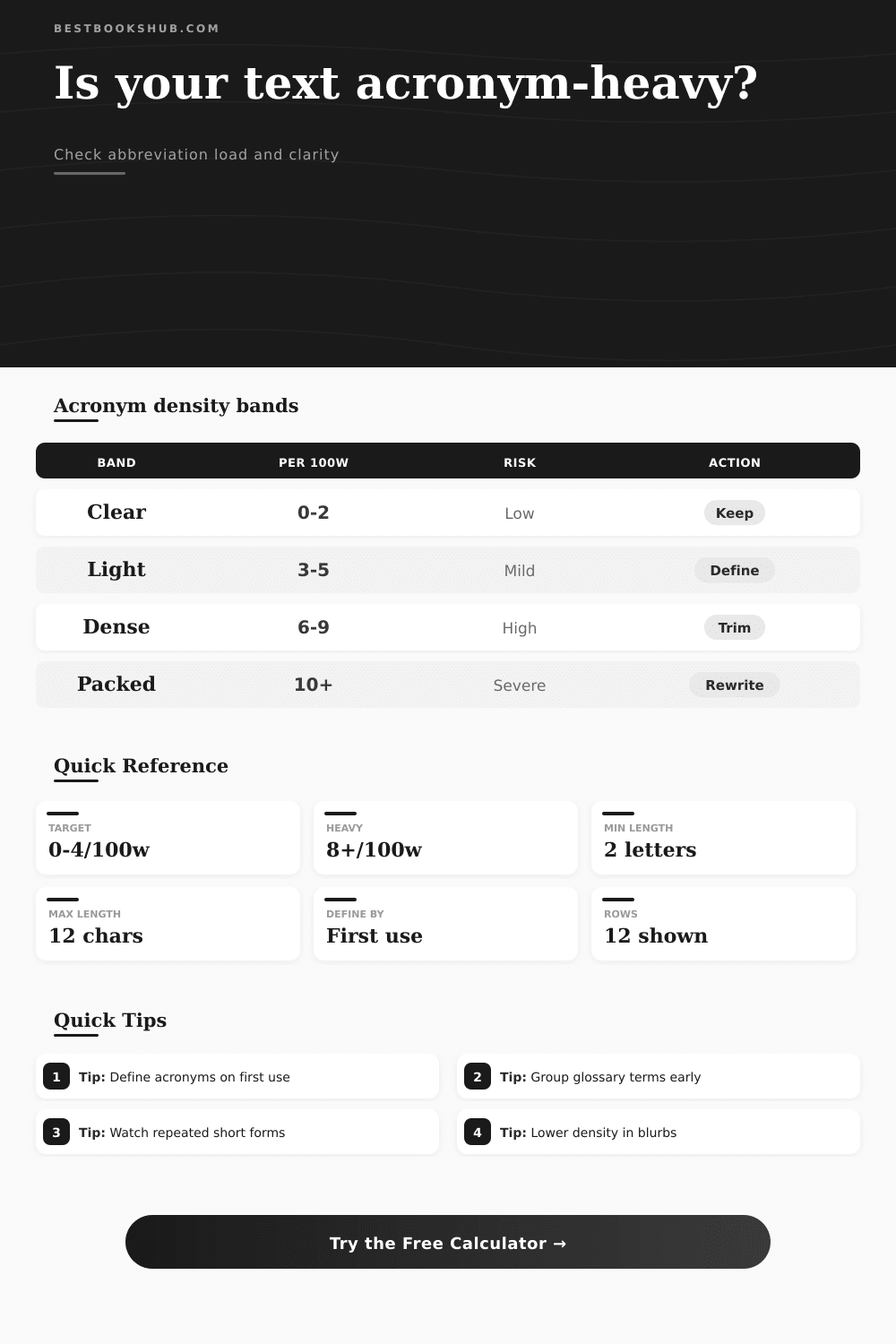
| Clear | 0 to 2.0 | Short forms are sparse and easy to track. | Keep acronyms that save meaningful repetition. |
| Light | 2.1 to 5.0 | Reader load is usually acceptable with first-use definitions. | Define the least familiar terms and check repeats. |
| Dense | 5.1 to 9.0 | The passage may feel institutional, technical, or insider-facing. | Expand low-value acronyms and break up clustered sentences. |
| Packed | Over 9.0 | Acronyms may slow comprehension and hide the main point. | Rewrite acronym-heavy sentences before copyediting. |
| Pattern type | Example form | Detection treatment | Editorial caution |
|---|---|---|---|
| Standard acronym | ARC, ISBN, DRM | Counted in strict and loose modes. | Define specialized publishing terms for general readers. |
| Dotted initialism | U.S., Ph.D., D.C. | Counted when two or more capital segments appear. | Often familiar, but still adds visual density. |
| Plural short form | ARCs, PDFs, APIs | Stemmed to the singular label when possible. | Repeated plurals can crowd process-heavy prose. |
| Mixed-case known term | ePub, LaTeX, XML | Counted in mixed or loose casing modes. | Useful in technical copy but define audience-specific terms. |
| Fictional shorthand | FTL, AI, EVA | Counted when uppercase or custom-listed. | Worldbuilding acronyms need context, not just a glossary. |
| Context | Reason acronyms appear | Comfortable range | Watch item |
|---|---|---|---|
| Jacket copy | Imprints, formats, awards, or genre labels. | 0 to 3 per 100 words | Unexplained trade shorthand. |
| Academic chapter | Methods, institutions, theories, and citation terms. | 3 to 8 per 100 words | First-use definitions and term stacking. |
| Technical manual | File types, devices, protocols, and procedures. | 4 to 9 per 100 words | Sentence clusters with three or more terms. |
| Editorial memo | Workflow terms, departments, formats, and schedules. | 2 to 6 per 100 words | Acronyms shared by staff but not authors. |
| Fiction glossary | Invented agencies, technologies, factions, and ranks. | 2 to 7 per 100 words | Names that compete with emotional stakes. |
Counts are editorial estimates. Review the match table for proper nouns, intentional style choices, and terms that are already defined by nearby context.
So how do we ensure our specialized texts remain clear? The calculator on top measure how often you use abbreviations, repeat short forms, miss definitions, or group too many sentences together. This helps you stay clear while being brief.
Do this before someone in editing tells you.
How to Use Acronyms Clearly
Maybe you’re reading a technical manual or academic abstract where every other word seem to be crunched into some sort of shorthand, or where everything’s capitalized. It feels like code. It’s tiring for a reason: Your brain isn’t equipped to carry around a mental glossary while following an argument. Measuring how dense the acronyms are is a question of reader empathy, not just some kind of nitpicking.
Acronyms aren’t inherently bad; actualy, it’s usually not the presence of an acronym that causes problems, but the spread of acronyms. As technical writers (and publishers), we tend to conflate “short” with “clear.” Substituting a lengthy organization name with first letter of each word will result in fewer characters on the page. True. Fewer visual spaces on the page. False. You’re trading visual space for cognitive load.
This page’s tool takes the acronyms it finds in your document, both those with dots between initials and ones without; and counts up your hits-per-hundred-words. If you’re getting a lot of hits, your reader is locked out. Too few? They’re invited in.
The writing profile also gives you some flexibility around context. For example, use almost no acronyms in a jacket blurb for a trade fiction novel. Readers don’t care about the internal logistics of an invented universe; they care about the stakes. In a technical manual, it’s another league entirely. Here, ISO or API or DRM are all part of native language. The calculator tweaks its thresholds based off those settings. What may appear dense in one kind of text can read as sparse in another. And you’d better know what lane you’re in.
For general readership, anything that isn’t a household term should be defined at first use. The calculator flags such definition gaps so you can spot where you’ve tripped up a reader.
The invisible kill shot in readability is sentence-level focus. While your overall density may be fine, it doesn’t mean there aren’t whole paragraph that are unreadable. How? This happens when you use three or four acronyms in a row. Those stacks of acronyms overload working memory.
Where do you see this? That’s where the tool’s “breakdown” comes in. The breakdown section find the densest sentence(s). From there, you can see exactly where the rhythm goes wrong. Sometimes it’s easiest to simply split a sentence. You can also expand on one term instead of rewriting an entire chapter. Look for the spots where the shorthand begins to pile up on itself.
Others fear that they’ll bog things down by defining everything. Yes, at first, they will. But by only half a second. Guessing and having to flip back to a glossary are both worse ways to interrupt the flow, they’re far more bad than a few words of explanation. And if you don’t believe me, just look at the reference table on the page. It explains exactly what various density bands mean for the average reader.
If you focus on bottom of the chart, acronyms help tell the story without taking over. And that’s why we’re here: to make it invisible. The friction between the reader and the author’s knowledge level is what good editing takes away. Acronyms can be shorthand. They may be necessary shorthands, but they must feel like smooth roads.
If you want to know if yours do (and you do), run your draft through this analyzer. And yes, it’s more than just counting letters. But more than that, I mean see if your words respect the reader who holds them in her hands by spending her time and attention on them. Make it clear, make it compelling, and make it breathe. Because that’s how you convert a puzzling tangle of acronyms into plain language again.