🔢 Text order analyzer
Ordinal number counter
Find numeric and written ordinals such as 1st, 2nd, first, second, twenty-first, and ranked list labels in pasted text.
| Detected ordinal | Value | Form type | Count | Share | Example context |
|---|---|---|---|---|---|
| Load a preset or paste text to see ordinal rows. | |||||
| Ordinal form | Example | Parser rule | Best use |
|---|---|---|---|
| Numeric suffix | 21st | Number + st/nd/rd/th | Ranks and dates |
| Written word | twenty-first | Tens + unit ordinal | Prose and headings |
| Separated word | twenty first | Adjacent tens and unit | Draft cleanup |
| Large marker | hundredth | Large ordinal word | Indexes and editions |
| Suffix ending | Use after | Exception | Examples |
|---|---|---|---|
| st | Numbers ending 1 | 11 uses th | 1st, 21st |
| nd | Numbers ending 2 | 12 uses th | 2nd, 42nd |
| rd | Numbers ending 3 | 13 uses th | 3rd, 103rd |
| th | Most other endings | 11, 12, 13 | 4th, 11th |
| Density band | Ordinals per 1k words | Common text | Editorial read |
|---|---|---|---|
| Light | 1-3 | Essay prose | Occasional order |
| Steady | 4-8 | Guide pages | Clear sequencing |
| Dense | 9-15 | Steps or ranks | Structure is central |
| Heavy | 16+ | Results or clauses | Review readability |
DISCLOSURE: This post may contain affiliate links, meaning when you click the links and make a purchase, I receive a commission. As an Amazon Associate I earn from qualifying purchases.
Have you ever been given directions like this? Every item is bolded and numbered, but it’s difficult to follow.
Ordinal numbers provides structure to human instruction by telling us where things go. They tell us what happens next, or what happened first. Take away the ordinals and you’ve got nothing more then a recipe (just a list of ingredients). It could be a race result that is just a jumble of names. Or a legal contract (ambiguous). These numbers help us build order…
Why Ordinal Numbers Matter for Your Writing
And yet you hardly think about their appearance until faced with a draft that mashes together “first,” “1st,” and “#1” in the same paragraph. But that’s inconsistent, and it creates issues for the reader. Without some kind of consistency, eye will stumble across the switch from number to word back again to number.
Here is where the tool comes into play. It scans your document for all ordinal markers. What are those? Any mention of a number that has been marked as something other than its cardinal self: i.e. Simple forms such as “1st,” but also complex forms such as “twenty-first.” It doesn’t simply count these. Instead, it groups them together. It categorizes their values and measures how many times they occur throughout your work.
Why does this matter? Heavy use of ordinals tend to indicate excessive procedural text. And procedural text need to be edited differently than narrative prose.
English have quirky rules for ordinals. You use “st” for one, “nd” for two, and “rd” for three. Then we make an exception for eleven through thirteen. A simple text parser without any contextual understanding will stumble over those oddities. By changing suffix mode you’ll discover just how many of those corner cases is in your draft. If it’s formal writing stick with strict matching; if it’s a more casual blog post maybe a looser match is OK? It all comes down to knowing who’s reading it and whether they care about readability vs precision.
You can get even more insight by using group modes. For example, you might write “first” in one sentence and “1st” in another. A simple count counts these as two distinct words. Grouping by value reveals that these is versions of the same concept.
This is where the rubber meets the road: the actual editing. Consistency is what we seek. Do you like to use numbers because they’re shorter? Then when “1st” appears alongside “first,” you’ll know that your style guide needs some attention.
And the results section make it clear: the breakdown table tells you how many times a certain word form dominates, and which ones stand out from the rest.
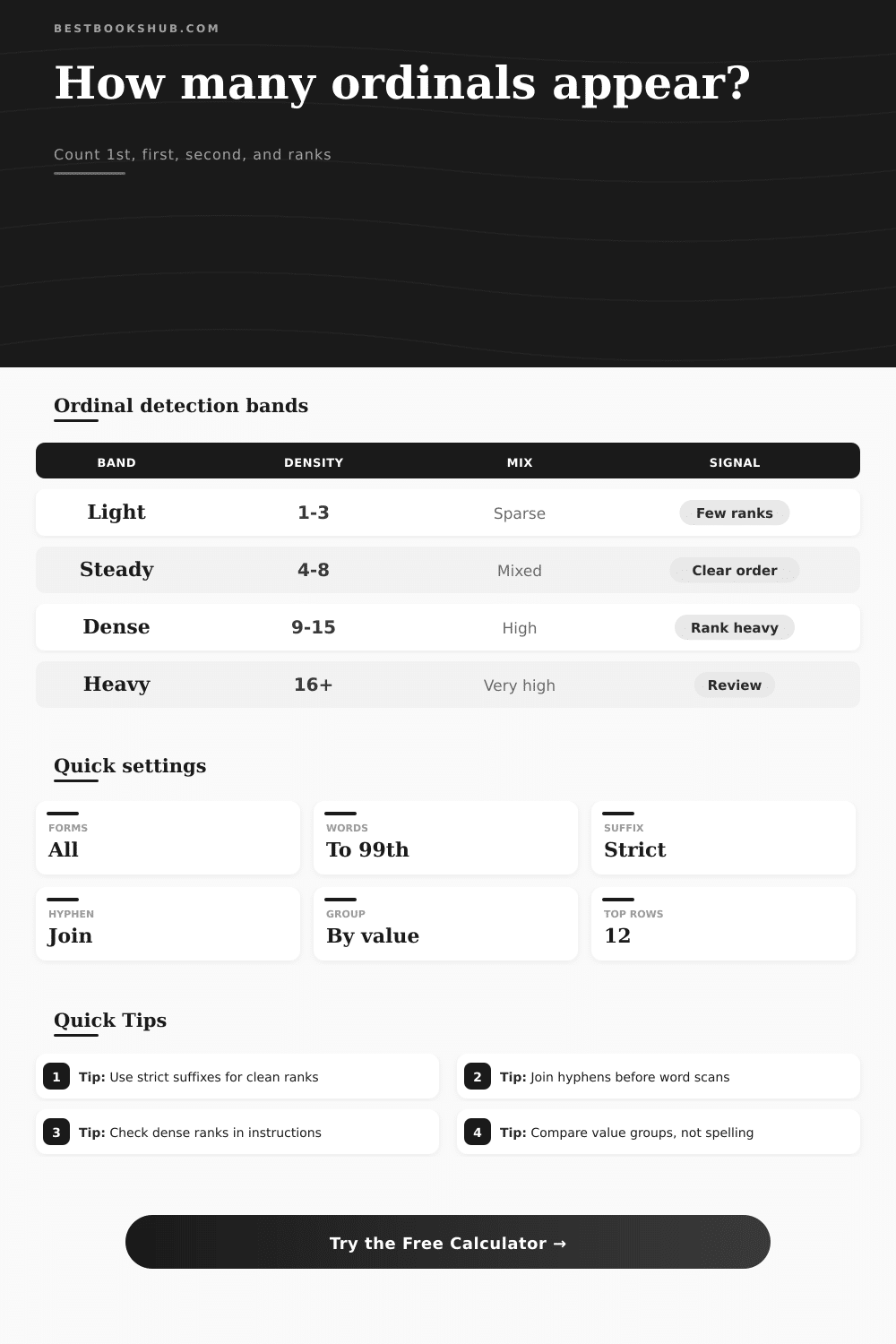
And then there’s density. Too many ordinals? You could of be overdoing it. Ranking things densely enough becomes robotic. A lighter density imply a more narrative flow. Do a quick check by looking at the density bands on the reference table. Are you in the heavy zone? Ask yourself whether each step requires a number. Sometimes a “next” or a “finally” sounds better than a “fourth” and a “fifth”. It’s a small change, but it makes the difference between mechanical and conversational.
Reading is rhythmic. It is a sequence of ordinal numbers. It is a pattern of pause and anticipation. When you read something, you’re looking for the next number, searching for that moment to re-orient your eyes. If the numbers aren’t formatted consistantly, it throws off that orientation.
Don’t think of this as getting rid of ordinals. Think of this as using their power. Audit your drafts using the calculator. What kind of mix of forms do you see? How dense are they? Are your suffixes right? After you get the ordinals cleaned up and consistant, the reader won’t notice the structure anymore.
The reader will just notice the story.