💬 Manuscript balance
Dialogue percentage calculator
Paste a scene, chapter, transcript, or script page to estimate how much of the text is dialogue compared with narration.
| Draft type | Typical dialogue | Narration cue | Best mode |
|---|---|---|---|
| Literary scene | 10-30% | High interiority | Quoted speech |
| Commercial chapter | 25-45% | Action and tags | Quoted speech |
| Conversation scene | 45-65% | Brief beats | Hybrid mode |
| Transcript | 70-95% | Speaker labels | Speaker-line |
| Detection mode | Counts as dialogue | Useful for | Watch for |
|---|---|---|---|
| Quoted speech | Words inside marks | Fiction drafts | Nested quotes |
| Speaker-line | Text after name label | Interviews | Colons in prose |
| Screenplay | Cue follow-up lines | Scripts | Scene headings |
| Hybrid | Combined signals | Mixed formats | Duplicate speech |
| Format clue | Example | Count behavior | Result effect |
|---|---|---|---|
| Quote pair | "I know." | Inside only | Clean speech |
| Speaker colon | Mara: Wait. | After label | Transcript fit |
| Script cue | MARA | Next block | Script fit |
| Beat line | She turned. | Narration | Lowers share |
| Scene signal | Dialogue percent | Likely pace | Revision check |
|---|---|---|---|
| Opening description | 0-15% | Slow | Add voice only if needed |
| Discovery scene | 20-40% | Moderate | Balance beats and speech |
| Argument scene | 50-70% | Fast | Track speaker clarity |
| Script page | 70-90% | Performance | Check action lines |
DISCLOSURE: This post may contain affiliate links, meaning when you click the links and make a purchase, I receive a commission. As an Amazon Associate I earn from qualifying purchases.
In other cases, maybe you read through a scene in your draft and find yourself thinking: This isn’t working, but I don’t understand what’s wrong. Probably it’s a rhythm issue. You’ve got all the elements, the characters and the words, but you haven’t found the right combination of description and voice. Maybe you’re hiding your best lines beneath a heap of exposition. Or perhaps you’re allowing your characters to chatter on while no action ground their speech. This is where dialogue percentage can be helpfull.
It isn’t a hard-and-fast rule; think of it more like a diagnostic tool, one to help with pacing issue. Once you enter your text into the calculator (above), it do the math for you, helping you determine whether a scene is too quiet or too loud. Intuition isn’t always reliable when we’re buried deep in a draft. Most writers intuitively know what balance feels like in a given scene, but over time we begin normalizing our own writing habits, which is why taking the time to look at numbers give us that objective baseline.
How Dialogue Percentage Helps Your Writing
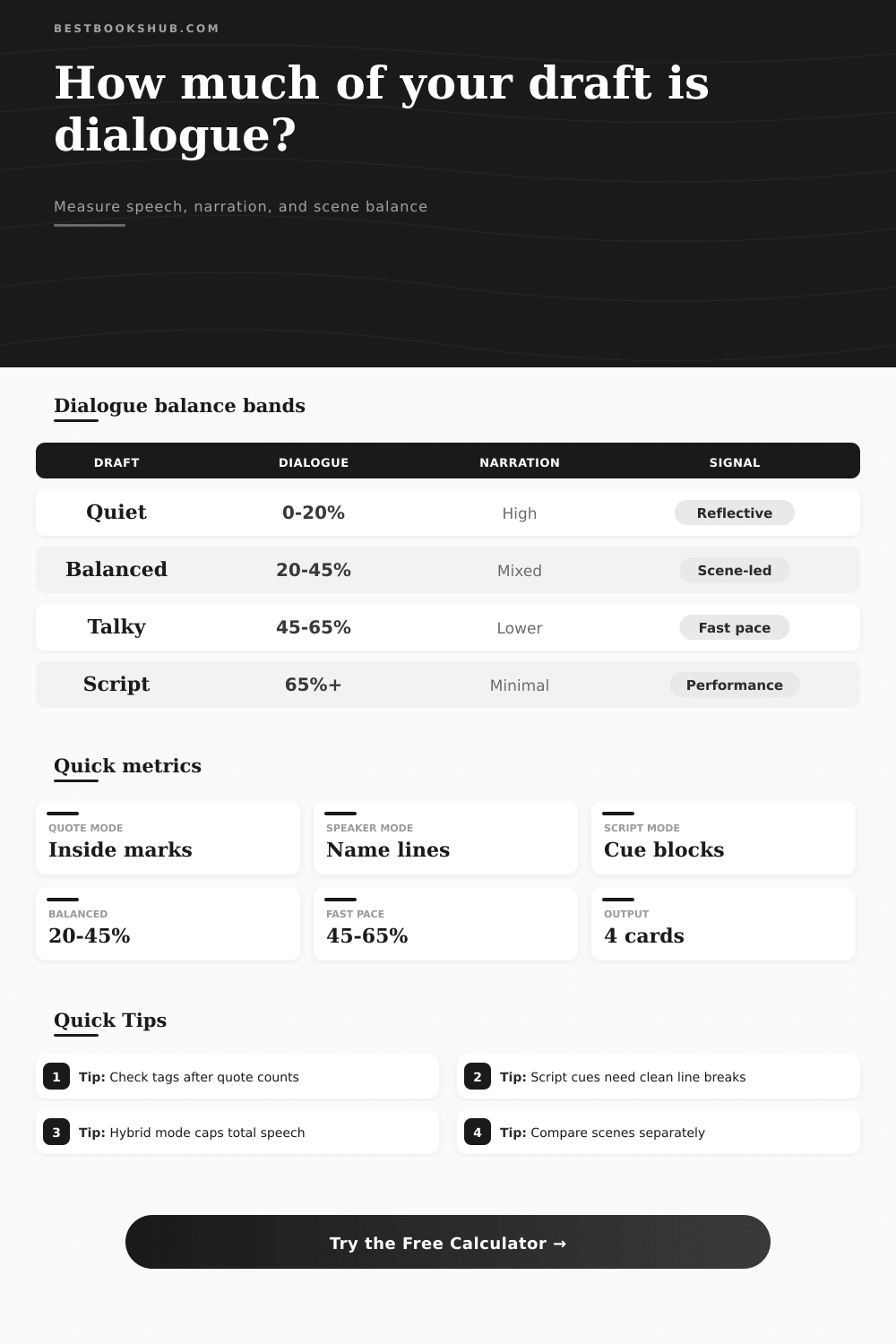
For standard narrative fiction, you’ll probably find yourself somewhere between a 20-45% dialogue share, which should feel healthy. This leaves plenty of room to describe things and ground reader in their time and place. It also maintains forward momentum provided by the characters interacting with each other. It avoids feeling too dense or too thin.
And then there’s what it counts. Each format need to be counted differently. Novel pages contain lots of sensory detail and thoughts; screenplays mostly feature dialogue and only a handful of action line directing actors’ performances. You can switch between modes, such as using speaker lines or quoted speech, to match your draft style. You can choose to use quoted speech based off how you have written the draft. That’s important because different draft styles (standard quotation marks vs). Clear speaker labels in a transcript-like format, will produce different results. And if you have a mixture, like many writers do, the hybrid mode help ensure you’re getting an accurate count of amount of spoken material without missing any context.
If you’re looking at a skewed result of either twenty percent or zero, this tells you that there’s a quiet, reflective pace going on. And that’s not necessarily a bad thing; sometimes a chapter require a lot of internal monologue or description to set the mood. But if you notice this low number in all your scenes, your readers may be feeling disconnected from your characters. They want to know what the people they care about are saying. Not how they look when they say it.
A high dialogue percentage, on the other hand, means a fast-paced conversation-heavy story. Great for quick exchanges and arguments. But tiring if stretched out across multiple chapter.
So: Use these metrics to see where things don’t line up in what you write. For example, perhaps you need to describe setting in chapter one, so it’s chock-full of description. But then chapter two also has lots of description, even though it’s supposed to be this really tense confrontation. Well, the calculator will tell you that second chapter is unusually quiet. And maybe you’ll realize you’re saying too much and showing too little. That doesn’t mean every single scene need to register the same number. It means that the beats match the tone of story. It’s all laid out on the page as a reference table, broken down by scene type and genre, so it’s a handy guide against which to compare.
But again: Don’t take these bands as strict limitations. Writing isn’t rigid like that. Use them as a place to consciously choose to focus on narration in certain spots, while letting dialogue do the heavy lifting elsewhere. Then when you know the baseline, you can intentionaly break the rules. Not by accident, but on purpose. Revisit that flat scene from earlier. Adjust the ratio. Shift the ratio. See how the rhythm springs to life.