💬 Dialogue analysis tool
Speaker attribution counter
Paste a scene to count dialogue tags, attribution verbs, speaker names, pronouns, placement, and tag density per exchange.
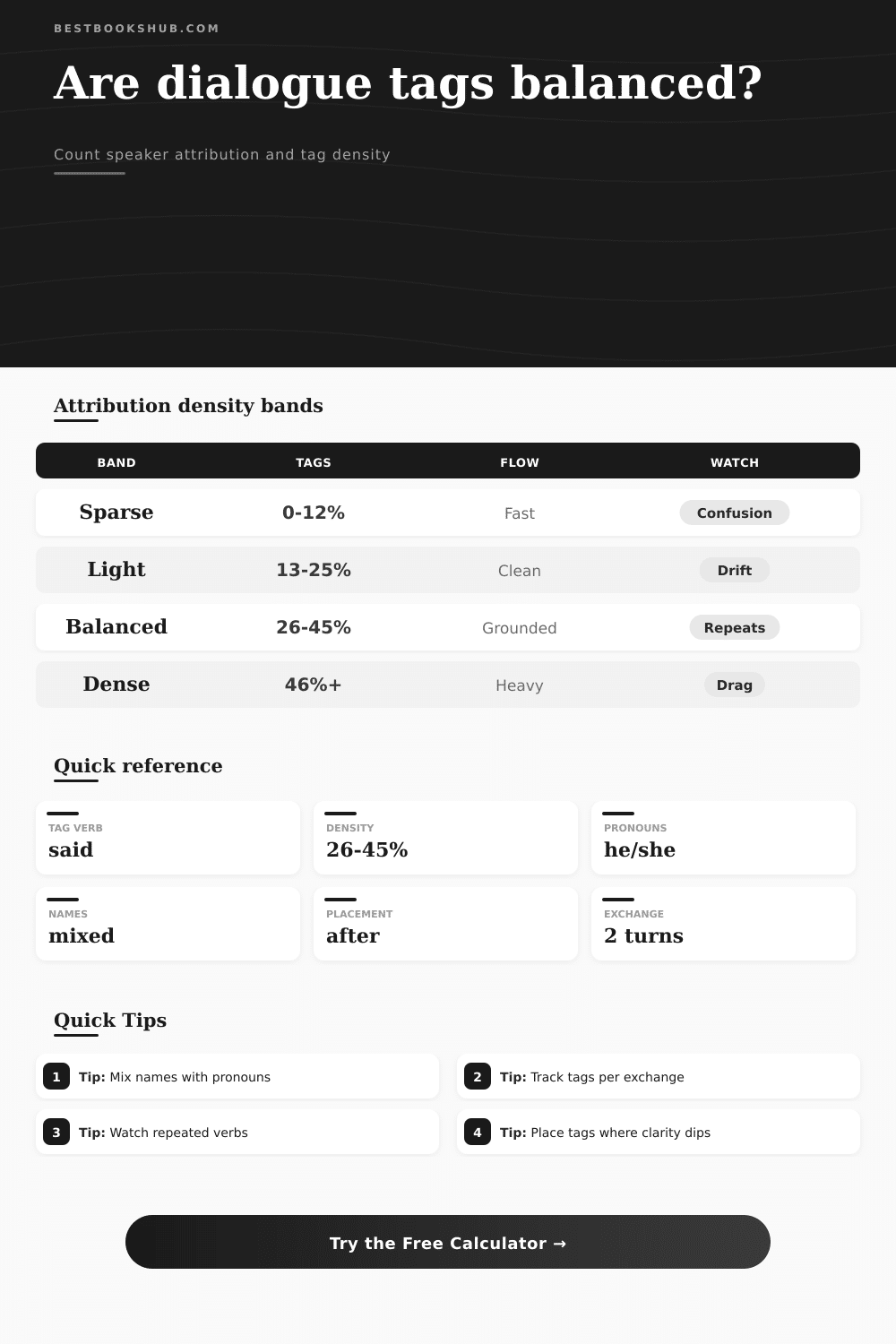
| Density band | Tags per turns | Dialogue effect | Use when |
|---|---|---|---|
| Sparse attribution | 0-12% | Fast and clipped | Two speakers are already clear through alternating turns. |
| Light attribution | 13-25% | Clean with room to breathe | Short exchanges need occasional grounding. |
| Balanced attribution | 26-45% | Clear but not crowded | Most scenes with two or three active speakers. |
| Dense attribution | 46-65% | Highly anchored | Group scenes or rapid interruptions need extra clarity. |
| Heavy attribution | 66%+ | Can feel repetitive | Use briefly when speakers change fast or voices overlap. |
| Verb family | Examples counted | Signal strength | Common risk |
|---|---|---|---|
| Neutral tags | said, asked, replied, answered | Low emphasis | Can repeat unnoticed until packed together. |
| Quiet tags | whispered, murmured, muttered | Soft vocal cue | May over-explain volume if used often. |
| Heated tags | shouted, snapped, demanded | Strong emotional cue | Can compete with the dialogue itself. |
| Flow tags | continued, added, began | Sequencing cue | Can make turns feel procedural. |
| Response tags | agreed, admitted, insisted | Attitude cue | Can flatten subtext if every line is labeled. |
| Attribution type | Example pattern | What it clarifies | Best placement |
|---|---|---|---|
| Name tag | Mara said | Exact speaker identity | After a switch, before a group turn, or after a long beat. |
| Pronoun tag | he asked | Continuing speaker flow | After dialogue when the speaker is already clear. |
| Verb-only clue | someone whispered | Voice action without name certainty | Before dialogue when suspense or distance matters. |
| Mid-dialogue tag | "I know," she said, "but..." | Breaks a long spoken turn | Inside long lines, pivots, or interrupted sentences. |
| Action-beat hint | Mara folded the map. | Speaker through action | Before or after a line when a physical beat carries identity. |
| Scene shape | Typical turn group | Useful tag rate | Clarity signal |
|---|---|---|---|
| Two-person volley | 2 turns | 0.3-0.8 per exchange | Alternation stays readable without many names. |
| Three-person scene | 3 turns | 0.8-1.5 per exchange | Speaker switches need regular anchors. |
| Group table scene | 4 turns | 1.2-2.2 per exchange | Names usually matter more than pronouns. |
| Interrogation rhythm | 2 turns | 0.5-1.3 per exchange | Question and answer roles stay distinct. |
| Argument with interruptions | 3 turns | 1.0-2.0 per exchange | Mid-tags help track cut-offs and pivots. |
DISCLOSURE: This post may contain affiliate links, meaning when you click the links and make a purchase, I receive a commission. As an Amazon Associate I earn from qualifying purchases.
A speaker attribution counter measure how many tags are used relative to the number of lines of dialogue. Because dialogue moves fast, we humans rely on these anchors when keeping track of who is saying what. It’s a way of counting something your eye can’t always catch so scene doesn’t dissolve into noise. It’s a breakdown of your scene into its actual elements.
Names as speaker markers count, as do pronouns. That’s important because a name tag pins everything down, but at the expense of flow. Pronouns keep things moving, assuming reader has kept up with who is saying what. Is there too much of either in your work? Does a two person dialogue have a lot of named speakers? Then you’re going to sound staccato and mechanical. If there is too little, people will lose interest. Ideally, you should of find a sweet spot where you are clear without slowing down the momentum.
How to Count Dialogue Tags
Said is also the go-to default of most writers. It’s invisible. But the tool include reference data about which tags is emphasized, and neutral tags aren’t given much weight. They fade into the background. That’s good; you don’t want your reader to focus on the verb instead of the voice.
Still, there’s a place for variety. When the tool see that you’re repeating one particular verb too many times, like muttered three times in a paragraph, it will flag it with a count. Repetition kills immersion. The tool highlights it by displaying the number of times you used that verb and the variety score. As the score go down, it’s time to replace a tag with an action beat.
Attribution has its silent partner: action beats. If character’s talking as he folds up a map, the reader connects his actions to his voice. No algorithm can read subtext perfectly; that’s why this is where you outsmart machine with your judgment. Here, the tool provides the math, and you bring the context. It will count the number of attributions for you. You’ll determine whether the silence is more telling than the whisper. That balance between quantitative analysis and qualitative instinct, this is what makes editing effective.
Rhythm is also dictated by placement. When dialogue tags follows the dialog, it feels conversational and naturaly. If it’s sandwiched between words in the sentence, it creates a break and is frequently used when interrupting or emphasizing something. Seeing that separation allow you to determine whether those tags in the middle of sentences are muddying the flow. Too much clutter with breaks in the middle of the line will make scene seem fractured.
The tool has a reference table that explains what each band look like (the density bands). Keep it light; clean up the scenes. Get it balanced, ground the reader. Get it dense… Anchor group scenes. Get it heavy, drag the pacing. Understanding how each scene fits in these bands will help you match your writing style to the scene type.
Scenes is tricky business, especially group ones. With four or more speakers, alternating turns become a guessing game without frequent naming. To fix this messiness, the calculator has an option to set the size of your exchanges. In other words, you may tolerate a higher tag density when there are many speaker around and only a few in a private conversation. By displaying tags per exchange, the tool accounts for this: it tells you how many anchors you’re giving compared to how many voices. Too little and the reader loses their place; too much and it sound like a roll call.
The best editing of dialogue isn’t so much about adding words as it is about removing noise. Remove all tags that don’t add clarity. Let the calculator do the math on that one (above). It’ll show you where you’re leaving gaps and it’ll mark out your over-tags.
Experiment with the presets; compare a balanced duet different than a tag-heavy scene. See how the flow metrics shift. See the difference in density. That’s going to teach you what good rhythm sounds like. It is a small detail, but it matters.
If you can read the scene from start to finish and never look up at who’s talking then you’ve done it right. No tool can feel the emotional weight of a line. That’s always human. But it can measure the structural integrity of your dialogue.
Begin with the data. Tweak the tags. Read out loud. When the voices sound distinct and words flow, you’re done. The attribution counter is just the beginning.