🎵 Lyric meter tool
Lyric syllable counter
Paste a verse, chorus, hook, bridge, or full lyric sheet to estimate syllables per line, stress beats, vowel groups, elisions, and section balance.
| Section | Line | Words | Syllables | Stress | Signal |
|---|---|---|---|---|---|
| Calculate to see line counts. | |||||
| Rule | How it counts | Lyric example | Adjustment |
|---|---|---|---|
| Vowel group | Adjacent vowels count as one starting unit | rain, dream, sound | Base count |
| Final silent E | Final E can be dropped unless kept for singing | make, time, breathe | -1 when silent |
| Final -le | Consonant plus le usually adds a syllable | little, candle | +1 when needed |
| Final -ed | Often silent after unvoiced endings | walked, kissed | -1 when clipped |
| Loose sung vowel | Some words open into extra sung beats | fire, higher, flower | +1 in loose mode |
| Option | Best fit | Typical change | Stress estimate |
|---|---|---|---|
| No elision | Clear diction, demos, notation | Keeps written syllables | Steady accent ratio |
| Common elision | Pop, folk, country, rock | Blends common sung words | Balanced accents |
| Heavy slur | Fast hooks, rap, dance phrases | Compresses weak vowels | Higher accents |
| Marked only | Edited lyric sheets | Uses apostrophe clues | Line-driven accents |
| Mode | Reads as | Section output | Use case |
|---|---|---|---|
| Auto headers | [Verse], [Chorus], [Bridge] | Named totals | Full lyric sheets |
| Blank lines | Stanzas split by empty lines | Stanza totals | Draft fragments |
| Whole lyric | All lines together | One total | Fast checks |
| Each line | Every line isolated | Line units | Meter debugging |
| Lyric part | Line range | Accent range | Meter note |
|---|---|---|---|
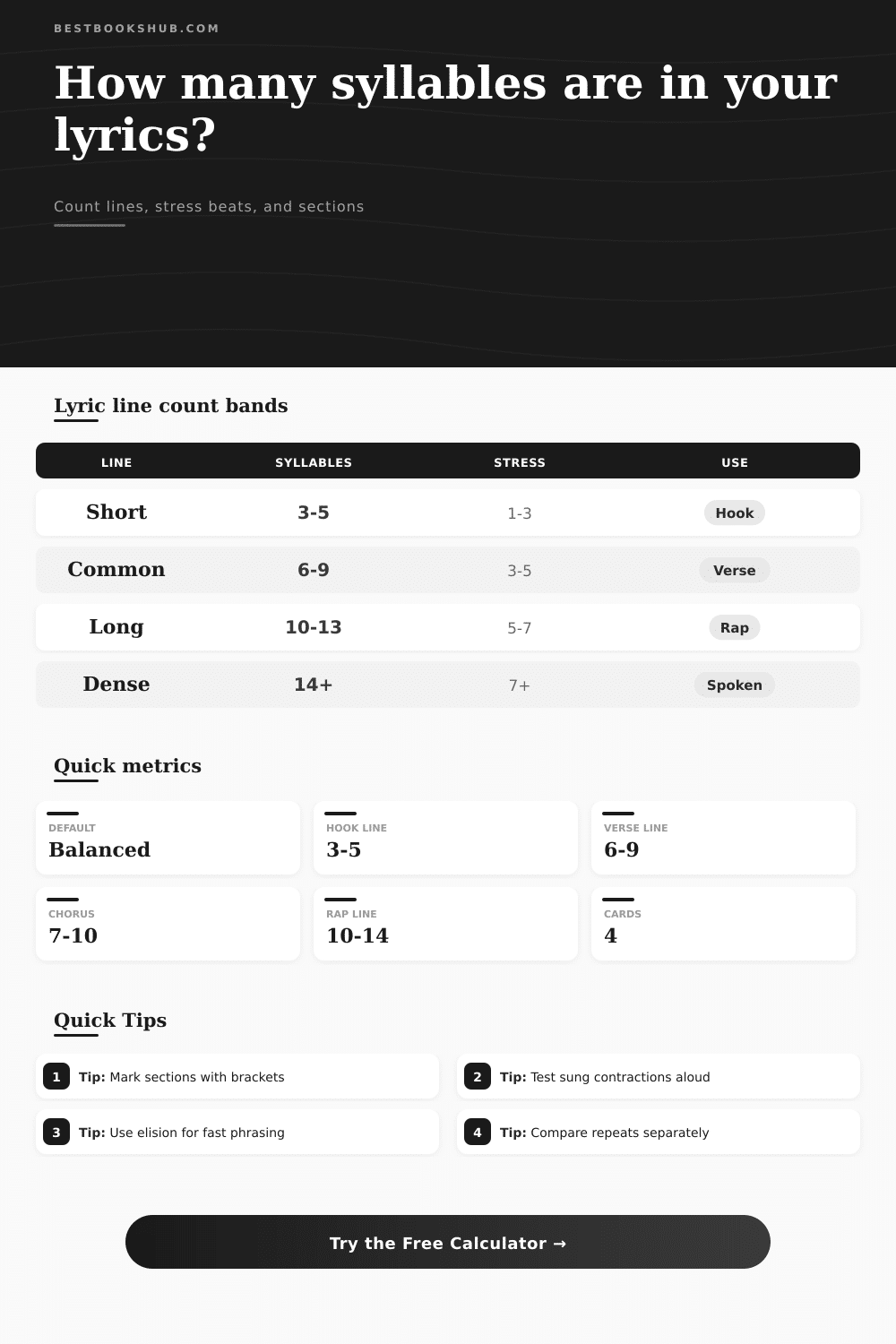
| Title hook | 2-5 syllables | 1-3 beats | Easy to repeat |
| Verse line | 6-9 syllables | 3-5 beats | Story-friendly |
| Chorus lift | 7-10 syllables | 3-6 beats | Room for melody |
| Rap bar | 10-14 syllables | 5-8 beats | Dense internal rhythm |
| Spoken line | 12+ syllables | 6+ beats | Flexible timing |
DISCLOSURE: This post may contain affiliate links, meaning when you click the links and make a purchase, I receive a commission. As an Amazon Associate I earn from qualifying purchases.
Sometimes you write a lyric that sounds awkward when you sing it. You think it’s right in your head, but it doesn’t feel good. Maybe it drags on melody line. Or maybe it runs out of breath before end of phrase. That’s typically a meter issue as opposed to a melody issue. Lyric has a rhythmic weight and that weight needs to match the structure of music. When a syllable count differ too much from natural pulse of song, the song falls apart.
Counting syllables is more than just math. They need to breathe along with music. The calculator do the estimating part, but it’s understanding what the numbers mean that makes for songwriting. When most people start learning to write lyrics they tend to apply equal value to each word (syllable). That’s a no-no. A stressed beat is weighted different than a syllable squeezed between other syllables. Unstressed syllables acts like connective tissue, allowing you to pack more words into a line but it’s the stressed beats that anchor the rhythm.
How to Make Your Lyrics Fit the Music
So if your verse lines contain six syllables and your chorus contains ten then the change in energy flows naturaly. If both contain nine then maybe song feels static. Breaking your text up into chunks with this tool helps you see where there might be imbalance in structure. Is your hook punchy enough? Are the verses too densely packed for melody you have in mind?
It doesn’t help that words can be complex with silent letters and groups of vowels. In the written word ‘make’, we have two vowels but sound out just one. With calculator you can switch between strict written counts and looser sung counts. Singing is going to change how you pronounce words. For example, “going to” may become “gonna” or “I will” becomes “I’ll”. Singing cuts your syllables short, which makes the phrasing tighter on those fast parts. If you’re writing something that is fast pace like rap or indie rock, then you should of take these short cuts into consideration. You can set tool up to adjust for popular omissions so you get an accurate view of what the actual number of beats there is in vocal line. Otherwise, you could end up with lines that feel rushed despite having a slower tempo.
You should also consider balance of each section. Typically you want chorus to feel larger and more open than verse. Often this result in fewer syllables per line in chorus compared to verse. That leaves room to stretch out with longer note values and melodic flights. For example, perhaps your verse lines has eight syllables then make an effort to keep your chorus lines at six or seven syllables. It gives your melody somewhere to go. The reference tables in the tool outline what’s common so you can see how the sections contrast. At a glance you can see if you’ve got too much going on in hook or if your bridge is too sparse.
Familiarity comes from consistency within a section. Interest comes from variation between sections. In addition, feeling of the song is dictated by its stress pattern. A ballad can be predictable and steady in its stress pattern, making it feel grounded. Rap rely on complex shifting accents and internal rhythms that generate momentum. By choosing your style, the tool will estimate those stresses and let you see if your words naturaly fall on strong beats. If the stress estimate doesn’t feel right, then maybe this line won’t sing. Perhaps you have to rearrange the phrase or switch out some words so that natural emphasis of language matches musical downbeats.
But in the end, this is just a diagnostic. It’s a way of finding out where the friction is before recording. Then you know what to move to make everything match the music based off those numbers. If it’s a long spoken-word verse or a concise country hook, it doesn’t matter; either way, word have to serve rhythm. Refine that draft with data and then sing it so you’ll hear how it feels. Math provides the map, and your voice plots the path.