📖 Poetry scansion tool
Foot per line calculator
Paste poem lines to estimate syllables, metrical feet per line, likely meter family, catalectic or hypermetric endings, and line-to-line regularity.
| Line | Text | Syllables | Adjustment | Feet | Status |
|---|---|---|---|---|---|
| Calculate to see line-by-line scansion estimates. | |||||
| Feet | Line name | Iambic or trochaic syllables | Triple-meter syllables |
|---|---|---|---|
| 1 | Monometer | 2 syllables | 3 syllables |
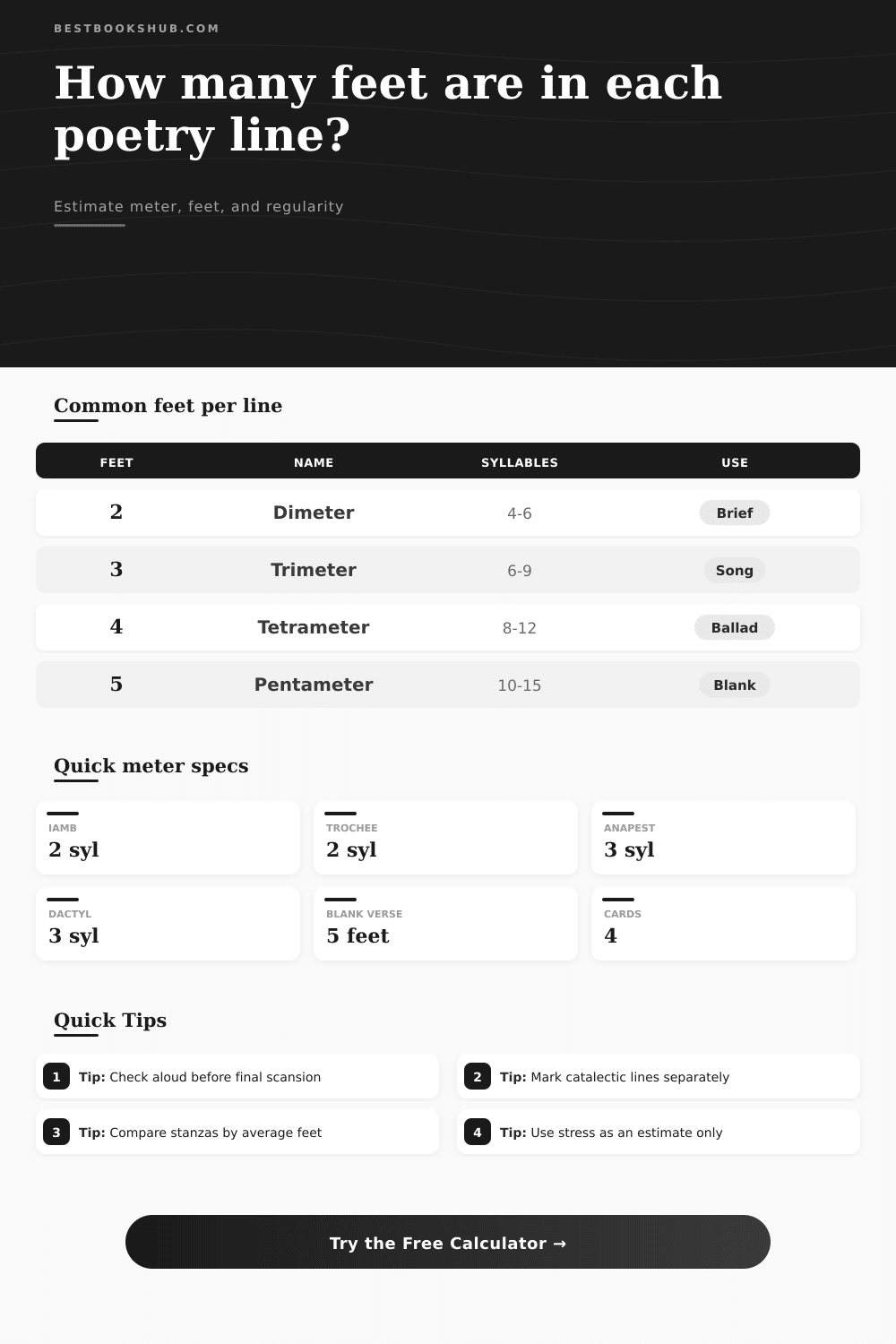
| 2 | Dimeter | 4 syllables | 6 syllables |
| 3 | Trimeter | 6 syllables | 9 syllables |
| 4 | Tetrameter | 8 syllables | 12 syllables |
| 5 | Pentameter | 10 syllables | 15 syllables |
| 6 | Hexameter | 12 syllables | 18 syllables |
| 7 | Heptameter | 14 syllables | 21 syllables |
| 8 | Octameter | 16 syllables | 24 syllables |
| Meter | Basic pattern | Syllables per foot | Typical line use |
|---|---|---|---|
| Iambic | weak strong | 2 | Blank verse, sonnets, dramatic verse |
| Trochaic | strong weak | 2 | Chants, songs, emphatic lyric openings |
| Anapestic | weak weak strong | 3 | Limericks, comic verse, galloping rhythm |
| Dactylic | strong weak weak | 3 | Classical imitation, long rolling lines |
| Amphibrachic | weak strong weak | 3 | Ballad-like movement and song verse |
| Spondaic | strong strong | 2 | Local emphasis inside another meter |
| Option | Adjustment | Best when | Result effect |
|---|---|---|---|
| Regular | 0 syllables | Lines close on the expected full foot | Strict target comparison |
| Catalectic | Minus 1 | A line deliberately drops the final weak syllable | Can normalize falling meters |
| Hypermetric | Plus 1 | A line carries an extra syllable beyond the measure | Marks overfull endings |
| Feminine | Plus 1 | An iambic line adds a final unstressed syllable | Keeps pentameter with extra ending |
| Auto | Closest of -1, 0, +1 | You want quick line matching by target | Chooses the nearest fit |
DISCLOSURE: This post may contain affiliate links, meaning when you click the links and make a purchase, I receive a commission. As an Amazon Associate I earn from qualifying purchases.
Before you’re able to name what you hear, you can feel the rhythm in your chest. That gallop is usually anapestic trimeter, while that steady heartbeat is almost certainly iambic pentameter. Writers is aware of this distinction instinctively, most often though struggling to demonstrate this insight on paper.
Scansion isn’t so much a matter of strict rules as it is tapping into pulse within poetry. What happens when you plug your words into the calculator above isn’t merely a matter of tallying up syllables. It’s a way of stress-testing the structure of the poem to see whether it will hold up against expectation or crumple beneath its own desire.
Understanding the Rhythm of Your Poem
By dividing the number of syllables in your text by the supposed length of foot, the calculator estimates which metrical feet you’ve produced. Then makes allowances for the ones that don’t quite fit the mold.
A poet promises something to their reader: meter. If you’re writing in iambic pentameter then that’s your promise to deliver ten syllables per line with five stressed beats. But life is messy. Language doesn’t always follow through on its promises. And that’s why we have settings for hypermetric and catalectic lines.
By making a hypermetric line, you add one additional beat (commonly known as a feminine ending). This softens up the ending and allows momentum to roll into next line. A catalectic line removes one final syllable from the end, giving it a decisive kind of sudden stop. What happens if you force all of your lines to exactly ten syllables? Your poem sounds mechanical.
Rhythm is what’s important, and regularity score shows you the consistency. It shows you how much a reader can predict the next beat. The higher the regularity score, the more they can predict next beat, which gives a sense of inevitability or comfort.
The other huge decision is which kind of meter to use. Iambic. The one most closely aligned with way we speak… Is the workhorse of English poetry. It turns out trochaic meter flips pattern on its head, and begins with an emphasis followed by a light syllable, making it feel more like a chant different than anything else. The three-syllable feet of anapestic and dactylic meters give the poem a rolling, galloping feel… Shakespeare was fond of using them in his mad scenes. Toggle through these options in the calculator; seeing how they fit will also help you dial into what mood works best for your poem.
You probably know that a sonnet should be pentameter, while a ballad might be alternating trimeter and tetrameter. Use the reference tables within tool to figure out where your poem lands, though sometimes it’s a blend. That’s why syllable counts is where most estimates go awry.
In English, we write words with lots of elided vowels and silent letters that drop out when we speak them. To account for this, the calculator includes several options for how to count. One method gives you one number by using a strict vowel count. Another method gives you a number based off how words sound in spoken English. That half-foot makes all the difference: it could convert a line from pentameter into a line of hexameter. Small as it seems, its significant for how the line sounds in the end.
To see what sounds right, you need to read your lines aloud. You have to feel where the stresses fall. No algorithm is going to get that right every time. The tool sets a baseline and flags deviations as a first step. So regularity is a feature, not a bug. It’s something we use deliberately.
On one hand, the lower the regularity of your poem, the more chaotic it might seem. But on the other hand, that chaos can reflect subject matter and be powerfully effective. That brings us to the second setting: Tolerance. This lets you set how much variance you’re willing to accept. For free verse, this will be all over the place, and that’s fine. We don’t want to force perfection. Instead we want to understand what’s going on below the surface.
Once you see the data, you’ll make better artistic choices. Should that extra syllable be considered a mistake? Or is it a meaningful variation? Scansion is like a map. It is not the territory itself. But what does this mean? The calculator provides you with the coordinates. Where are the stresses? How many feet do I have? Okay, but now how do I use them?
Scansion helps you see structure beneath your words. It’s the support system for the poem. But then there’s the music. After all, how do you break the meter if you don’t know what it is? And how do you lean into its regularity if you don’t understand it? How do you disrupt it for effect?
The tool takes care of heavy lifting. It counts and compares for you, leaving you free to focus on meaning.
There’s a heartbeat in your poem. Now you’ve just got to learn to listen close enough to hear when it skips a beat. That’s the rhythm. That’s the soul of the piece. Understand that rhythm and everything changes.