🎵 Sound pattern tool
Assonance counter
Measure repeated vowel sounds, near-assonance, stressed-word weight, dominant vowel groups, and line-by-line density in poems, passages, and drafts.
| Rank | Vowel group | Hits | Weighted | Share | Example words |
|---|---|---|---|---|---|
| Load a preset or paste text to see vowel groups. | |||||
| Band | Score range | Density signal | Draft reading |
|---|---|---|---|
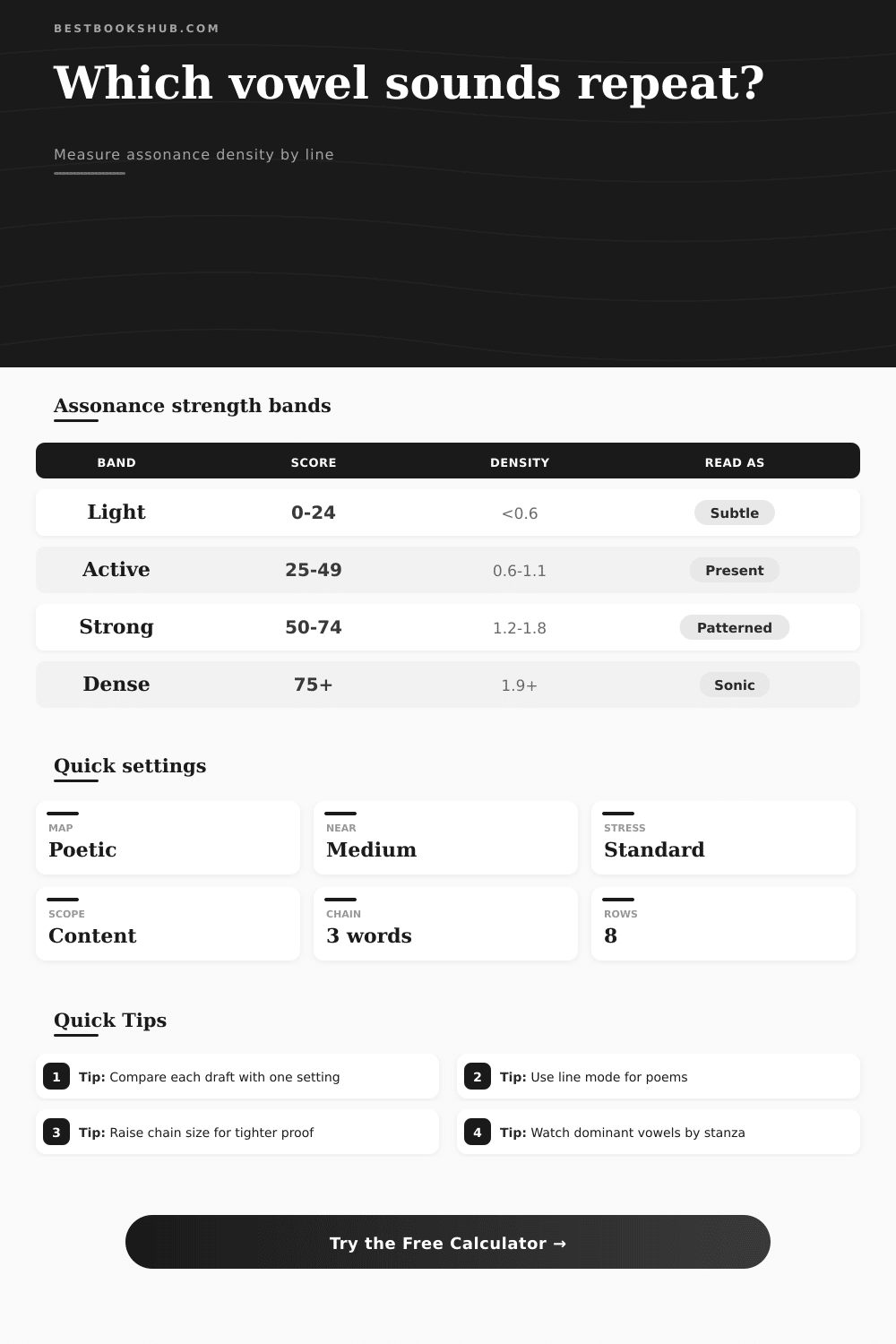
| Light | 0-24 | Under 0.6 repeats per line | Vowel echo is subtle or scattered. |
| Active | 25-49 | 0.6-1.1 repeats per line | Patterns are present without dominating. |
| Strong | 50-74 | 1.2-1.8 repeats per line | Vowel music shapes the passage clearly. |
| Dense | 75-100 | 1.9+ repeats per line | Repeated vowel sound is a major texture. |
| Group | Common spellings | Near partners | Typical effect |
|---|---|---|---|
| long a | a, ai, ay, eigh | short e, long i | Bright, open lift. |
| long e | e, ee, ea, ie | short i, long a | Clean, thin ring. |
| long i | i, y, igh, ie | long a, oi | High, sharp glide. |
| long o | o, oa, ow, oe | oo, aw | Round, slow pull. |
| oo | oo, u, ue, ew | long o, short u | Deep, smooth mood. |
| Setting | What changes | Best for | Watch for |
|---|---|---|---|
| Strict same sound | Counts identical groups only | Close proofing | Misses soft echoes. |
| Medium near matches | Adds related vowel neighbors | Most poems and prose | Moderate overlap. |
| Broad neighboring sounds | Credits wider vowel families | Loose lyrical drafts | Can feel generous. |
| Stressed weighting | Raises longer and line-end words | Performance rhythm | Uses a heuristic. |
| Passage type | Useful mode | Common signal | Density aim |
|---|---|---|---|
| Lyric poem | Line by line | Dominant vowels cluster by line. | 1.2-2.4 |
| Blank verse | Stanza weighted | Echo moves across line breaks. | 0.8-1.8 |
| Literary prose | Whole passage | Assonance sits inside sentences. | 0.4-1.2 |
| Dialogue | Content words | Voice repeats without looking forced. | 0.3-1.0 |
DISCLOSURE: This post may contain affiliate links, meaning when you click the links and make a purchase, I receive a commission. As an Amazon Associate I earn from qualifying purchases.
Remember the experience of reading some poems and knowing they are right inside your head, but on the page they look flat? There’s a quiet little hum of repetition, a kind of music you can hear in your ear tying the words together, but they seems stubbornly ordinary on the page. So much of what makes a poem come alive is called assonance, when the vowel sounds repeat within a line or between lines. Assonance provide the invisible glue that holds the words together, the echo you hear before your ears pick up on rhyme.
But how to measure this tricky thing that doesn’t live on the page at all, only in mouth? This tool does the hard work by reading your passage for those secret patterns, it converts that sound into something concrete to work with. What many writers consider an all or nothing characteristic, we view as a matter of degree. Assonance exist along a range based off how dense it is.
How to Use the Assonance Tool
A score at one end may indicate that your text is direct and clear. Exactly what you want in something that needs to go fast, like prose. At the other, it may be telling you that your piece is full of sound and is therefore good for some form of elevated speech or lyrics. Where you land on the scale in between the two will tell you if the reason something reads heavy is because of vowel clashes, or something else entirely. The calculator plots all of this for you, preventing guesswork about why a stanza seem so thick with echo.
English is a messy language and settings matter because of that. Spelling, region, and stress change vowels. The strict mode will only count an exact match. That can be good for checking something in particular or proving a point. Spelling, region, and stress change vowels. The strict mode will only count an exact match. That can be good for checking something in particular or proving a point. Broaden the sensitivity switch to medium or broad and throw the net wider. It’ll catch near matches that may not have been spelled right but still seem to flow with a sense of rhythm. Basically, you’re instructing the algorithm how forgiving your ear will be. For most draft work, the medium setting is best. It recognizes that though certain sounds (a long A and a short E) are technically different, often times they feel like they live next door.
The dominant vowel clusters in your piece will also provide a picture of its mood. A grouping of long A’s often lifts energy with an open, bright sound. A grouping of long O or OO sounds drags down the tempo, adding a heavier and more contemplative feeling. If you see one grouping, then you know you’ve got a sound pattern that wasn’t necessarily intentional, yet the text is humming away in a certain key. For this reason, it can be a good way to check consistency. Did you write a melancholy scene? Then if the tool flags a burst of high, sharp I sounds, maybe there’s a tonal leak you didn’t notice.
The craft begins getting technical here with line density. You don’t want every line to land in the exact same way. That’s a mechanical rhythm; like a drum machine with no variation. You want peaks and valleys. With the tool, you can go line by line and see how the strongest sounds aligns with the strongest images. Sometimes they don’t. If the vowel noise around a powerful metaphor is too loud, then that metaphor could of gotten lost. Checking the density allows you to cut out the excess and keep the music where it supports the meaning.
Another key to writing today is near assonance. This isn’t quite as blatant as perfect rhyme. It’s therefore more sophisticated-sounding, too. Ending your lines with the same sound is a cliché. It provides a familiar feel while avoiding the clichéd. When the calculator highlights such connections, you can pick out places to tighten a phrase. You can replace an ‘outlier’ word that interrupts the line with one that continues it, which makes the whole passage flow more smoothly. It is a tiny change, but it is the difference between singing and just being read.
Again, I don’t want to imply that you should be chasing a perfect score here. But using this tool will help you become aware. When you can see the patterns you can control them. You’ll know when to break them for emphasis and when to lean into them. The numbers are simply a guide. In the end, it’s your ear that is the final judge. But with another set of eyes, or in this case ears on the page you begin to trust your instinct. You begin to hear what was always there. What the invisible glue looks like becomes visible and now you have the power to hold it together or let it fall apart the way you want.