🎵 Sound pattern tool
Consonance counter
Measure repeated consonant sounds across a poem, paragraph, lyric, or manuscript excerpt, with separate reads for endings, internal echoes, alliteration, clusters, and line density.
| Sound family | Letters counted | Typical effect | Watch point |
|---|---|---|---|
| Sibilant | s, z, sh, zh, ch, j | Hiss, shimmer, hush | Can dominate soft lines quickly |
| Stop | p, b, t, d, k, g | Impact, closure, pulse | Endings feel especially firm |
| Nasal | m, n, ng | Hum, murmur, inward tone | Often hides inside quiet prose |
| Liquid | l, r | Flow, roll, continuity | Can blur if every line leans on it |
| Fricative | f, v, th, h | Breath, friction, pressure | Useful for whispered texture |
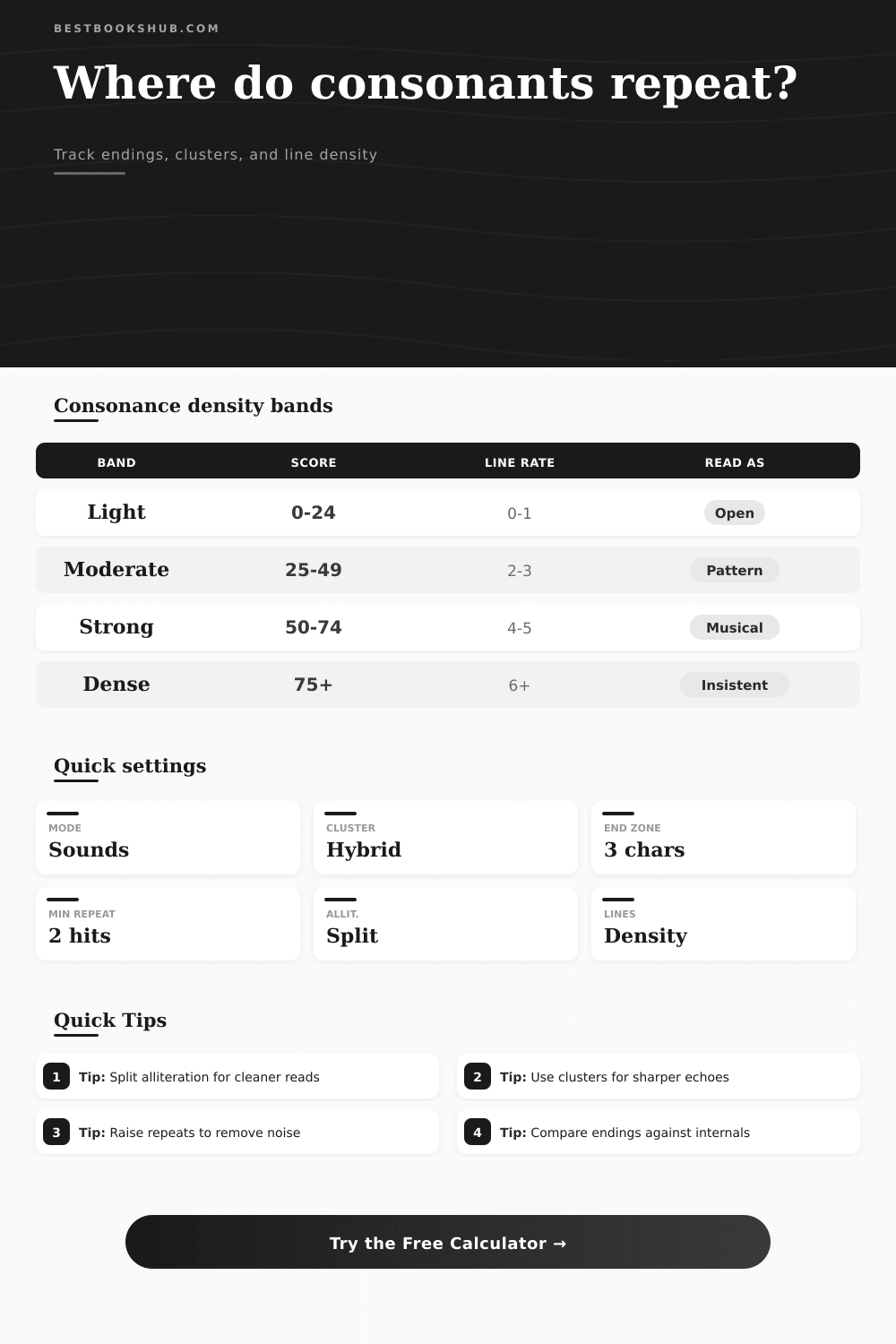
| Score band | Repeated hits | Line density | Likely reading |
|---|---|---|---|
| Light | Few scattered repeats | 0 to 1.9 hits | Open texture with light sound ties |
| Moderate | Several clear anchors | 2.0 to 3.9 hits | Noticeable pattern without crowding |
| Strong | Many shared consonants | 4.0 to 5.9 hits | Musical pressure and strong cohesion |
| Dense | Repeats in most units | 6.0 or more hits | Insistent texture that shapes tone |
| Position | What is counted | Consonance use | Separate from |
|---|---|---|---|
| Opening | First consonant or cluster | Can support a motif | Alliteration, if split |
| Internal | Middle consonants and blends | Core consonance texture | Vowel rhyme or meter |
| Ending | Final consonant window | Creates echo and closure | Full end rhyme |
| Cluster | Adjacent consonant blends | Sharper repeated bite | Single-letter repeats |
| Cluster type | Examples | Best setting | Why it matters |
|---|---|---|---|
| Initial blend | br, fl, st, cl | Split alliteration | Keeps starts from inflating the score |
| Medial blend | nd, mp, lk, rch | Hybrid | Finds echoes inside words |
| Final blend | ld, sk, nt, rst | End window 2 or 3 | Shows line-end closure |
| Soft pair | sh, ch, th, ph | Sound families | Tracks digraphs as sounds |
DISCLOSURE: This post may contain affiliate links, meaning when you click the links and make a purchase, I receive a commission. As an Amazon Associate I earn from qualifying purchases.
Rhythm comes from using consonance in your writing. While it is not as obvious as alliteration or rhyme, reading out loud will help you see how important consonance is for making sentences sound connected. Maybe you have a draft where everything appears right on paper, yet reads awkward. It’s likely not because of actual words. Rather, there is too many similar-sounding consonants connecting the words. Listen carefuly and you’ll hear it. You’ll notice the texture. Instead of a choppy texture, you want a smooth one. By doing so, you create music, and you do this without distracting rhymes.
That’s what it measures here. It measures not just letter counts, but grouping of sound families like ‘s’ and ‘sh’, ‘c’ and ‘k’. Why? Because English isn’t a phonetically spelled language. Sound-alike words with different spellings will be missed by tools that merely measure exact letter matches. By focusing on the acoustic result you get a truer picture of how your text lands in ear. That’s why it’s more about music then the written notation itself.
How Consonance Creates Rhythm
This one allow you to distinguish between internal consonance and alliteration. Alliteration is repetition of the first sound, such as SSS sound in Samuel Taylor Coleridge‘s work. Catchy stuff, but overused it can come across as forced. Internal consonance occur within words. It binds them together subtly without calling attention to itself. Separating these metrics help you see if you use too many headline-style openings.
Enter the text into calculator, and it will do the maths for you. This will indicate where weight falls in your writing. Look out too for echoes at the end of words. The repetition of consonant sounds at the close of words give a feeling of closure. Words with hard stops at ends (e.g. Words with hard stops at the ends, like bat or cat, are full and final. Nasal sounds like n and m hums, which leaves a soft impression. Consider table of references on the page which shows contribution of each family of sounds to the mood. Fricatives bring breath, sibilants hisses, liquids flows.
If you have lots of endings it’s worth reading through these last words out loud. Listen closely and you’re probably going to pick up a pattern of something satisfying or even repetitious. This change the overall impression.
So how does this connect back to theory? Density. Low = Acoustically loose. High = Aggressive/insistent. Typically what you’ll be looking for is moderate density where sounds support meaning but don’t overwhelm it. By playing with settings on the clusters you can alter how sensitive that measurement is. Single letters is worth less than blends such as ‘nd’, ‘st’. For a tense scene, you may wish to increase frequency and sharpness of clusters. A reflective passage might sounded better with softer, scattered sounds.
You write based off what you see, of course, but also based on what you hear. What’s its sound? When you edit you focus on structure and clarity, but too frequently overlook how it sounds. Even if you’re not a poet, you know that rhythm is someone else’s problem. There’s a beat in every line, there’s a texture to each paragraph. By pulling these out you give yourself the power to shape sound of what you’ve written. You decide where you want it to breathe and where you don’t. The effect is prose that seems inevitable. It is not just because it looks correct, but because it sounds right.
No single formula exist for achieving perfection. How much consonance is correct depends on context. More repetition suits a nursery rhyme different than a legal brief. The solution lies in awareness. Once you get used to listening for this, you’ll begin to recognize the pattern everywhere you read. Jarring clashes in hastily-edited drafts and subtle echoes in news headlines jump out at you. You should of used it more.
Use the tool to validate hunches. Allow the numbers to affirm what your ear already suspects. Return to the page and polish the tune. These are the instruments that is the words. Play them with purpose.