📝 Rhetorical repetition tool
Anaphora counter
Measure repeated opening words and phrases across lines, sentences, and stanzas, with density scoring, strongest opener detection, and phrase-length controls.
| Rank | Opening phrase | Hits | Units | Stanzas | Phrase length |
|---|---|---|---|---|---|
| Run the calculator to see repeated openers. | |||||
| # | Unit opening | Best match | Opener hits | Stanza | Signal |
|---|---|---|---|---|---|
| Matched lines or sentences will appear here. | |||||
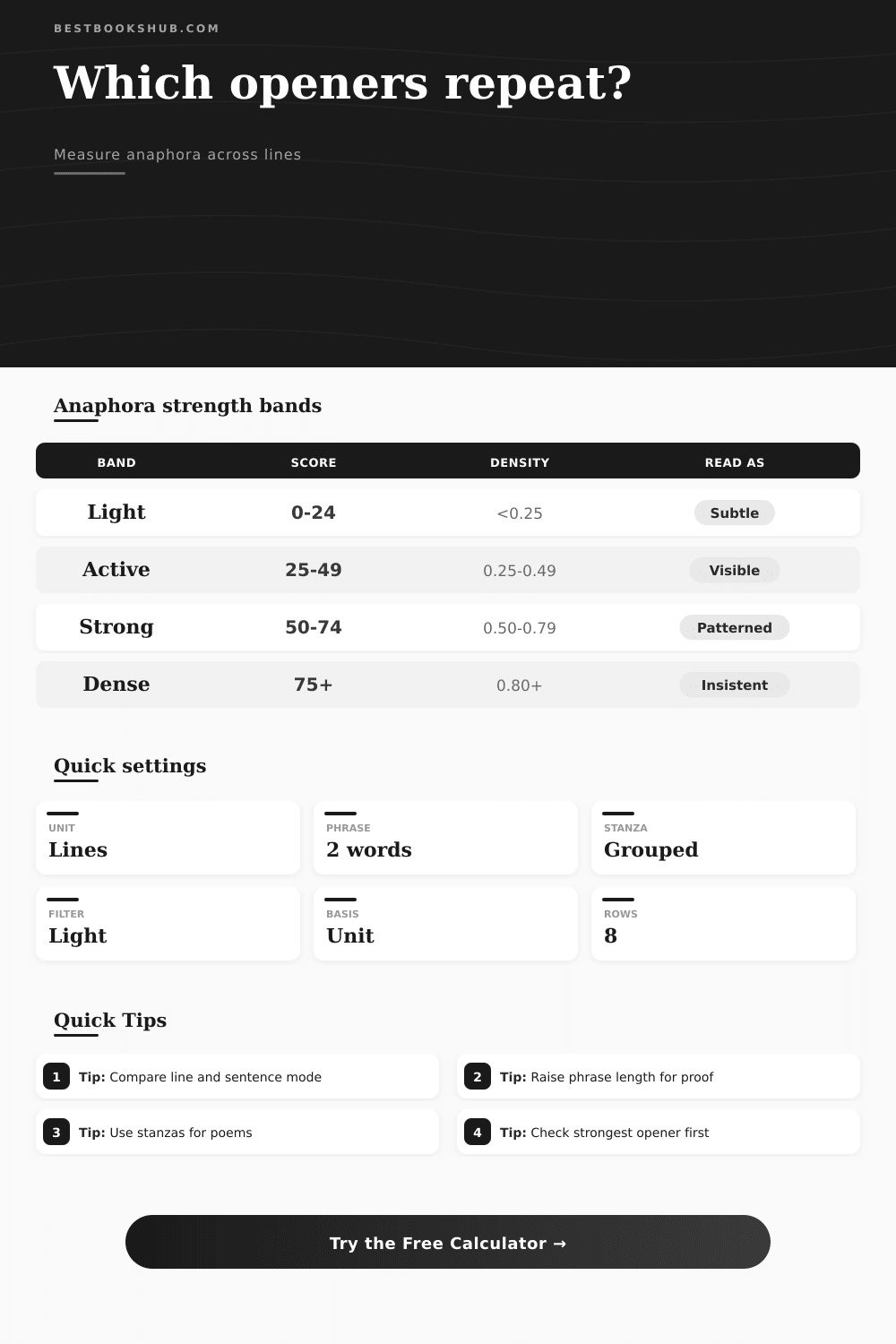
| Band | Score range | Density clue | Typical use |
|---|---|---|---|
| Light | 0-24 | Few repeated openings | Subtle emphasis or incidental echoes |
| Active | 25-49 | Repeated opener in several units | Clear rhetorical rhythm without dominance |
| Strong | 50-74 | Multiple repeated units or stanzas | Deliberate cadence, argument, or chant |
| Dense | 75-100 | Recurring opener controls the passage | Insistent speech, litany, chorus, or refrain |
| Mode | Best for | What it compares | Watch point |
|---|---|---|---|
| Lines | Poems and lyrics | Opening words at each line start | Line breaks affect the count |
| Sentences | Speeches and essays | Opening words after sentence breaks | Long sentences reduce unit count |
| Both | Mixed drafts | Line starts plus sentence starts | Short lines can increase density |
| Stanza weighted | Poems with sections | Repeats that recur inside blank-line groups | Blank lines define the stanza map |
DISCLOSURE: This post may contain affiliate links, meaning when you click the links and make a purchase, I receive a commission. As an Amazon Associate I earn from qualifying purchases.
These are phrases or words repeated at the start of each sentence, line, clause, or other part. This can be a rhythm that sticks in ear as you hear it in protest chants, in political addresses, in church sermons. But writing this stuff well is not as easy as it appears.
The rhythm can become monotonous rather than driving; you may miss seeing a compelling pattern that your eye slides past on a routine word like “and”. The anaphora counter measure how many times the opening phrase are repeated throughout stanzas, sentences, and even lines. Use it to see if your cadence is repetitive or just feels repetitious by accident.
How to Use the Anaphora Tool
What does count as a unit? That’s the first question you need to answer. Do you want to analyze both sentence starts and line starts, or just one or the other? Your choice here will matter: Prose and poetry works on different grids. For example, in prose, the sentence boundary plus the breath are the dominant signals. A long paragraph where every third sentence start with same word feels different than a series of short lines where those same words repeat at the start of each stanza.
You don’t want to accidentally inflate your score by choosing the wrong kind of unit. Analyze a speech as though it’s a series of poems and you may think there’s a powerful rhetorical theme when actualy it’s just an accidental coincidence. Once you select the mode (i.e., whether you’re looking at line starts only, sentence starts only, or both), the calculator take care of the segmentation for you. No more manual counting required!
The main thing that trips people up is phrase length. By chance alone, any single word. Even a common one such as we or the; will probably show up again. The shorter the text, the more likely this is to happen. That is why there’s a minimum phrase length setting on the tool. Filtering for say two-word or three-word openings rules out random collision and shows what’s meant.
So yes, when you see the phrase “we must” appear five times or more, you have a signal. When you only see word we repeated, maybe you’re just writing in your own voice. Increasing the minimum phrase length increase the standard of proof. It requires the pattern to become more specific. And it becomes rhetorically more signficant. You want to know if you are echoing a theme or just repeating a subject. Or are you echoing a theme?
Structured layout, including grouping stanzas, provide extra layers of meaning to poetry or other writing. Blank lines serve both mental and visual boundary functions. If there’s a repeated opener that appears once in every stanza, it creates a refrain that anchors the piece. When multiple such repeat are grouped into one block, we feel it’s a list.
The reference table on the page help you interpret the resulting density score, the higher the score, the more the repetition is driving the entire passage. Light scores mean subtle emphasis, ok for gentle prose. Dense means it’s driving the entire passage, perfect for a chorus but potentially tiring for an essay. It is useful to know how close you are to that limit so you would of know when to tone down the effect.
That’s where good starter filters can help clean up the noise. Prepositions and articles are structural glue: they’re not thematic anchors. Filter them away, and you get to the substantive words that bear meaning. Leave them in place, and you may notice lots of words such as on or in, which tell you nothing about how youve structured your rhetoric. Focus the analysis instead on the nouns and verbs that actualy construct your argument. It’s a small tweak, but one that makes the data meaningful.
The point is control. The point being: anaphora shouldn’t be forced; rather, it must feel inevitable. The ear comes to expect the return of the phrase once it’s in the right pattern. There’s a sense of conviction, a sense of order. Wrongly placed, it loops.
Here’s the thing about the tool: it moves you from instinct to evidence. You can see precisely where the repetition lands. You can see just how densely it happens. You can try out different lengths for the phrase and get a read on how strong the pattern is. Then you can tinker until the rhythm reinforces the message.
The math clarifies the ear. It starts as a feeling: something echoes here. It ends with a clear map of how that echo has been built. And that clarity turns a draft into a statement.