📚 Rhetorical repetition tool
Epistrophe counter
Find repeated ending words and phrases across lines, sentences, and stanza groups, then score how strongly a passage closes on the same language.
| Ending phrase | Words | Repeats | Units | Stanza spread | Strength |
|---|---|---|---|---|---|
| Run the calculator to see repeated ending phrases. | |||||
| Unit | Ending sample | Matched closer | Group | Repeat load |
|---|---|---|---|---|
| Line or sentence endings will appear here. | ||||
| Group | Units scanned | Repeated closers | Dominant closer | Density |
|---|---|---|---|---|
| Stanza summaries will appear after calculation. | ||||
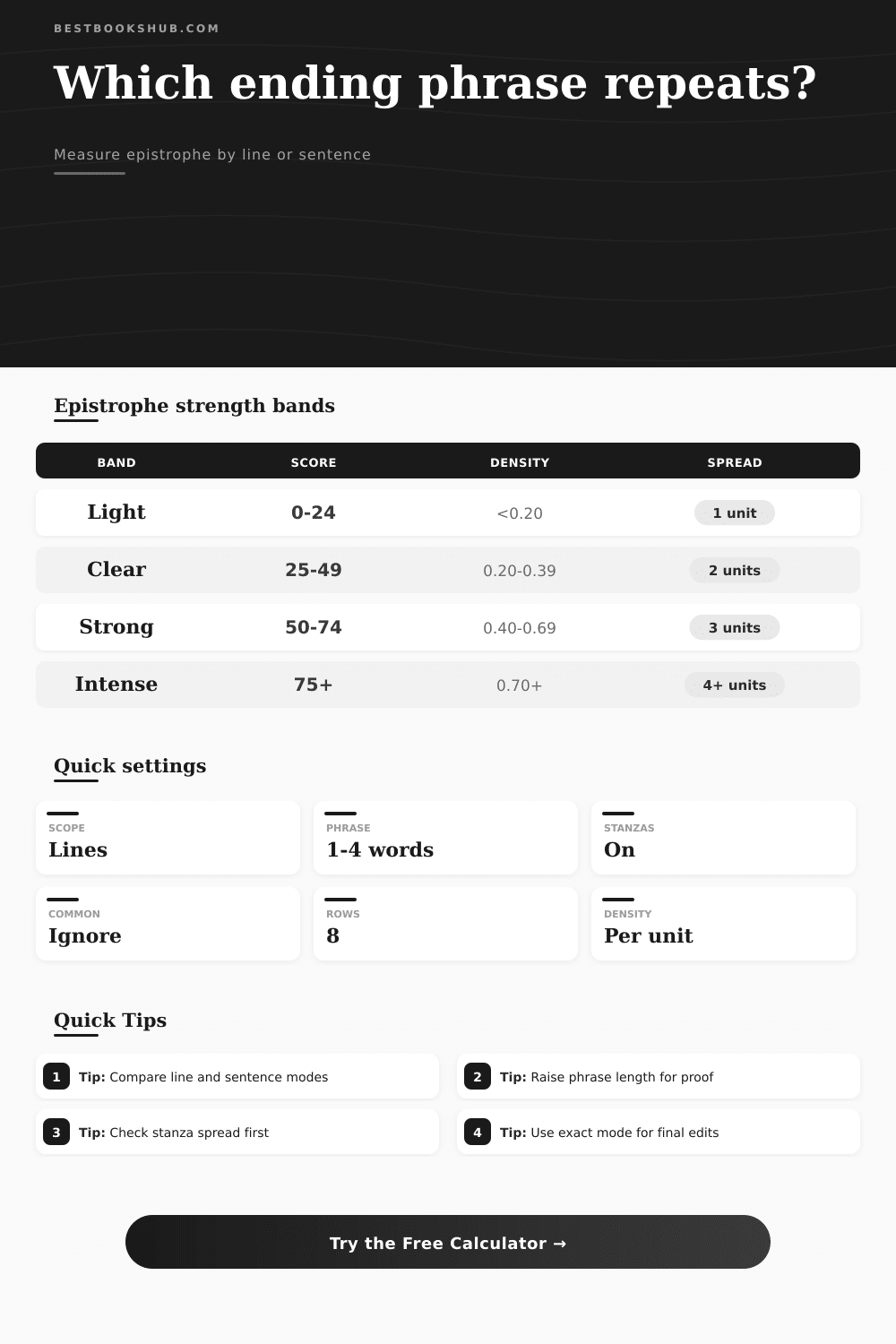
| Score band | Typical pattern | Density guide | Editing read |
|---|---|---|---|
| 0-24 | Few repeated closers | Below 0.20 | Light or incidental ending echo |
| 25-49 | One clear repeated ending | 0.20 to 0.39 | Noticeable refrain effect |
| 50-74 | Several matching endings | 0.40 to 0.69 | Strong epistrophe pattern |
| 75-100 | Repeated closer drives structure | 0.70 or higher | Intense rhetorical closure |
DISCLOSURE: This post may contain affiliate links, meaning when you click the links and make a purchase, I receive a commission. As an Amazon Associate I earn from qualifying purchases.
The tool can help point out epistrophe in your writing. Epistrophe is when you repeat a phrase or word again and again as the end of each line or clause. It’s an interesting form of writing that provide a rhythm, alerting the reader that something important being said.
Because you’re used to getting new information at the beginning of a sentence, your eyes tend to skip over it. The emotional impact at the end of a sentence matter most. This is why your brain may overlook those parts if it has no reason to look for them.
How the Tool Finds Epistrophe
Here’s how it works: It scans through your text looking for those trailing phrases. How frequently are they repeated? It tallies that up. And what about how much and how spread out that repetition is within the stanzas or paragraph itself?
Paste in some dialogue, a speech or even a poem. Then let the tool go to work comparing the ending units, whether you define them as lines or full sentence.
Epistrophe isn’t simply about repetition but more precisely about pattern recognition. Repetition of a common word is generaly bad editing. A technique is repeating a phrase at the end of multiple clauses as part of an argument. That’s epistrophe. The tool can help you identify when repetition is intentional, and when it isn’t.
So what about all those common function words: “or”, “and,” and all that? These don’t add much rhetorical value because they show up all over the place. You can exclude them from calculation. By doing this, you’ll be able to focus on meaningful phrases. Words grouped together into a couple or trio shows intent better than words alone.
And if it is scattered across only one stanza, the effect is localized, almost like a joke callback. But how does this work if the phrase only exists in one stanza? Then it’s localized to that one location. But what if it occur in several sections? Now it serves as a structural backbone. The density measure will let you know whether youve accomplished either one.
Too low here and the pattern’s too diffuse to make an impact; too high and you’re hammering home the refrain. Sometimes it comes from monotony. Sometimes what’s in the middle is as important as how it begins and ends, and when we has no variety in the middle, the ending just gets flat.
Does your repeat ending come clustered or distributed? That’s something else the stanza spread feature reveals for you. A good use of epistrophe will vary what’s in the lead up to an ending, but keep the beat. Otherwise it sounds more like repetition different than rhythm.
The data is there but the decision to determine if it matches the mood is between your ear and eye. Does this mean you have to nail a perfect score? No. There are times when an epistrophe will be used lightly, almost like it stays in your mind after reading. Sometimes it is intense and demands attention. The tool with reference bands offer a guideline but context always informs how it should of been used.
Perhaps your intention is a subtle effect in a lyric poem; maybe you intend an intense one in a political speech. Try for your desired effect by matching your intent to the execution.
Look at your best close phrase. Is it focused on the word you want to bring forward? Can you change earlier phrases to pull the focus to that word? Once you recognize the pattern, you can strengthen it (or weaken it) to contrast against other parts of the writing. The strength of the end relies on what gets you there.