🙏 Back matter fit desk
Acknowledgments Length Checker
Paste acknowledgments to measure total words, estimated print pages, ebook screens, named thank-yous, paragraph shape, tone signals, and section size.
Load a realistic book scenario, then replace it with your own section and adjust the production target.
DISCLOSURE: This post may contain affiliate links, meaning when you click the links and make a purchase, I receive a commission. As an Amazon Associate I earn from qualifying purchases.
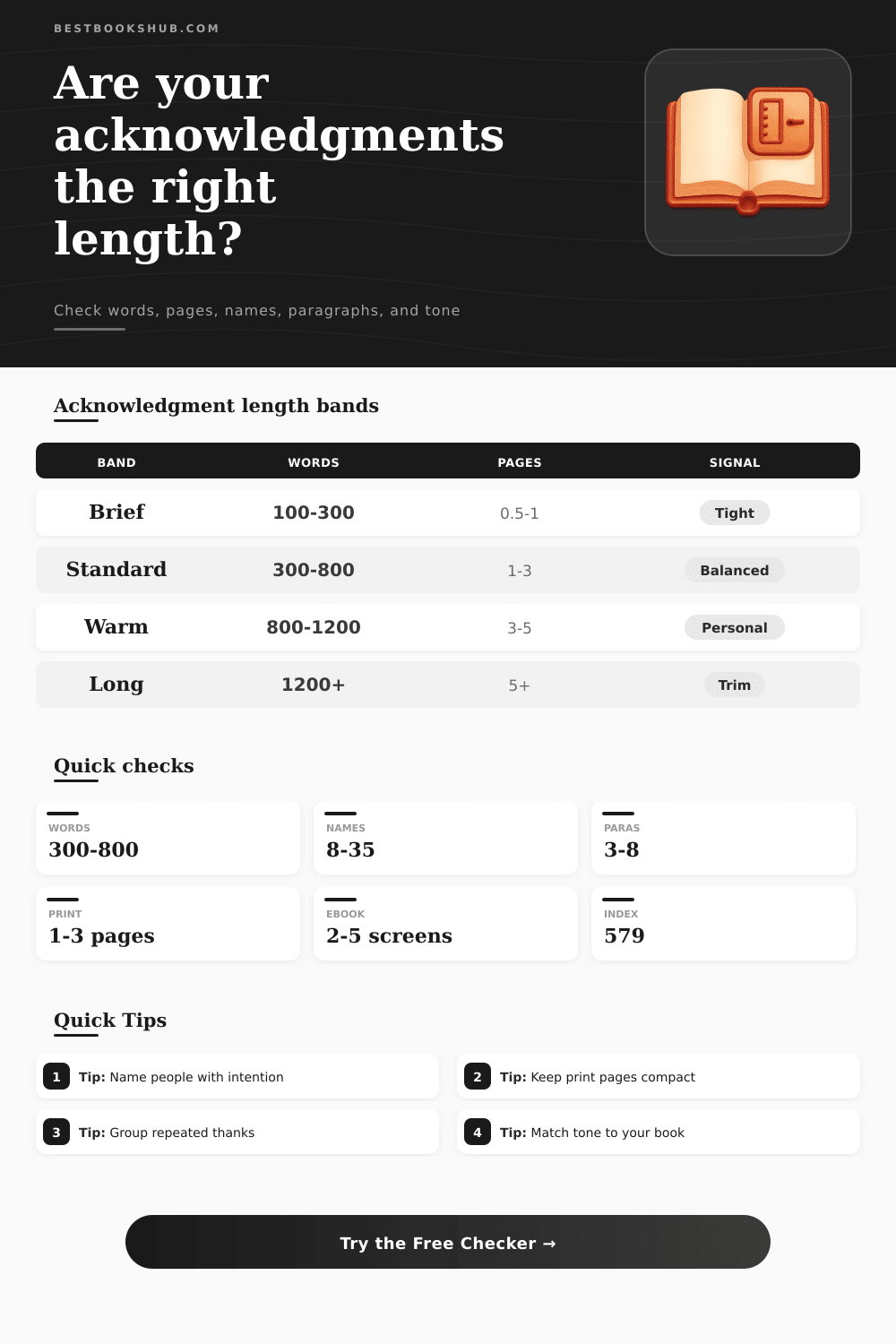
Use these reference bands to interpret the calculator outputs. They are planning ranges, not rules for who deserves thanks.
| Length band | Total words | Print pages | Ebook screens | Best fit |
|---|---|---|---|---|
| Brief note | 100-300 | 0.5-1.2 | 1-2 | Poetry, short ebooks, lean genre fiction |
| Standard book | 300-800 | 1.2-3.2 | 2-5 | Most novels and trade nonfiction |
| Warm personal | 800-1,200 | 3.2-4.8 | 5-7 | Memoir, family-rich fiction, personal nonfiction |
| Expanded team | 1,200-1,800 | 4.8-7.2 | 7-10 | Research, anthology, heavily collaborative work |
| Tone band | Common cues | Useful length | Watch for | Good adjustment |
|---|---|---|---|---|
| Warm trade | Thanks, grateful, generous, names grouped | 300-900 words | Run-on lists of names | Group by role or moment |
| Formal academic | Institution, archive, funding, colleagues | 500-1,500 words | Too much private detail | Keep personal thanks concise |
| Intimate memoir | Family, love, memory, grief, home | 600-1,300 words | Emotional repetition | Use fewer, stronger paragraphs |
| Concise professional | Team, editor, agent, readers, production | 150-600 words | Sounding abrupt | Add one warm closing sentence |
| Name count signal | Named thanks | Density cue | Likely reader effect | Revision move |
|---|---|---|---|---|
| Light | 1-10 | Few direct names | Focused and private | Check no key contributor is missing |
| Balanced | 8-35 | Names plus groups | Personal but readable | Merge similar roles if needed |
| Team heavy | 20-70 | Many contributors | Collaborative and broad | Use clusters by role |
| Overloaded | 70+ | Long list energy | May feel like credits | Move groups into one sentence |
| Format priority | Section target | Page cue | Ebook cue | Practical check |
|---|---|---|---|---|
| Print first | 1-3 pages | Looks intentional in back matter | Usually 2-5 screens | Preview final trim pages |
| Ebook first | 1-4 screens | Usually under 2 pages | Fast to scroll | Keep paragraphs short |
| Balanced | 300-1,000 words | Compact print section | No long wall of text | Use 4-8 paragraphs |
| Audio note | Shorter closing | Print unaffected | Works as back matter | Read aloud for rhythm |
This is a length checker for the acknowledgements. It tell you roughly how many words there are. It gives an estimate of number of pages or screens on your ebook. It shows what shape the paragraphs are. It counts how many named thank-yous there are. It checks if tone is right. It shows how big the end section is going to be.
The acknowledgments are the last part of book and act as a quiet handshake that turns private debts into public record. There are two potential issues here. Either writer does not bother with the section, which is not surprising, or they writes a stiff paragraph that feels like an afterthought and then add a quick list that reads like film credits.
Why Length Matters for Acknowledgments
The length matter because it will affect how people see you. Too little, and you might come across as aloof; too much, and people will be skimming before they even make it through your final set of thank-yous. This will vary by genre, production limitations, and social conventions. Does your book fit in a warm section or can you afford to take up a few more pages? Are you writing a memoir where you has several chapters worth of family history? Do you need to be both academic and human (and give a nod to the institutions that supported your work)? How is this shown in the physicality of the book and its impact when it settles into our minds once we’ve read the last word?
You can convey same amount of gratitude in a few words or many, but it’s all about the rhythm of the paragraphs. One long wall of text just makes me feel burdened with names to get through. Give some white space between each group and make them stand out on there own. The math is handled by the calculator above, but seeing what happens to the average paragraph length changes your tone. Four words average: Clipped. An average of forty words are thoughtful. Both tones has their place if you think about the relationship you’re celebrating and then match the rhythm.
The power of a name to affect how we read cannot be overlooked. A list of thirty feels collaborative. An 80-name list feel like a wedding reception no one wanted to attend. Better to group than list every person by name. Thank the editorial team in general; then pull out the two folks who made particular contributions to the book. Generosity is noticed more than completeness.
Readers also notice when the acknowledgments sudden turn into a victory lap. Writers feel their way through the issue of tone, but they don’t necessarily quantify it. Words such as heart, gratitude, patience signals a warm trade book. Words such as colleagues, funding, and archive signal academic writing. There’s a great gap between those vocabularies. A formal history will sound off-key if you inject too many close-to-home family words. A memoir that sounds too corporate sounds like you’re reading someone else’s annual report. The best acknowledgments maintains one tone from start to finish.
On one hand, print and ebook formats push in opposite directions. An infinite scroll on your phone vs. Three neat-looking pages in hardcover. Back matter that balloons your paper cost: readers see it. A digital edition that takes a full ten swipes before getting to the next book: readers see it. Most trade books falls roughly between 300 and 800 words. You have space to be generous while avoiding trying anyone’s patience.
And we all make similar errors when writing for different genres. We tell the reader to thank our editor and our agent in the same breath, then we go on to describe our cat for three paragraphs. We bury the most important person halfway down a list. We fail to recall that the last sentence is what sticks with the reader longer. It’s not always the long list of who did what where; sometimes it’s a quiet little line that says something very specific and works harder.
Thank god, because the calculator won’t be able to tell you who to thank. It only shows what their words add up to, once they’re turned into a string of pages, then screens, then minutes of readers’ attention. Once you look at the numbers, you will know how to edit. Cut the sentence that repeats what the last one said. Combine the two paragraphs that thanks the same writing group. Add a warmer line if the tone feels too cold. It’s all in proportions; never completeness (that counts with acknowledgments).
It should of feel as though the author is taking a step back, allowing other voices a moment to breathe at the close of the book. That echo arrives just where it’s supposed to if you’ve got the length correct.