📖 Focused reading planner
Active reading time calculator
Estimate focused reading hours, clock time with breaks, session count, and daily pages for books, chapters, study packets, and review-heavy reading.
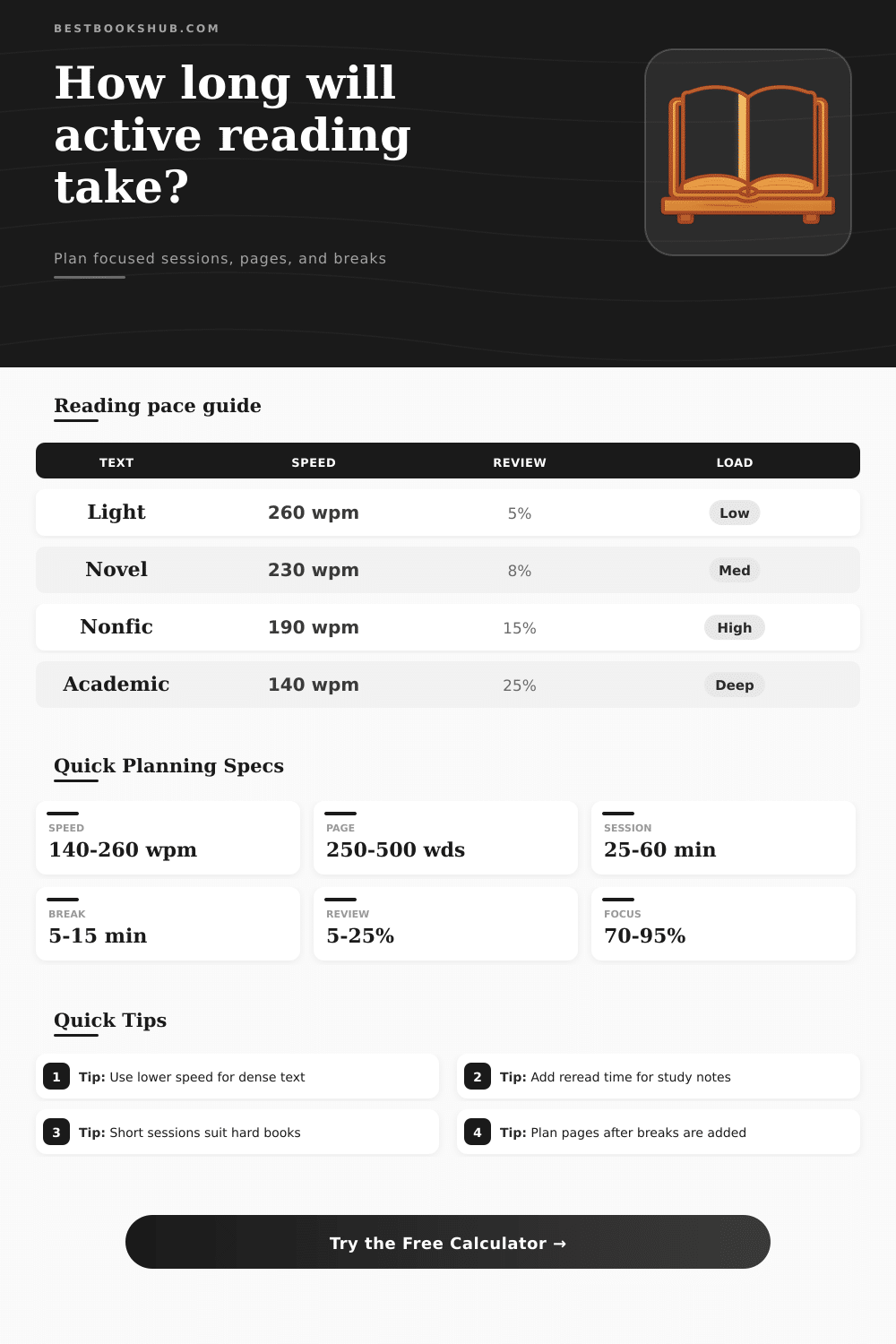
| Reading type | Useful speed | Words per page | Planning note |
|---|---|---|---|
| Light fiction | 240 to 300 wpm | 250 to 330 | Usually needs a small review buffer unless the prose is complex. |
| General nonfiction | 180 to 230 wpm | 300 to 400 | Use a moderate difficulty factor when chapters introduce new ideas. |
| Textbook chapter | 120 to 180 wpm | 400 to 600 | Plan for examples, diagrams, rereads, and end-of-section checks. |
| Research article | 90 to 150 wpm | 500 to 800 | Dense sections often need summary notes and targeted rereading. |
| Book club reading | 190 to 250 wpm | 280 to 360 | Add annotation time for questions, quotes, and chapter flags. |
| Session pattern | Best for | Typical break | Planning effect |
|---|---|---|---|
| 25 minute blocks | Hard chapters, notes, exam work | 5 minutes | More blocks, lower fatigue, easier to schedule around busy days. |
| 45 minute blocks | Most active book reading | 10 minutes | Balanced for pace, recall, and page progress without rushing. |
| 60 minute blocks | Immersive novels and stable focus | 10 to 15 minutes | Fewer starts and stops, but focus efficiency may drop late. |
| 90 minute blocks | Weekend sprints or research days | 15 minutes | Works best when notes are batched after each block. |
| Common reading plan | Pages left | Suggested setup | Expected active time |
|---|---|---|---|
| Short chapter review | 25 to 40 pages | 170 wpm, 15 percent review, 30 minute sessions | About 1.2 to 2.2 focused hours |
| Weekend novel finish | 120 to 180 pages | 240 wpm, 5 percent review, 60 minute sessions | About 3 to 5 focused hours |
| Book club deadline | 200 to 300 pages | 220 wpm, 10 percent review, 45 minute sessions | About 5 to 8 focused hours |
| Textbook unit | 80 to 140 pages | 140 wpm, 25 percent review, 25 minute sessions | About 6 to 12 focused hours |
| Research stack | 60 to 120 pages | 120 wpm, 35 percent review, 45 minute sessions | About 5 to 13 focused hours |
DISCLOSURE: This post may contain affiliate links, meaning when you click the links and make a purchase, I receive a commission. As an Amazon Associate I earn from qualifying purchases.
There are books you pick up with great expectations. Halfway through, you realize that even though your eyes keeps moving, your brain has wandered away and you’ve read the same paragraph three times. That’s not a failure of will. Generally, that’s bad planning.
Reading is like running a mile on an empty stomach: most people approach reading expecting their bodies to figure it out in real-time, hoping for the best. When you’re actively reading, you’re doing mental work; it takes strategy, not mindless consumption. There’s a gap separating effortless reading (gliding through novels) from reading that feels like effort (wrestling with a heavy textbook), and that gap can only be crossed when we use honest time estimates instead of wishful thinking.
Plan Your Reading Time Well
When you put in your particular constraints, the calculator will do it for you. No more guessing at how much time you can squeeze out for real study during a hectic week. No more pretending that you read at a constant rate.
Your reading rate slows down dramatically as soon as you begin to pause and look up unfamiliar words in past chapters, highlight important arguments, and write margin notes. You’ll vastly underestimate the time required for something technical if you’re basing your schedule around how quickly you skim through a fluffy piece of fiction. And when you make this mistake, you end up rushing through sessions just so you can reach an arbitrary number of pages rather then accumulating true understanding.
First, set the tool’s assumptions about the difficulty of the text and type of annotations. Even if your eyes go as fast, it takes more than double the time to read a textbook chapter with 450 words per page compared to a standard trade book page. 450 words/typical page) compared to a typical trade book (e.g. This is about 150 to 300 words. And you’re also grappling with complex terms, examples, and diagrams which need to be mentally translated into something meaningful. Then throw quote summaries/notebook entries on top of that, and your actual reading speed becomes even slower.
Most people assume they should read at their “base” rate, no matter what kind of output they’re generating. To account for this, the tool incorporate cognitive-load multipliers so that it provides you with a realistic baseline before factoring in any break times.
Reading isn’t a steady slog. It’s a series of breaks, and each break helps us absorb the material. Staring at a book for four hours straight doesn’t increase retention after about an hour-and-a-half. That’s why breaks are essential. If you’re using the reference section with its planning specs, you’ll see that focusing on a particular block size has specific consequences in total clock time vs. Focused effort. Hard books does well with shorter blocks since longer sessions can erode your attention span through fatigue. Immersive story-based books benefit from longer blocks as the context transitions naturaly from one chapter to the next.
Pattern selection matters more than raw hours spent sitting at a desk. And that’s exactly what the page does well: It makes the point clear in the reference table (matching common reading goals with suggested speeds and review buffers). When reviewing sections to study for an exam, you’re going to have to read those same sections again so you can remember the information. And that second pass is where true retention occurs, which is why that buffer percentage matter so much.
Far too many readers completely skip over this second level of work, causing them to panic-cram the night before their next exam/discussion deadline. Adding review time into your original plan shifts that grunt-work over multiple days rather than piling it all onto one fatigued evening.
Don’t force yourself to speed-read (when exhausted). When you get tired, adjust your pace for the day so you’re hitting your daily goals, not exceeding them. The calculator has a built-in “daily pages” figure, which includes review cycles and appropriate break time. Even if you think you can push harder, don’t, it’s far more effective to hit your page count consistently over time than it is to exhaust yourself half-way through the end date. It would of been better to finish slightly ahead of schedule so you can write your notes clearly, rather than exhausting yourself halfway through the deadline and burning out.
When you match your expectations for reading with how it works at its best through active engagement, reading stops being a daunting task. Instead, it becomes something you know you can do. It becomes something you have a realistic plan to complete, rather than just a fuzzy intention.