📖 Prose pace tool
Adverb density calculator
Paste fiction, essays, reviews, blurbs, or classroom prose to measure adverb load, intensifier pressure, repeated adverbs, and sentence pacing.
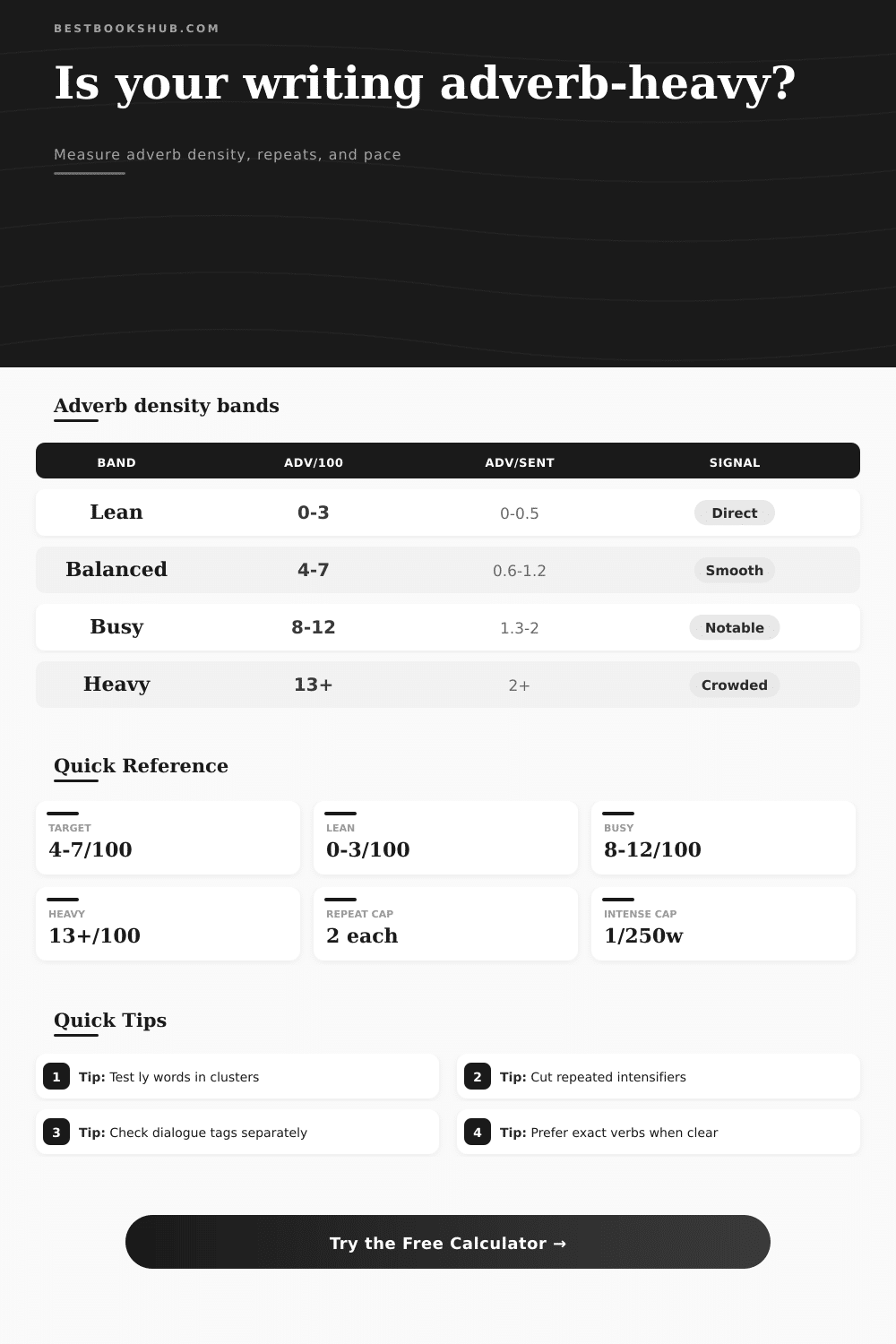
| Band | Adverbs per 100 words | Adverbs per sentence | Common editing signal |
|---|---|---|---|
| Lean | 0 to 3 | 0 to 0.5 | Direct pacing, verb-led prose, sparse modification. |
| Balanced | 4 to 7 | 0.6 to 1.2 | Moderate guidance without crowding most sentences. |
| Busy | 8 to 12 | 1.3 to 2.0 | Noticeable modifier layer; check clusters and repeats. |
| Heavy | 13 or more | More than 2.0 | High adverb pressure; revise weak verbs first. |
| Function | Examples | Useful when | Watch for |
|---|---|---|---|
| Manner | quickly, quietly, carefully | The action needs a precise movement or tone cue. | Replacing a verb that could carry the action alone. |
| Degree | very, really, almost, barely | The sentence needs scale, limit, or qualification. | Stacked intensifiers that weaken the noun or verb. |
| Frequency | often, rarely, always, never | The passage tracks habits, patterns, or repeated events. | Absolute claims in analysis or summary passages. |
| Time and place | then, soon, here, outside | The reader needs sequence or location clarity. | Too many directional cues in consecutive sentences. |
Fiction scene
Best target is usually balanced. High manner adverbs can signal verbs that need more force or specificity.
Dialogue-heavy prose
DISCLOSURE: This post may contain affiliate links, meaning when you click the links and make a purchase, I receive a commission. As an Amazon Associate I earn from qualifying purchases.
Tags and quoted speech can raise adverb counts. Use the quote option to see whether dialogue drives the score.
Book review
Degree adverbs are common in evaluation, but repeated boosters can blur the reviewer's claim.
Academic note
Careful qualifiers may be useful. Watch for almost, generally, and often when claims need sharper support.
| Text type | Typical target | Good first pass | Keep adverbs that |
|---|---|---|---|
| Literary fiction | 3 to 7 per 100 | Check repeated manner adverbs near dialogue and action. | Add rhythm, irony, point of view, or exact timing. |
| Genre fiction | 4 to 8 per 100 | Trim action adverbs after weak verbs or dialogue tags. | Change meaning in ways the verb cannot show. |
| Book review | 5 to 9 per 100 | Reduce stacked boosters before evaluative adjectives. | Clarify scope, frequency, or strength of judgment. |
| Academic prose | 4 to 10 per 100 | Separate useful qualification from habit phrases. | Signal caution, method, probability, or limitation. |
| Blurb or summary | 3 to 6 per 100 | Cut vague boosters and keep pace high. | Set sequence, contrast, or promotional emphasis. |
| Preset | Likely density | Main pressure point | Revision aim |
|---|---|---|---|
| Quiet literary | Lean to balanced | Time and place adverbs | Keep rhythm, remove redundancy. |
| Action scene | Busy | Manner adverbs after action verbs | Strengthen verbs and sequence beats. |
| Book review | Balanced to busy | Degree adverbs in evaluation | Make claims specific and less boosted. |
| Academic note | Balanced | Qualifiers and frequency adverbs | Keep necessary caution, trim habits. |
| SEO summary | Busy | Repeated boosters | Reduce sameness and improve clarity. |
What happens when the action is supposed to be fast but the words are slow? You may have noticed your sentences drags. It’s often the result of too many adverbs. Adverbs are a writer’s quick fix: Use an adverb when you have a weak verb. It is like saying a door closes loudly, rather than saying the door slammed. It’s easy in the moment but it’s a trap.
The calculator above helps you spot where writers take those shortcuts so you can catch shortcutting before editor does. For example, although the tool counts words that end in ly, it doesn’t stop there. It tells difference between manner adverbs and intensifiers (degree) and repeats them to boot. For example, the first type (a word like “quickly”). Tells you how something was done. The second type, a word like “very”; just makes the verb stronger without adding anything new.
How to Use Adverbs Correctly
In other words, most of us use the latter far too much and don’t even know we’re doing it. The system points out those pressure points and lets you decide whether your writing is saying it or simply shouting louder.
Okay, so now maybe you’re thinking: Why are there more adverbs okay in certain genres? Because academic prose use qualifiers such as often and generally to ensure accuracy. When a scholar says a finding is absolute but it’s only probable, their credibility suffers.
Novels don’t operate that way. The last thing you want is for the reader to be told how she reacts to the scene; the reader should of have that reaction themselves. A novelist trusts his verbs enough to leave out qualifying words, whereas a score full of them makes you think he’s still describing what’s going on instead of allowing it to unfold.
Your writing’s context matters; this is where the presets come in. They provide a standard against which to measure use of your degree adverbs. A book review naturaly carries more degree adverbs than a middle-grade adventure story (obviously). If you’re evaluating something. Say, a book, then words such as poorly and brilliantly are useful. But if each look is odd and each run is swift, it drags a middle-grade adventure tale out of its stride. Depending on what kind of document you choose, the tool alters its expectation to match. It doesn’t judge a police report to the standard of lyric essay.
There’s also something called intensity weighting that you might want to know about. Emotional padding is represented by words such as too, so, and really. These are typically used when someone isn’t certain whether or not last word was powerful enough. Since they indicate hesitation, the calculator will put more weight on them. So if the majority of the spike in your score happens after you’ve given those intensifiers some serious weight, you’re not struggling with adverb density. You’re struggling with confidence. Instead of sharpening the image, you’re turning up the volume in an attempt to force the reader to give a shit.
Flowing prose doesn’t repeat itself. Perhaps the writer didn’t realize he repeated “quietly” six times on two pages. The highlight shows you where those chunks are so you can replace them with a different word or just delete them. By definition, silence is quiet. By definition, a whisper is quiet. Adding an adverb to let the reader know what volume-level you’re talking about isn’t necessary.
There’s no magic number for editing, either. There are patterns, yes, but then there are other patterns that override them. Having a “lean” score doesn’t make you a better writer; it makes you a writer who is trusting the nouns and verbs to do all of the lifting. Having a “heavy” score doesn’t make you a worse writer; it makes you a writer who explain too much. The key is to develop a rhythm where you know when to use modifiers instead of using them out of habit.
Let’s begin with your dialogue tags. In most cases, saying he said loudly is a big no-no. The volume should come across in the dialogue. When it comes time for the shout, the reader will know from the context or even the capitalization. Cutting these tags will lower your density number fast and help bring conversation back into focus.
Lastly, believe in the revision process. Run the scan on your draft, paste it back in, let it be your map, then delete what’s not working for you. Where are the thickets? You get to choose the paths to clear. Control is what writing is all about.
Adverbs are great tools, but they’re meant to be used deliberately. The key is knowing what exactly it is we’re measuring. Then once you know the pattern, you break it. When the clutter is gone and the prose flows, then the story gets to breathe at last.